

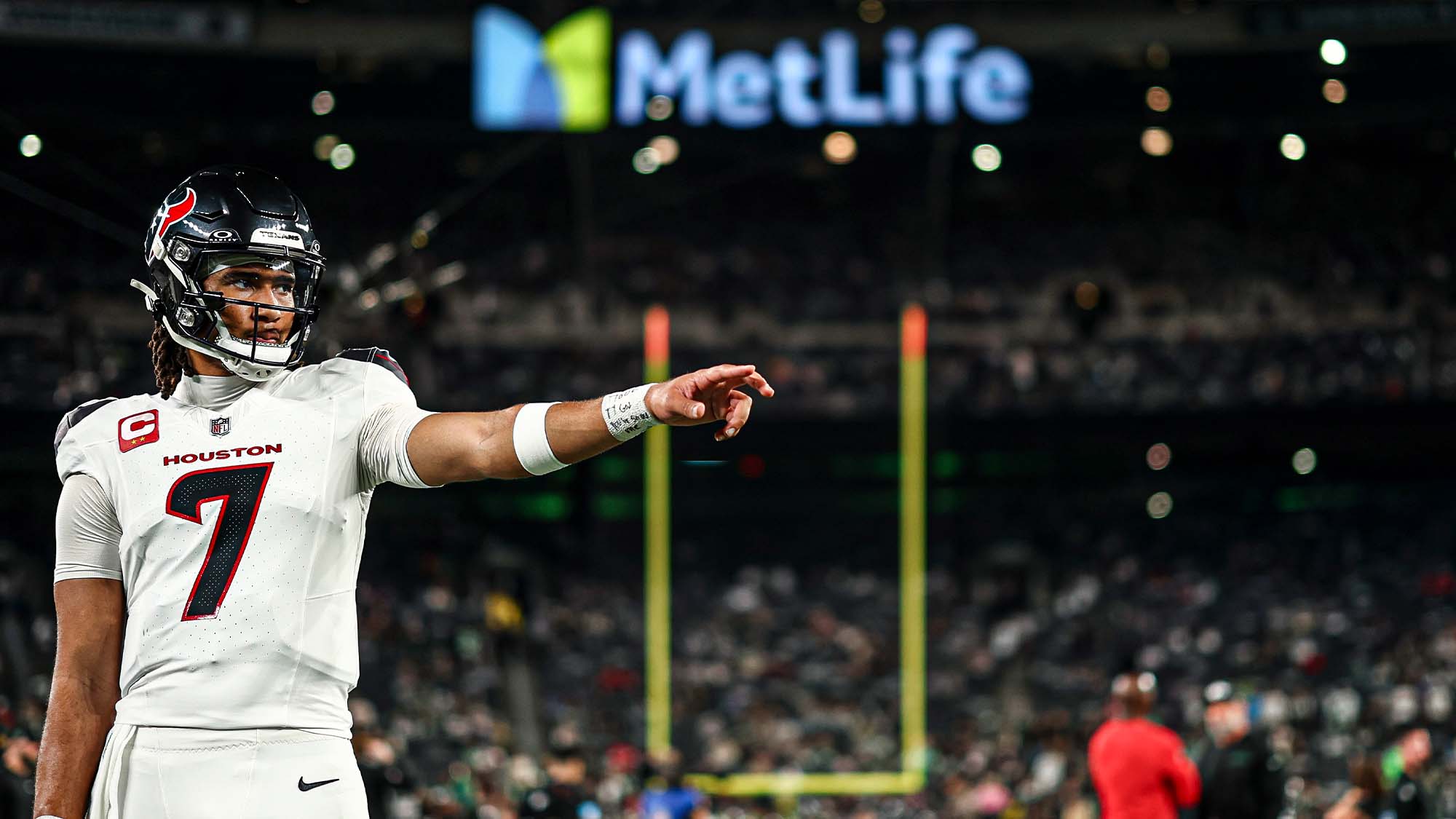
The Houston Texans are facing a quarterback dilemma—one so perplexing that an anonymous person inside the league told ESPN, “I’m glad it’s not my problem.”
Texans signal-caller C.J. Stroud is eligible for a contract extension as he enters his fourth NFL season. However, Houston has tabled contract talks with the second overall pick of the 2023 draft, as the two sides reportedly “aren’t close” on an extension.
The Ohio State product had his fifth-year option for the 2027 season exercised. With no extension in sight, it appears that Houston is planning to use the 2026 season as a prove-it year for Stroud, whose first three NFL seasons have been a roller-coaster ride.
With Stroud’s future in limbo, ESPN’s Bill Barnwell asked people around the league about the quarterback’s trade value. Barnwell reported that the responses were split, with some teams still viewing him as “a really valuable quarterback,” while other teams were “far less confident.”
Still, Barnwell believes that Stroud would command “two first-round picks and more” in a trade.
The speculation around Stroud prompted a debate on X/Twitter as to whether the perpetually quarterback-needy New York Jets should make an aggressive offer for Stroud.
NFL draft analyst Marcus Whitman shared a poll asking whether the Texans should accept a trade offer from the Jets in which New York gives up two first-round picks for Stroud. With over 4,000 votes as of this writing, more than 57% of voters said “yes,” Houston should accept.
Is this a deal that would make sense for the Jets?
Let’s examine both arguments.
Why the Jets should make the deal
Simply put, Stroud would immediately become the highest-ceiling young quarterback to wear a Jets uniform since Joe Namath. That’s because his ceiling isn’t hypothetical. He has actually shown a Pro Bowl-level ceiling in the NFL.
Perhaps you can argue that prospects like Zach Wilson, Sam Darnold, or Mark Sanchez had more potential than Stroud coming out of college, but none of those players managed to display any semblance of star-caliber production during their Jets tenures. Their ceilings were always hypothetical. Stroud has already shown that he can be an NFL star.
In his 2023 rookie season, Stroud led the NFL in passing yards per game (273.9) and had the league’s lowest interception rate (1.0%), while ranking third in yards per pass attempt (8.2). He earned Pro Bowl honors and led the Texans to a 9-6 record in his 15 starts.
Houston won the AFC South, and in his first playoff game, Stroud completed 16 of 21 passes for 274 yards, three touchdowns, and no interceptions (157.2 passer rating) as part of a 45-14 win.
That would be the best season by a Jets quarterback in over 50 years, and Stroud did it at 22 years old. After enjoying one of the best rookie quarterback seasons in NFL history, the hype for Stroud was through the roof.
What followed, though, were two strangely mediocre seasons. Stroud not only failed to improve upon his debut campaign, but he stooped to the level of a below-average starting quarterback. From 2024 to 2025, Stroud ranked 27th out of 40 qualified quarterbacks in adjusted EPA per play (0.074), 25th in passer rating (89.6), and 23rd in yards per pass attempt (7.1).
Stroud’s decline clearly has Houston skeptical about whether he can ever recapture his 2023 form.
But if he could do it as a 22-year-old rookie… how much of Stroud’s skill set could have really changed since then? Why couldn’t he do it again in the right situation?
For a team like the Jets, rolling the dice on proven potential in a player like Stroud could be more appealing than rolling the dice on unproven potential in a rookie draft pick.
If the Jets’ first-round pick does not land high enough, they may end up trading multiple first-round picks to land a rookie quarterback, anyway. Based on the success rate of first-round quarterbacks in recent years, including those drafted as high as first overall, there is a good chance that the quarterback New York drafts will never show a ceiling as high as the one Stroud has shown.
None of the last four quarterbacks chosen first overall—Cam Ward, Caleb Williams, Bryce Young, and Trevor Lawrence—have had a season as effective as Stroud’s 2023 campaign. Stroud’s 2023 passer rating (100.8), passing yards per game (273.9), and yards per pass attempt (8.2) exceed the top marks of those four quarterbacks across their 11 combined NFL seasons.
Of course, the caveat is that a rookie quarterback comes with five years of affordable team control, whereas Stroud will soon command a lucrative contract if he returns to his peak form.
But all that really matters is finding your franchise quarterback. If Stroud can return to the player he was as a rookie, or even build upon it, the Jets wouldn’t think twice about giving him the contract he deserves. They would finally have a quarterback they could build around for years to come.
Stroud is still only 24 years old; he will turn 25 in October. Quarterbacks often do not hit their peaks until their late 20s or early 30s. It makes little sense to write him off at this stage, considering the talent he had coming out of college and the ceiling he has already shown in the NFL.
The Jets will begin their aggressive hunt for a franchise quarterback as soon as the next opportunity arises. If the Jets believe in Stroud’s potential and his fit with their scheme, roster, and culture, they could absolutely deem him a better usage of multiple first-round picks than an unproven rookie, depending on their view of the upcoming class.
Why the Jets shouldn’t make the deal
While it is certainly too early to write Stroud off, it would also be naive to completely ignore the decline he has shown over the last two years.
It is not as if Stroud has been straddled with a hellish situation in Houston. Things haven’t been perfect, but they have hardly been different from his first season. There is more than enough support for him to replicate what he accomplished in 2023.
Firstly, the Texans’ defense has been dominant, allowing the second-fewest EPA per play over the last two seasons. Thanks to the defense, Stroud has not been asked to lift the weight of the world on his shoulders. Houston’s offense enjoyed the fourth-best average starting field position in 2024 and the second-best in 2025.
Offensively, it is fair to say that the pass protection has been spotty, but many quarterbacks have dealt with worse protection. Houston ranked 19th in Pro Football Focus’ team pass-blocking grade in 2024 and 22nd in 2025. Back in Stroud’s rookie season, they were 19th. So, it’s not as if there has been any sort of noticeable drop-off in offensive line play to explain Stroud’s drop-off in production.
In terms of weapons, it would be picky for Stroud to complain. He has had Nico Collins as his No. 1 wide receiver for the last two seasons; NFL coaches and executives just ranked Collins the eighth-best wideout in the league. Dalton Schultz is a quality starting tight end. While it hurt the Texans to lose wide receiver Tank Dell for the entire 2025 season, Jayden Higgins and Xavier Hutchinson stepped up admirably.
In fact, Houston’s weapons were incredibly reliable for Stroud in 2025. He had just 1.4% of his passes dropped, the lowest rate of any quarterback.
One legitimate issue around Stroud was the Texans’ run game, which ranked 29th in yards per rush attempt (3.9) this past season. Once again, though, it doesn’t fully explain his decline, as the Texans were even worse in that category during his rookie season (3.7).
Considering that Stroud’s surroundings do little to explain a drop-off in quarterback production, most signs point back to Stroud simply playing worse football. And since it happened two seasons in a row, it is fair to wonder if the league has “figured him out.”
Stroud has gradually declined in many metrics that the quarterback can take ownership of. Most notably, his adjusted completion percentage (which accounts for drops, throwaways, etc.) has dropped in two straight seasons despite his average depth of target going down. Basically, he’s hitting his target less consistently despite relying on a safer diet of throws, which is the opposite of what should be happening.
- 2023: 73.9% adjusted completion percentage (23rd of 33), 9.4 ADOT (2nd of 33)
- 2024: 72.3% adjusted completion percentage (32nd of 39), 8.6 ADOT (13th of 39)
- 2025: 71.4% adjusted completion percentage (30th of 36), 8.5 ADOT (17th of 36)
Given all of these red flags, it would be completely understandable if the Jets or any other NFL team scouted Stroud and deemed him a lost cause who isn’t even worth their time, let alone two first-round picks.
After all, Stroud has been a below-average starter in each of the last two seasons. Based on how high a percentage of that drop-off seems to be attributable to him instead of his surroundings, it would be reasonable if the Jets projected Stroud to continue being a below-average starter moving forward, despite his age and ceiling.
In that case, it would certainly be preferable for the Jets to keep their picks and focus on the upcoming rookie quarterback class.
