

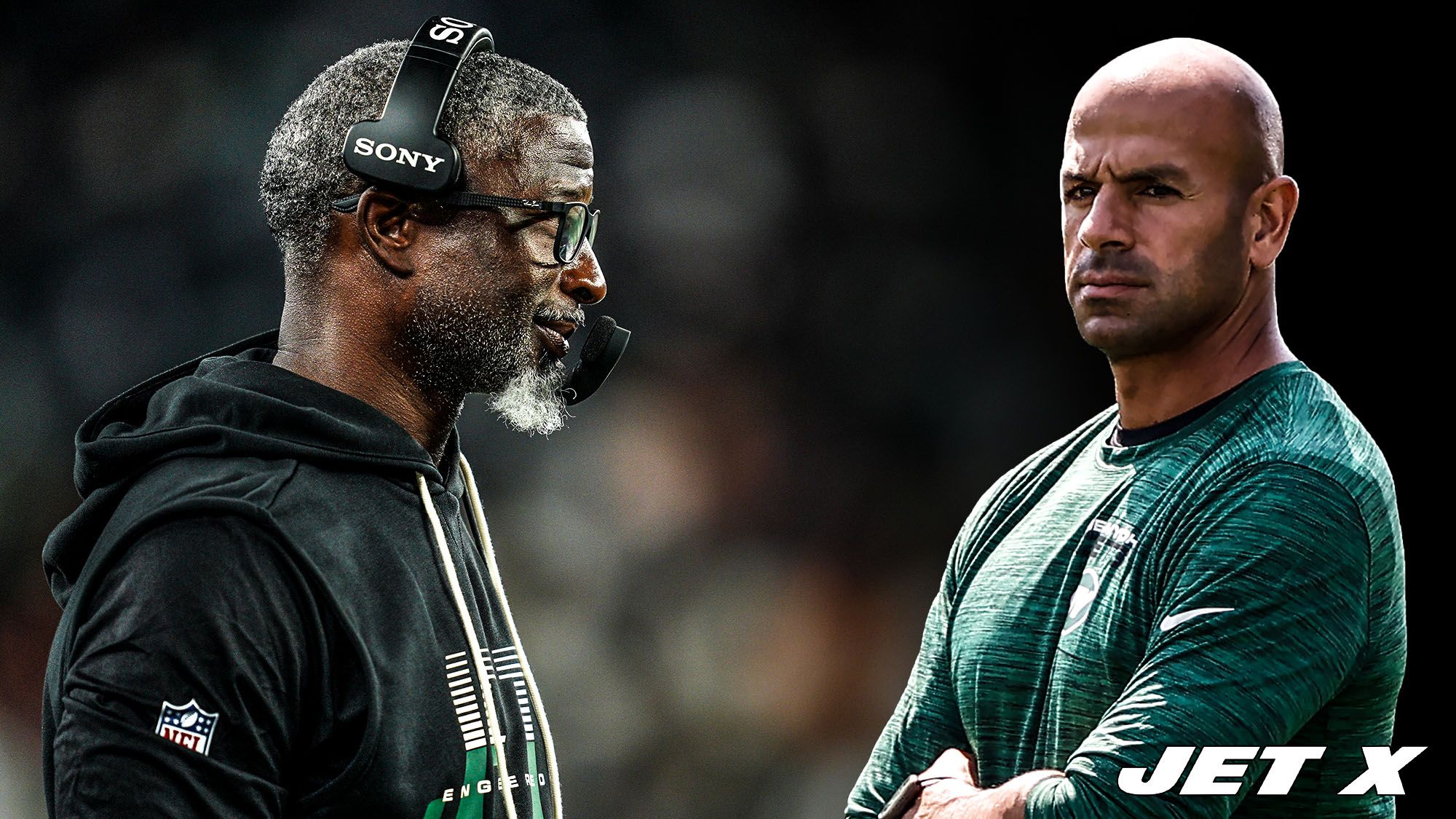
Aaron Glenn experienced a tough rookie season as an NFL head coach. It doesn’t take a genius to understand how true that statement is.
While many will point to the lack of on-field talent down the stretch, the 0-7 start to the season makes it impossible to argue that Glenn’s rookie New York Jets campaign could be deemed a success. Worse yet, the process didn’t even begin in September.
Upon taking the helm, the second-greatest cornerback in Jets history did himself no favors. Generating hype is one thing; openly showcasing brashness, coupled with an ornery attitude towards the media, placed a target directly on his back.
Entering his sophomore season, however, Glenn publicly admits that he handled the media discourse poorly.
“Absolutely. Absolutely,” Glenn told The Athletic’s Jonathan Jones. “[It was] another mistake, because I came in and I was already pissed at something else, [which] had nothing to do with the media. And then I started to think, ‘Man, [why] take it out [on] these guys and gals, and for what? They had nothing to do with this here.’ That was a mistake.”
Who knows why Glenn is taking this tack now? Perhaps he felt the need to get ahead of the potential media roadblock as a rookie head coach. Perhaps not.
Either way, it’s small potatoes.
It doesn’t come close to hitting the heart of Glenn’s issues from 2025. I mean, honestly, nothing the media does will help or prevent him from putting together the best game plan to slow down Josh Allen — while keeping him in the pocket as much as possible.
Instead, it’s a wholly separate quote that both contrasts with last year’s version of the coach and lines up much more cleanly with the modern National Football League.
The media machine
Before we get to Glenn’s revealing quote, let’s first dissect the relationship between NFL organizations and the media.
We no longer live in Kansas — if “Kansas” represents the old ways. No longer does print journalism dominate sports media, just as fantasy football players don’t have to religiously rely on Chris Berman and Tom Jackson for their Sunday point totals.
Quite obviously, we live in a far different world. The internet changed everything, and, specifically, for the NFL, the NFL Network was the opening salvo that led us to our more optimistic media slant.
Suddenly, the NFL had its own media brand. No longer did the world’s most powerful professional sports entity have to live and die by third-party views. The powers that be could generate in-house angles.
As time marched forward, the story of “team access” also evolved. That pesky internet allowed in-house media to reach fans like never before, diminishing the importance of credentialed media members.
It all led us to this very moment, when the “season of hope” has never been more unbreakable.
Think about it: How often is there a negative word preached during NFL draft and training camp time? Especially as it relates to the draft, it feels like everything is great, every franchise had a great draft, and every prospect is the right pick — whether it comes from the NFL’s in-house media machine or outside of that scope.
That’s just the way it is these days.
(It’s why, when a well-intentioned yet admittedly foolish fella raises reasonable and football-focused concerns about drafting David Bailey over Arvell Reese, Jets fans look at him like he already grew a fully-formed yet horribly diseased third eye. But that’s an entirely different matter.)
New York, N.Y.?
Granted, big-time franchises operating in the New York/New Jersey metropolitan area face tougher challenges than those operating out of Jacksonville, Fla. It’s doubtful anybody would argue against that certainty.
Yet how significant is the media’s voice in relation to actual wins on the field? Moreover, how do organizations view the potential roadblock posed by the media regarding on-field success?
The most recent former Jets head coach, Robert Saleh, revealed something interesting during a recent spot on The Rich Eisen Show.
“Self admittedly, when [I] look at the past, and I’ve said it before, I’ve been vocal in regards to trying so hard to control narratives, [and] to keep a positive light around the New York Jets,” Saleh told Eisen. “It meant well. I was trying my best to work with the people around the building, [and] outside the building, to make sure that the messaging around the team was in a way that allowed us to operate.”
Saleh then capped it off with his very own eureka moment — one that all head coaches must realize in order to have even the chance at success…
“In reality, none of that sh*t matters,” Saleh added. “When you win, you’re a winner; when you lose, you’re a loser, and the narrative will be whatever that result is.”
‘Tis the season of growing pains.
Glenn takes his turn
Earlier in training camp, Aaron Glenn harped on wanting to focus on David Bailey’s bad reps that could be coached up. He didn’t do so destructively; rather, in my humble opinion, he intentionally did so to do right by his young player.
Ladies and gentlemen, boys and girls, children of all ages: the David Bailey hype train reached unattainable, unrealistic levels this summer. Not only did it not reflect what was actually happening on the practice field, but it also wasn’t anything that would help Bailey in his professional football journey.
Instead of continuing to add to the hype, Glenn intelligently halted it a bit.
In addition to other impressive quotes suggesting he can conquer this modern football landscape, Glenn recently touched on something that lies at the heart of his 2025 struggles.
“When you say identity, I start to look at that a different way,” is how Glenn started to answer the question on Wednesday. “To me, your identity is, ‘What does the other team say about you?'”
Bingo.
A football team’s identity is rarely created in the summer. Sure, there could be some baseline elements preached and practiced that they carry into the regular season, but the on-field play identity is never really cemented until October, at the earliest.
For good measure
All of this identity talk is especially important in today’s ultra-strategic league.
With physicality at an all-time low, offensive coordinators have a much easier time moving the chess pieces on the board. Speed becomes the most impactful element, and due to the lack of physicality, it becomes more predictable.
Glenn took over a team in an unabashed way, preaching his vision from the jump: physical, tough, etc. He wanted a winner at quarterback, signed Justin Fields while exiling Aaron Rodgers, and envisioned a rush-first team of old, while citing the run-heavy Philadelphia Eagles’ recent Super Bowl triumph.
Round peg, square hole-type thing. At least that’s what’s realized once the going gets tough and the tough gets going.
The successful NFL teams float like a butterfly and sting like a bee, varying from week to week these days. Optimistically, Glenn backed this idea during a WFAN spot last week.
“We’re going to be at our best at whatever we have to do to win the game,” is how Glenn answered Craig Carton’s attempt to ask about his team’s offensive identity.
Again, that’s a bingo, and it stands in stark contrast to Glenn’s mindset and attitude a year ago.
Aaron Glenn has a steep hill to climb regarding the 2026 New York Jets. At the very least, when boiling things down to the coach’s critical quotes, this version of the man differs greatly from the one we experienced in 2025.
