

The New York Jets have announced their initial 53-man roster for the 2026 season.
While changes are expected to come before the season begins, this gives us a reference point to compare the roster’s progress over the past year.
How does the Jets’ 2026 initial 53-man roster compare to the 2025 edition?
Let’s go position by position and determine which side has the advantage, and whether that advantage is slight (★), solid (★★), or major (★★★).
Quarterback
- 2025: Justin Fields, Tyrod Taylor
- 2026: Geno Smith, Cade Klubnik
The Jets seem to have upgraded their starting quarterback by going from Justin Fields to Geno Smith, although Smith must prove he can bounce back from his brutal 2025 season before being considered a significant upgrade. Still, Smith’s body of work over the last four seasons is much better than that of Fields.
The concern is the downgrade at backup quarterback. For now, fourth-round rookie Cade Klubnik is a noticeable downgrade as the backup compared to Tyrod Taylor. The Jets can still address this in the coming days, but they lose points for the time being.
Give the 2026 Jets a slight advantage here.
- Advantage: 2026 (★)
Running back
- 2025: Breece Hall, Braelon Allen, Isaiah Davis, Kene Nwangwu, Andrew Beck (FB)
- 2026: Breece Hall, Braelon Allen, Isaiah Davis, Kene Nwangwu, Andrew Beck (FB)
Same bunch, so we have nothing to discuss here.
- Advantage: Wash
Tight end
- 2025: Mason Taylor, Jeremy Ruckert, Stone Smartt
- 2026: Mason Taylor, Jeremy Ruckert, Kenyon Sadiq, Jelani Woods
The Jets have upgraded significantly at tight end. The selection of first-rounder Kenyon Sadiq is a massive ceiling-raiser, while Jelani Woods adds depth to the unit, bringing more upside as a receiver than his 2025 counterpart, Stone Smartt.
Not to mention, Mason Taylor is poised for a second-year leap after a promising rookie year, while Jeremy Ruckert looks like a slightly more appealing player than he did at this point one year ago after an improved season as a blocker.
- Advantage: 2026 (★★)
Wide receiver
- 2025: Garrett Wilson, Josh Reynolds, Allen Lazard, Tyler Johnson, Arian Smith, Xavier Gipson
- 2026: Garrett Wilson, Adonai Mitchell, Omar Cooper Jr., Isaiah Williams, Tim Patrick, Arian Smith
It would be premature to say that this year’s unit is significantly improved, as the Jets are still betting on a number of unknowns, but the ceiling is clearly far higher.
Last year, Garrett Wilson was followed by three role-playing veterans with little to no upside: Josh Reynolds, Allen Lazard, and Tyler Johnson. This year, he will be joined in the starting lineup by Adonai Mitchell, a recent second-round pick who is burgeoning with speed and untapped potential, and first-round pick Omar Cooper Jr., who appears ready to step in as the starting slot receiver.
We still don’t know what Mitchell and Cooper will provide this year; they might both struggle, making this unit a wash compared to last year. Neither player is proven.
However, they both have the ceiling to become great weapons, and that is enough to make this unit an upgrade over last year’s, which was filled with capped-out vets who were all but assured to provide nothing more than mediocre role-playing skill sets.
- Advantage: 2026 (★)
Offensive line
- 2025: Olu Fashanu, Armand Membou, Alijah Vera-Tucker, John Simpson, Joe Tippmann, Josh Myers, Xavier Newman, Chukwuma Okorafor, Max Mitchell, Marquis Hayes
- 2026: Olu Fashanu, Armand Membou, Joe Tippmann, Josh Myers, Dylan Parham, Chukwuma Okorafor, Max Mitchell, Kohl Levao, (Jordan Meredith—trade yet to be processed)
On paper, we have to give the edge to the 2025 group in this particular comparison. At the time, Alijah Vera-Tucker and John Simpson were undoubtedly viewed as a more formidable duo than Dylan Parham and Josh Myers today.
In 2024, Vera-Tucker and Simpson both ranked among the top 12 overall guards at Pro Football Focus. Meanwhile, Parham was about a league-average guard in 2025, while Myers was a bottom-tier starting center. So, it would be a stretch to claim that the Jets’ projected starting offensive line looks better today than it did exactly one year ago.
However, Vera-Tucker suffered a season-ending injury shortly after this depth chart was announced, which pushed Myers into the starting lineup. Then, as the season progressed, Simpson had a down year. Parham’s 2025 season was more impressive than Simpson’s, and he is also two years younger, so Parham projects as an upgrade over the 2025 version of Simpson.
All things considered, it is realistic to expect that the Jets’ offensive line will be better in 2026 than it was in 2025, especially accounting for the potential leaps of young tackles Armand Membou and Olu Fashanu. But in this specific exercise, the Jets’ offensive line looked better on paper when the initial 53-man roster came out in 2025.
- Advantage: 2025 (★)
Defensive tackle
- 2025: Quinnen Williams, Harrison Phillips, Jay Tufele, Jowon Briggs, Leonard Taylor III
- 2026: Harrison Phillips, David Onyemata, Jowon Briggs, T’Vondre Sweat, Darrell Jackson Jr.
The Jets’ defensive tackle unit looks much deeper this year than last year. With the additions of David Onyemata and T’Vondre Sweat, along with Jowon Briggs appearing much more formidable after his breakout season, New York is four-deep with solid players here.
However, one of these lineups includes Quinnen Williams, and the other does not, so the advantage goes to the side that has a player who keeps opponents up at night.
New York’s interior defensive line is deep this year, but they don’t have a proven star. Briggs has the potential to be that player, though. We’ll have to see if he can translate his second-half production in 2025 over a full season.
- Advantage: 2025 (★)
Edge rusher
- 2025: Will McDonald, Jermaine Johnson, Micheal Clemons, Tyler Baron, Braiden McGregor
- 2026: Joseph Ossai, Kingsley Enagbare, Will McDonald, David Bailey, Braiden McGregor
This is one of the Jets’ most clearly upgraded positions.
In 2025, the Jets had Will McDonald and a boatload of question marks. Jermaine Johnson was coming off an Achilles tear. The third edge rusher was Micheal Clemons, a proven liability, and the fourth and fifth players were Tyler Baron and Braiden McGregor, who are practice squad-level talents.
Now, McDonald might end up ranking third or fourth on this unit in snaps.
Joseph Ossai and Kingsley Enagbare are seasoned veterans with solid all-around games. They will substantially raise the edge-setting/run-defending floor for this group, while not being slouches as pass rushers.
Meanwhile, second-overall pick David Bailey immensely raises the pass-rush ceiling. After having precisely one proven above-average pass rusher off the edge last season, Bailey gives the Jets two potential double-digit sack guys along with McDonald.
- Advantage: 2026 (★★★)
Linebacker
- 2025: Jamien Sherwood, Quincy Williams, Zaire Barnes, Kiko Mauigoa, Marcelino McCrary-Ball
- 2026: Demario Davis, Jamien Sherwood, Kiko Mauigoa, Marcelino McCrary-Ball
While Quincy Williams was an All-Pro for the Jets in 2023, his play fell off in 2024, so his stock was on the decline entering 2025. Jamien Sherwood, though, was viewed as an ascending, top-10 linebacker after his breakout 2024 season.
This year, the Jets are looking at an inverse situation. Sherwood’s stock is down after a rough 2025 campaign, but he is playing beside a proven veteran in Demario Davis who still produced at a top-10 level last season.
Depth-wise, the Jets are in a similar spot. Like last year, they don’t have a third linebacker with a proven track record of reliable defensive play in the regular season. Kiko Mauigoa and Marcelino McCrary-Ball return, while Zaire Barnes is out.
Davis’ consistency compared to Williams’ erratic play gives this year’s unit a slight edge.
- Advantage: 2026 (★)
Cornerback
- 2025: Sauce Gardner, Brandon Stephens, Michael Carter II, Qwan’tez Stiggers, Azareye’h Thomas
- 2026: Brandon Stephens, Azareye’h Thomas, Jarvis Brownlee Jr., Qwan’tez Stiggers, Nahshon Wright, D’Angelo Ponds
The Jets had one of the NFL’s best cornerback units from 2022 to 2024, and that was expected to continue in 2025. They still had Sauce Gardner, one of the best corners in the NFL, and Michael Carter II, one of the league’s better slot corners, although both players were coming off a down year.
Brandon Stephens was brought in as a high-risk, high-reward free agent signing to replace D.J. Reed as the CB2. That was a clear downgrade, but Gardner’s presence was still enough to make this a solid unit overall.
This year, Gardner is out, and now Stephens is projected as the CB1 after a year in which he was credited with allowing an 8:0 touchdown-to-interception ratio, per PFF. That alone makes the 2026 unit a clear downgrade on paper compared to last season.
Beyond Stephens is plenty of uncertainty. Second-year man Azareye’h Thomas, a 2025 third-round pick, is seeking a breakout year after showing some promise in limited stretches last season. Second-round rookie D’Angelo Ponds is expected to start in the slot.
To the Jets’ credit, the depth looks better this year. Nahshon Wright and Jarvis Brownlee Jr. are solid backups on the outside and in the slot, respectively.
However, when you lose a shutdown No. 1 corner and don’t add any players with a remotely similar track record, the unit has to be considered a downgrade on paper until proven otherwise. While the group has some upside thanks to the youth of Thomas and Ponds, they are unproven for now.
- Advantage: 2025 (★★)
Safety
- 2025: Andre Cisco, Tony Adams, Malachi Moore, Isaiah Oliver
- 2026: Minkah Fitzpatrick, Dane Belton, Andre Cisco, Malachi Moore
This might be the most significantly upgraded position on the Jets’ roster. They added an All-Pro in Minkah Fitzpatrick, who still played at a top-10 level among safeties last season, and a solid player in Dane Belton, who also would’ve been the best safety on the team in 2025 based on how he and Andre Cisco performed that year.
It remains to be seen whether Belton or Cisco starts beside Fitzpatrick in Week 1, but either way, this unit has more top-end talent and more depth than last year.
- Advantage: 2026 (★★★)
Specialists
- 2025: Nick Folk, Austin McNamara, Thomas Hennessy
- 2026: Jason Sanders, Austin McNamara, Thomas Hennessy
Nick Folk came into 2025 coming off back-to-back years as the league leader in field goal percentage (he went out and did it again). Meanwhile, Jason Sanders is coming off a season lost to a hip injury, followed by a preseason finale that saw him miss an extra point and come up short on a 54-yarder.
Kicking uncertainty has returned in Florham Park.
- Advantage: 2025 (★)
Verdict
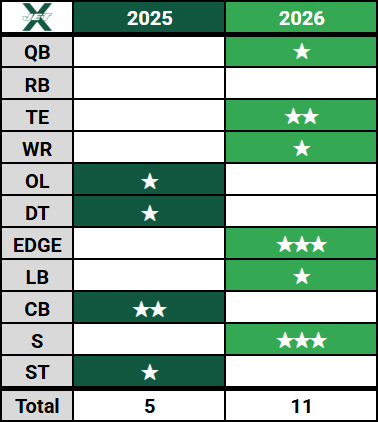
All things considered, it is fair to argue that the Jets’ roster looks more talented today than it did one year ago.
While the Jets dealt away two of their best players from last year’s initial 53-man roster, they have already turned those players into Adonai Mitchell, Kenyon Sadiq, and D’Angelo Ponds, three players who help compensate for the losses of Williams and Gardner. Even so, they still have two first-round picks from those trades waiting to be used in 2027.
The Jets also maximized their 3-14 season by drafting David Bailey and Omar Cooper Jr. with their high first and second-round picks (the latter being used in a trade-up for Cooper).
On the veteran market, New York was more aggressive than last year, especially defensively. Darren Mougey traded for both Minkah Fitzpatrick and T’Vondre Sweat, while doling out eight-figure salaries to Joseph Ossai, Kingsley Enagare, Demario Davis, and David Onyemata. Dane Belton and Nahshon Wright were also added in free agency.
Quarterback, of course, will be the main factor that determines whether the Jets are an improved football team. On paper, Geno Smith has a much stronger track record as a starting quarterback than Justin Fields, but Smith’s down year in 2025 is a concern as he approaches his age-36 season, along with the QB2 downgrade from Tyrod Taylor to Cade Klubnik (for now, at least).
Mougey seems to have done a solid job of pushing the Jets’ roster forward from where it was after his first offseason, all while maintaining long-term cap and draft flexibility. Give him credit.
But now, it’s about translating all of that work to the field. Mougey’s predecessor, Joe Douglas, often received similar praise for apparently upgrading the team on paper, but he never found the right formula to translate the supposed talent upgrades to victories.
Winning in the NFL is about more than accumulating as much talent as possible across 53 players. It’s about how those 53 pieces work together. From ownership, to management, to coaching, to the players, it has to be a well-oiled machine in which all of the parts complement one another to produce the desired result: wins. If the pieces don’t fit, it doesn’t matter how shiny they are.
The 2026 season will be Mougey and Aaron Glenn’s first opportunity to do what Douglas and Robert Saleh could: find the right blend of ingredients to create a winning formula that not only matches, but exceeds the sum of its parts.
