
Get excited, New York Jets fans! It’s the time of year that you have all been waiting for: When debates about the head coach’s job security become the main topic of conversation in October!
It arrived about as quickly as fans expected. Well, based on their pre-season expectations, that is. Going into the year, with three of their first four games on the road, and three of the four against NFC North opponents who had winning records last year, Jets fans expected a slow start for a team with a 5.5 win total.
But a dominant season-opening road win over the Tennessee Titans inspired hope. And while the Jets lost their next two games in competitive fashion, the overall product felt competent enough to the point where many fans and media members believed that good things were brewing in Florham Park.
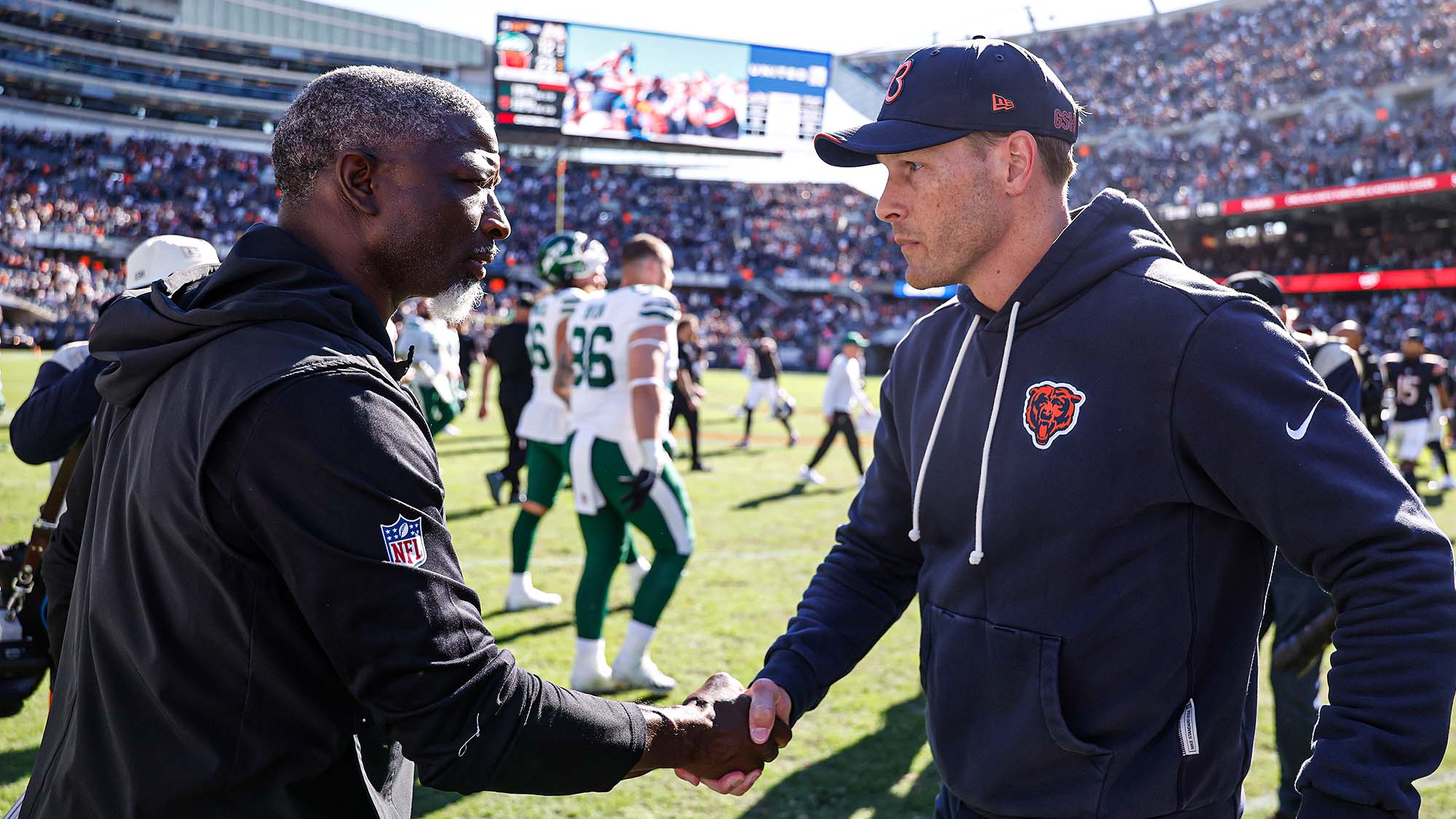
Alas, that optimism is no more after the team’s historically grotesque 23-12 beatdown at the hands of the Chicago Bears.
Don’t let the final score fool you: in Chicago, the Jets played some of the worst football not just in franchise history, but in NFL history. They joined the 1999 expansion Cleveland Browns as the only teams in league history to allow more first downs (34) than they had total offensive plays (32).
The Jets were also outgained by 335 yards, marking the seventh-worst margin in Jets history. Two of the franchise’s seven worst performances in that department have come in 2026, the other being New York’s 2025 season finale in Buffalo, which took place in January.
Yes, it’s time to talk about Aaron Glenn’s job security.
Does Glenn need to go?
The magnitude of New York’s incompetence in Chicago is significant enough to wipe out the optimism generated by the Jets’ overall respectable body of work through three games when we analyzed them in totality through things like total yards margin, net points, and whatnot. Here are the numbers that matter now: The Jets have played 21 games under Aaron Glenn. They have won four.
That is Glenn’s body of work to this point.
Even worse than the win-loss record is the quality behind it. Only one of those wins came by multiple scores. Meanwhile, the Jets have lost nine games by multiple scores.
Glenn was given a second chance after overseeing a 3-14 team that was worse than its record let on; the 2025 Jets are the third-worst team in NFL history when excluding special teams efficiency. They easily could have gone 0-17 if one of the greatest special teams units in league history (a highly luck-based strength that is not sustainable, as this year has proven) did not give them the edge they needed in each of their three wins, all being one-score victories against weak opponents.
It was a campaign that certainly justified a one-and-done firing. Many coaches have gone one and done for far less offensive outputs.
New York even let Glenn rebuild the majority of the coaching staff, essentially admitting that he struck out so badly on his first go-around of building a staff that nearly every crucial coach was shown the door after one measly season.
To validate the Jets’ decision to give him a second chance, Glenn needed to show substantial progress in many areas as a head coach. Minor progress was not going to cut it when considering how low he had set the bar.
Yet, four games into his second season, many of the exact same issues that plagued his first season are still omnipresent.
Poor game and clock management? Check—in spades. The lack of situational awareness from Glenn and his offensive coordinator hire, Frank Reich, was the main problem that cost the Jets a Week 2 win over the Green Bay Packers.
Wasted timeouts early in halves? Check. Through four games, the Jets have blown six timeouts prior to intentional usage for clock-management purposes in the waning minutes of a half, including at least one in all four games.
On the opening drive of Sunday’s loss to Chicago, Glenn foolishly challenged a down-by-contact ruling on a play where the Bears’ ball-carrier was clearly down before fumbling, seemingly just throwing the flag in the heat of the moment without first confirming whether the ball was actually out.
One-sided no-show blowout losses? Check. It seemed, through three weeks, that these may have been eliminated, but Week 4’s Jets performance looked just like the December 2025 stinkers that Glenn’s defenders chalked up to roster quality. Now, not only is it happening in Year 2, but it happened with the Jets having their starting quarterback active (one who has been playing well, at that) while the opponent was riding a backup quarterback who has not started in three years.
Penalties have also arisen as an issue. This actually was not a major problem in 2025, as the Jets finished with the 17th-most flags, but they have risen to fifth this year.
Even Glenn’s value as a defensive mind is coming into question. The defense got off to a hot start through two weeks, but it was against Cam Ward and an extremely banged-up Packers offense in the rain. Over the last two weeks, Glenn has been tested, going on the road against strong offenses led by coaches who worked closely alongside him in Detroit. In both games, he had circles coached around him.
In fact, the last two games represent one of the worst defensive stretches in Jets history, at least based on down-to-down consistency. New York coughed up 61 combined first downs to Detroit and Chicago, the most in a two-game span in franchise history, beating a record set by Robert Saleh’s debut team (60) in 2021.
At this point… what are the positives that Glenn offers to the Jets organization?
Thirteen games remain. Glenn has plenty of time to turn things around.
Today, though, the body of work is this: 4-17 with a -211 point differential and a rapidly growing list of record-setting losses and streaks.
From the worst December point differential in NFL history, to 20 straight games without an interception, to a performance matched only by an expansion team in its debut game, the Glenn-led Jets are best known for redefining what “bad” even means. Jets fans already thought they were at rock bottom before he arrived, but Glenn has displayed an incredible skill for finding rockier bottoms.
The reason Sunday’s performance in Chicago carries so much weight is that it merges the 2026 season with Glenn’s debut season, thereby validating Glenn’s 21-game sample as a full body of work. We can no longer pretend that the 2025 season does not play a part in Glenn’s evaluation due to excuses about the roster. Four games into his second season, we are seeing the same issues leading the same quality of results.
So, let’s answer the big question: No, the Jets should not part with Glenn. Not now, and not at any point during the season.
Dumping a coach mid-season would only further taint the franchise’s reputation as it seeks to attract candidates in January. The Jets will already have a hard enough time bringing in a top-ranked candidate. They do not need to make things harder by showing themselves to have a quick trigger, as they did in 2024 with Robert Saleh, which led to the process that yielded Glenn during a coaching cycle that included coaches like Ben Johnson and Liam Coen.
But if Glenn is to return in 2027, the bar is very, very high for him over the next 13 games.
Finishing around 6-11 with plenty of moral victories will not cut it, even if it technically represents doubling the Jets’ 2025 win total. Remember, we have to look at Glenn’s whole body of work—the first four games of 2026 have not proven that Glenn has changed as a coach since then. So, even by doubling the Jets’ win total, Glenn would be a 9-25 coach, with a horrendous point differential, to boot.
Keep in mind what is on the line for the Jets in 2027. They will have three first-round picks, with one of them (or multiple, if traded) likely to be allocated toward their next hopeful franchise quarterback.
Do the Jets want a 9-25 coach with a point differential in neighborhood of -300 to be entrusted with those resources?
I would argue that the answer is clearly “no”.
Thus, the current answer to the Aaron Glenn debate is simple: If he wants to return, he must make it glaringly obvious that he should be trusted with three first-round picks and a franchise quarterback. That’s the bar.
Fans and the Jets can quantify that bar however they’d like. Perhaps it’s a playoff appearance. Maybe a high-quality 8-9 finish would get it done. There may even be a version of 7-10 that meets the criteria for some people.
But if the Jets cannot answer that question—Do we trust this coach to use three first-round picks and develop our franchise quarterback?—with a resounding “yes”, then it will be time to part ways at the end of the season.
