
Four pressures, zero sacks.
That was the combined stat line for the New York Jets’ edge rushers in their Week 4 loss to the Chicago Bears. As a result, the team let backup quarterback Tyson Bagent dice them up from clean pockets throughout the afternoon.
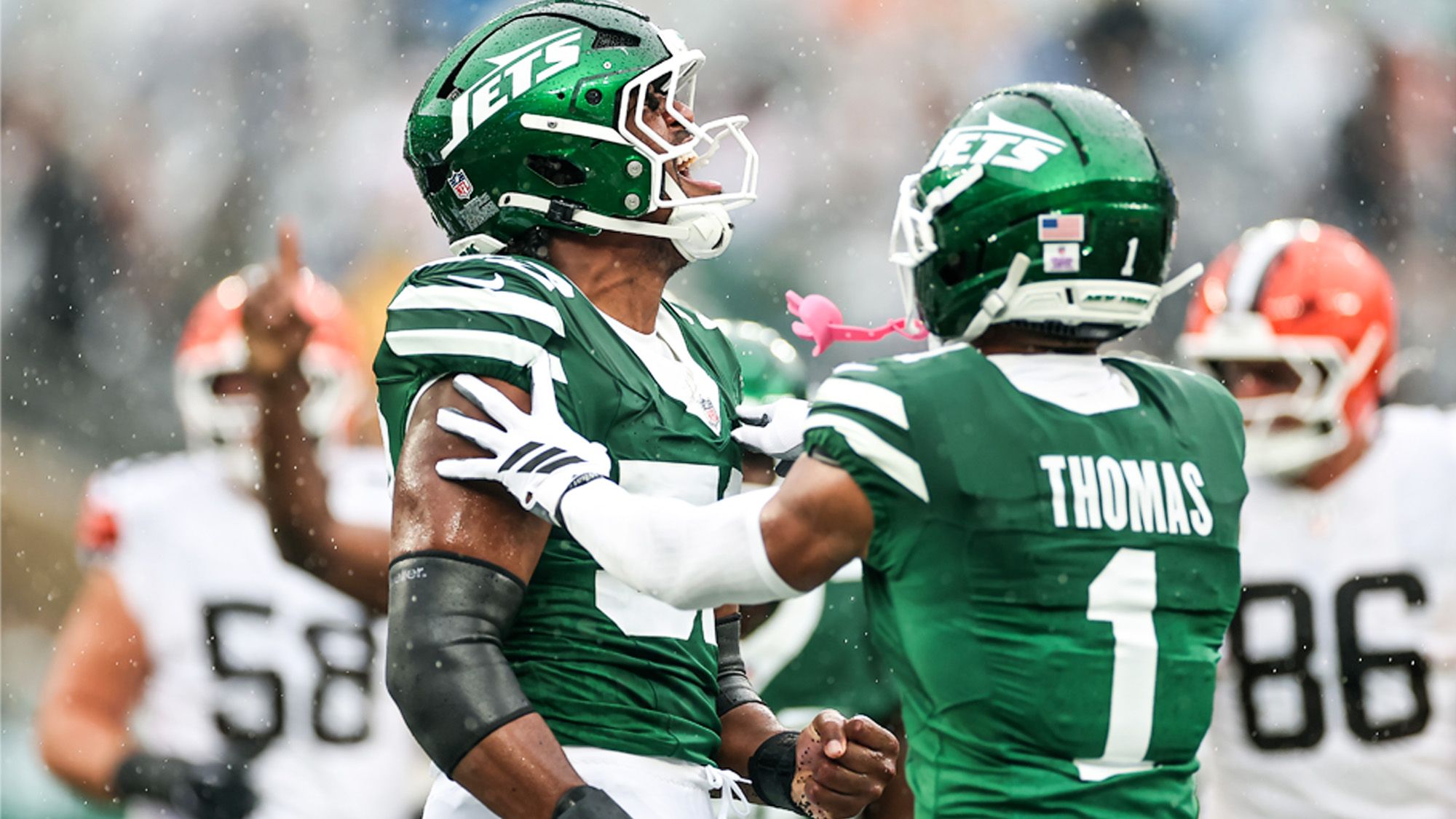
One week later, the Jets’ pass rush looked entirely different in Sunday’s win over the Cleveland Browns, and the final score reflected it.
Jets’ pass rush success vs. Cleveland
After struggling mightily to generate much of anything against Chicago, the Jets desperately needed their pass rush to step up. They got just that, and then some.
The Jets finished Sunday’s game with eight sacks, the most by any NFL team in a single game this season, just a week after not even generating one. According to Pro Football Focus, they also pressured Deshaun Watson on 22 of his 44 dropbacks, a 50% rate, the fourth-highest mark of Week 5 (prior to Monday Night Football).
That’s a crazy turnaround. More importantly than the sacks, they consistently got home against Watson, never allowing him to get comfortable.
The biggest reason behind the Jets’ improvement was No. 2 overall rookie David Bailey. In addition to a career-best three sacks, Bailey finished with nine total pressures on 31 pass-rushing snaps, good for a 29% pressure rate. That’s incredible output from the rookie, who had generated just 11 pressures on 102 pass-rush snaps entering Sunday’s game (10.7%).
Bailey’s three sacks also tied Hugh Douglas (Week 3, 1995) for the most by a Jets rookie in a single game since 1982, when sacks became an official statistic.
What stood out most about Bailey was how often he affected the quarterback. It’s a conundrum we discussed during the week: how to assess a player like him at a position (pass rusher) where even top rookies don’t necessarily light up the stat sheet with sacks.
Will McDonald also finished with three pressures and a sack to seal the game on 16 pass-rushing snaps, while Kingsley Enagbare contributed five pressures across 37 pass-rush reps. The position group had a well-rounded outing, though Bailey was the clear headliner.
Joseph Ossai was the only Jets edge not to finish with a pressure, according to PFF, though he played just 22 defensive snaps (17 pass-rush snaps) before an ankle injury forced him to leave the game.
Beyond the edge group, the rest of the Jets’ defense also stepped up to contribute to the strong pass-rush presence. In a game where Aaron Glenn blitzed Deshaun Watson on 64% of his dropbacks, New York generated plenty of schemed-up pressures.
Safety Dane Belton had four pressures, while cornerback Jarvis Brownlee had three, and both players recorded a sack. Linebackers Jamien Sherwood and Demario Davis had two pressures apiece.
Defensive tackles Jowon Briggs and Darrell Jackson Jr. added one sack apiece.
Consistently creating havoc up front is the blueprint for success in the NFL. Entering Sunday’s game, the Jets’ secondary had been among the best in football, but their weak pass rush didn’t let it shine. It was a troubling disconnect.
If Sunday signals the Jets’ pass rush is turning a corner, their defense will be in a solid position. So far, coverage really hasn’t been an issue for the team. Starting cornerbacks Brandon Stephens and Azareye’h Thomas have largely held their own, while safeties Belton and Minkah Fitzpatrick have done an excellent job in the back end.
Even with a league-average pass rush, the Jets could emerge as one of the league’s top defenses through their coverage. The key, though, will be maintaining that league-average production on a consistent basis. Sunday’s outing was encouraging, but it also doesn’t mean that everyone should suddenly forget the results from the prior two games.
New York’s Week 5 win over Cleveland was a perfect example of what it looks like when strong coverage is coupled with an equally strong pass rush.
