


We are six weeks into the 2026 NFL season, and it’s starting to become clear what works and what doesn’t for teams, especially in the personnel department.
For the 2-4 New York Jets, several questionable personnel decisions have surfaced, as our own Michael Nania highlighted.
Today, let’s break down three Jets that should be playing more than they did over the first six games.
TE Jeremy Ruckert
This year, the Jets rank 13th in the usage rate of 12 personnel packages (1 RB, 2 TE, 2 WR), using those looks on 26.1% of their plays. Meanwhile, they have run 13 personnel (three TEs on the field) on 8.1% of their plays, the 15th-highest mark in the league.
The priority tight end snaps have gone to first-round rookie Kenyon Sadiq and Mason Taylor, who has returned from injury and looked solid over the past few weeks.
However, when he has been on the field, TE3 Jeremy Ruckert has been quite efficient for the Jets.
According to Ray Carpenter’s on/off data, the Jets’ offense has averaged +0.020 EPA per play with Ruckert on the field, compared to -0.076 without him, marking a +0.096 swing in EPA per play when he is out there versus not.
That discrepancy ranks 33rd among 127 qualified tight ends, putting Ruckert ahead of around 75% of tight ends in terms of his team’s offensive EPA improvement when he’s on the field.
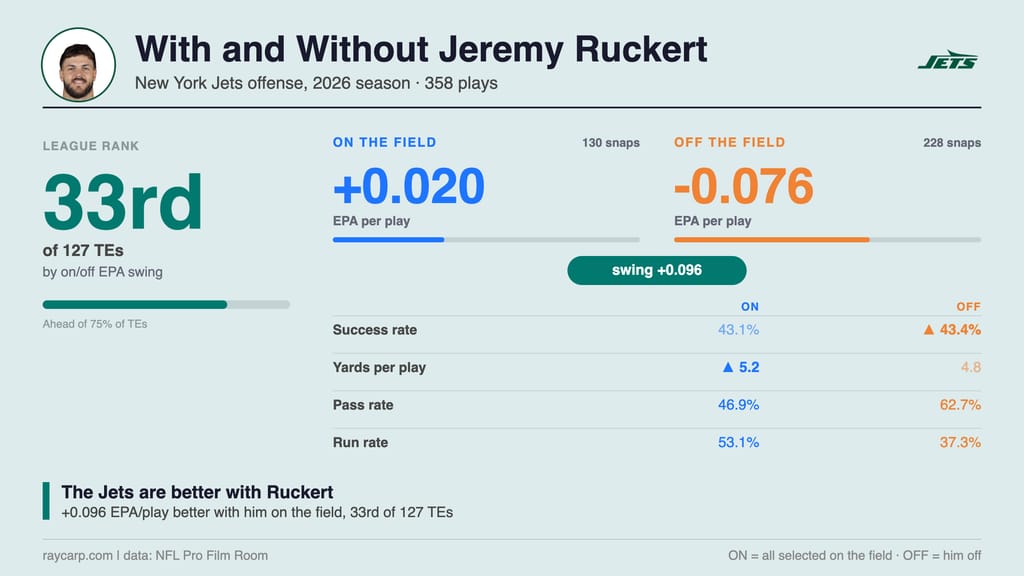
It’s also not a tiny sample size, as he has played 130 offensive snaps this season, compared to 228 sidelined. The Jets are also averaging 5.2 yards per play with him on the field, compared to 4.8 without him.
Another interesting wrinkle: the Jets have run the ball on 53.1% of their plays with Ruckert out there, compared to just 37.3% without him. That indicates his usage is heavily tied to the running game.
That is nothing abnormal. Typically, TE3s across the league are expected to be primarily blockers rather than receiving threats. The Jets have Taylor and Sadiq to carry the pass-catching load. Ruckert’s role is to do the dirty work, and he’s done a solid job so far.
You may be asking where Ruckert will get additional snaps with Taylor and Sadiq leading the room. Based on the start to the season, he should be taking some snaps from the Jets’ current TE4, Jelani Woods.
Ruckert has played 130 snaps compared to Woods’ 108, and the difference in efficiency is night and day when you look at the on-off numbers. The Jets lose 0.105 points in their EPA per play with Woods on the field compared to not, ranking 92nd among 127 TEs.
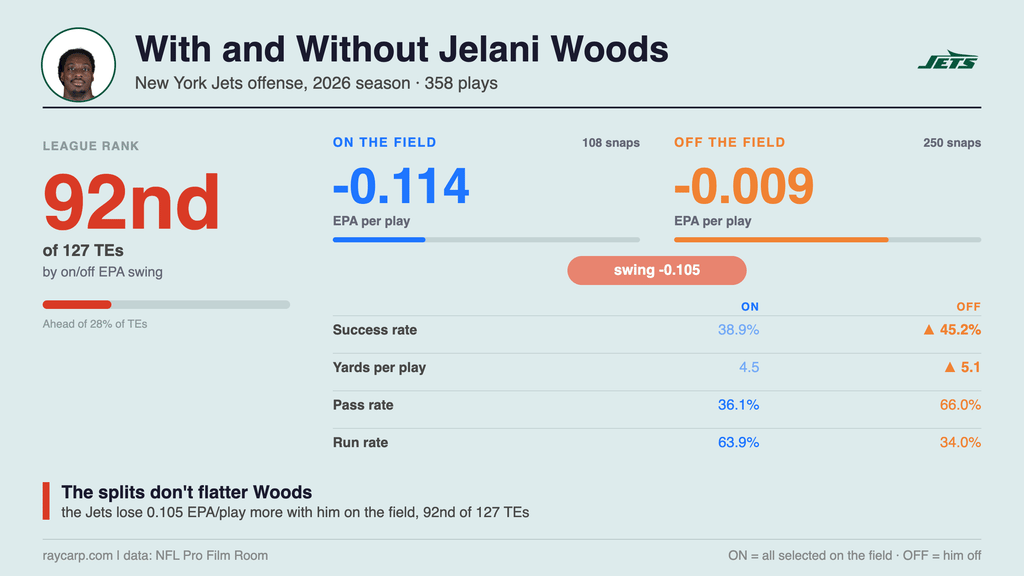
Furthermore, the Jets’ success rate on offense also skyrockets from 38.9% with Woods on the field compared to 45.2% without him. The team’s usage of him is also confusing: New York’s pass rate is just 36.1% when he is on the field versus 66% when he’s not. Meanwhile, the run rate with him on the field is 63.9% compared to 34% off the field.
Woods’ top strength is easily pass-catching. Of course, with Taylor and Sadiq, those opportunities will be limited, but there is no reason Woods should be deployed as a run-blocker as often as he has. Despite his large frame and athleticism at 6-foot-7 and 253 pounds, the film doesn’t show a plus run blocker.
There is certainly a role for Woods, but he has played way too many snaps, and in the wrong situations, especially when you consider Ruckert’s workload.
DT Darrell Jackson Jr.
Now, let’s flip to the defensive side of the ball, where things get even more interesting.
Darrell Jackson Jr. has been one of the Jets’ under-the-radar pieces up front this year, and the on/off data shows he’s been impacting the game when he’s on the field.
Through six games, the fourth-round rookie has played 143 of the Jets’ 386 defensive snaps (37%). However, when he’s on the field, opposing offenses are averaging -0.162 EPA per play. When he’s off, the number rises to -0.004, an 0.158 EPA-per-play improvement for the Jets’ defense with Jackson on the field, ranking 40th among 248 qualifying defensive linemen.
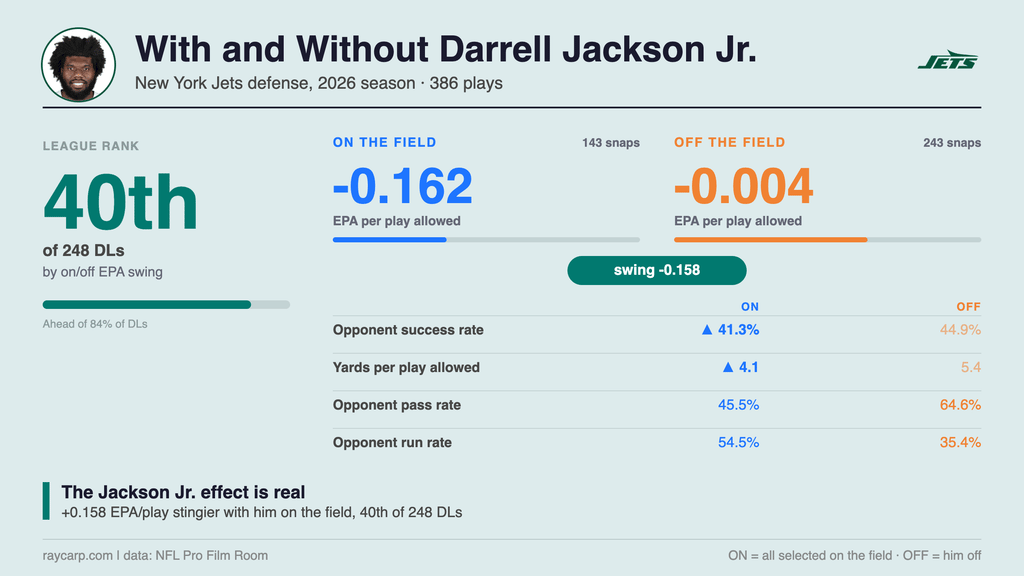
Beyond that, opposing offenses are averaging just 4.1 yards per play with him on the field, compared to 5.4 without him. That’s a pretty substantial difference (1.3 yards per rep). The opponent success rate also goes from 44.9% without him to 41.3% when he’s on the field.
Against the Cleveland Browns in Week 5, he was one of the team’s unsung heroes, making two huge back-to-back pass deflections in the fourth quarter before coming up with a crucial sack later in the game alongside Kingsley Enagbare. It’s safe to say he’s made the most of his workload, especially for a Day 3 rookie.
Harrison Phillips, who leads the Jets’ interior defensive linemen in snaps this season (211), hasn’t been nearly as efficient. The Jets are currently allowing 0.260 EPA/play more with him on the field than without him, based on a 175-snap sample. He ranks 227th among 248 defensive linemen in EPA swing.
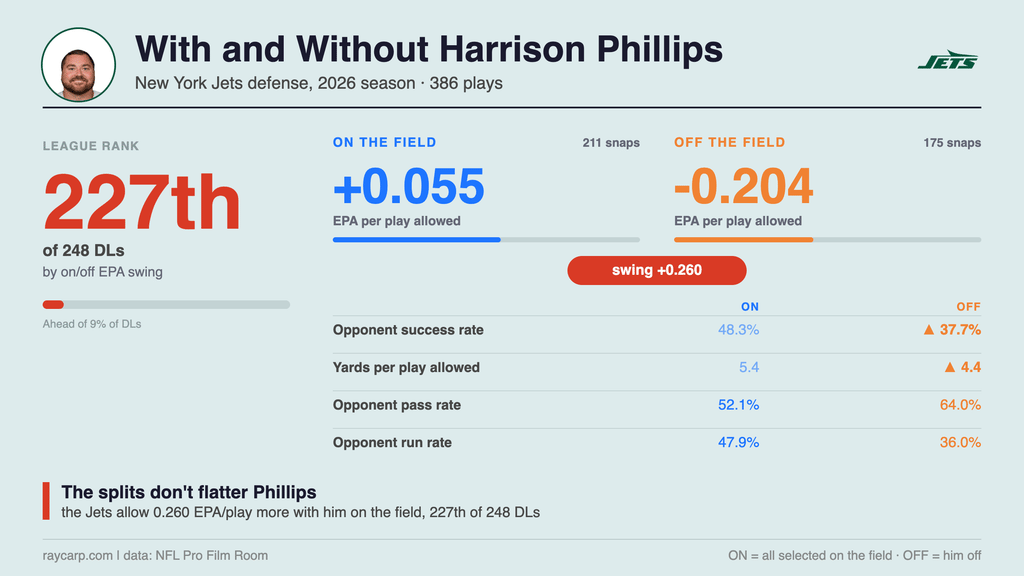
The Jets’ success rate allowed based on Phillips’ presence is even more alarming. With him on the field, the Jets have allowed a 48.3% success rate, compared to 37.7% when he is on the sideline. That’s a more than 10% swing, yet he still leads the Jets’ interior defensive linemen in snaps played.
Phillips’ leadership is valuable, and he should still be used in the DT rotation, but he shouldn’t be playing as much as he has, especially with the emergence of someone like Jackson. The Jets should not take away all of his snaps, but limiting his role would certainly make sense.
It will be interesting to see if Gang Green picks up on trends like these. Teams that find sustainable success adjust their schematic approach based on what’s working and what isn’t.
At 2-4, the Jets’ season isn’t dead yet, but to remain afloat, they need a win over the 0-5 Miami Dolphins on Sunday. To stay above water, rewarding their efficient players with more playing time would make sense.
