
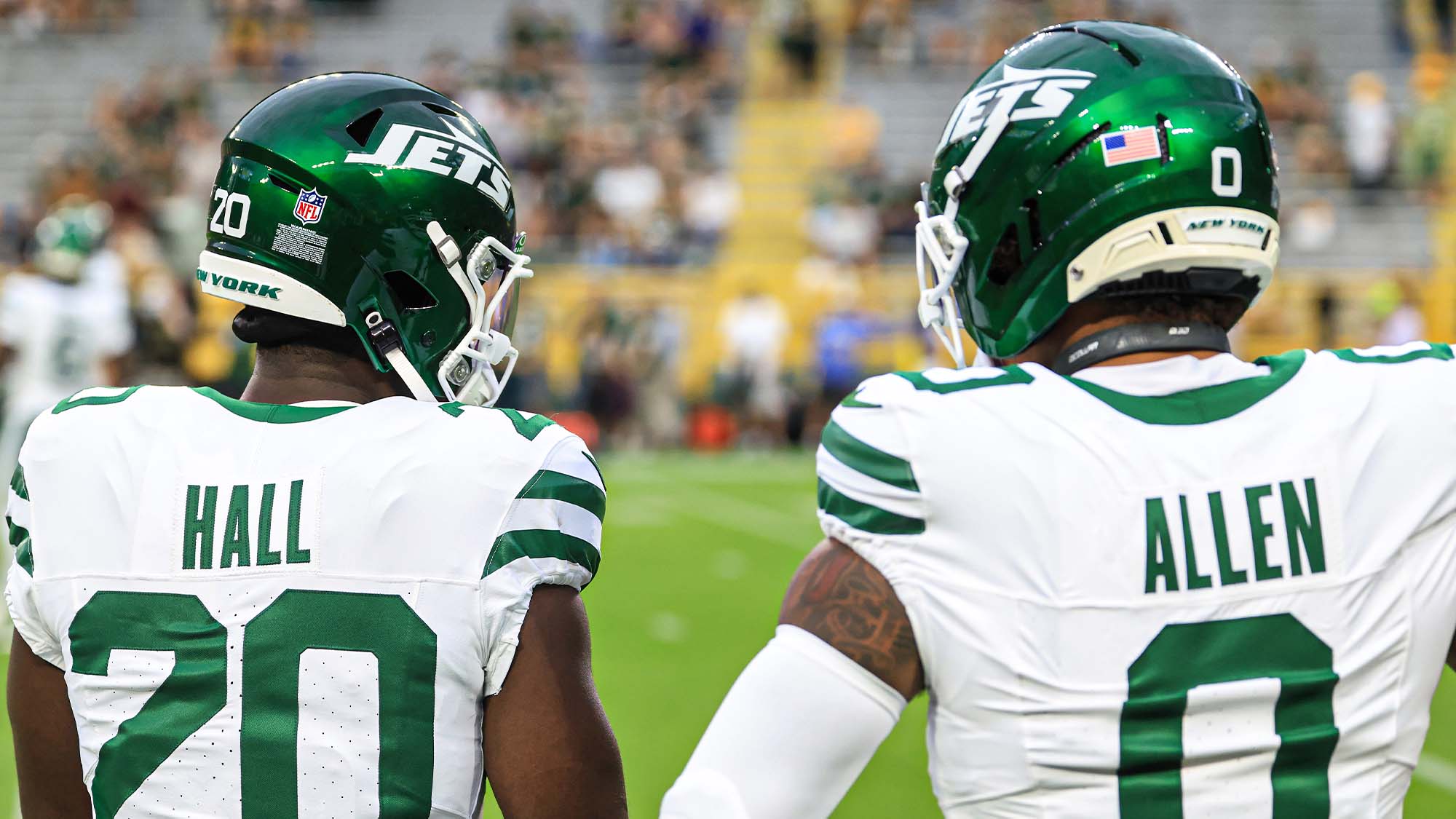
There’s one thing about New York Jets running back Braelon Allen that nobody can dispute: He’s emerged as one of the NFL’s most reliable rushers in 2026.
The numbers say it all. Entering Week 10, among RBs with at least 100 rushing attempts, Allen ranks fourth in yards per attempt (5.0), fifth in yards after contact per attempt (3.7), and second in rushing success rate (57.5%).
After two years of creating intrigue with his imposing frame but struggling to produce results that backed up the hype, the former fourth-round pick has finally put everything together in the ground game.
Allen’s rapid rise occurred while he was starting in place of the injured Breece Hall, who missed five games with a quad injury. Naturally, it caused some fans and media members around the NFL to implore New York to trade Hall and hand the keys to Allen.
The Jets were adamant about not trading Hall, whom they signed to a three-year, $43.5 million contract in the offseason. The trade deadline came and went, and the Jets walked their talk, hanging onto their ninth-leading rusher in franchise history.
Besides the obvious benefits of having two quality RBs—depth, competition, keeping each other fresh—there’s an excellent reason why the Jets were wise to keep both Hall and Allen: The complementary nature of their skill sets.
Your team. Your decisions.
Jet X Game Simulator
Win a lifetime membership
Beat any of the five Legend challenges without simulating.
Play the weekly matchup or relive a classic. Choose a current matchup or classic game, and log in to save Coach Points.
Learn MoreChoose your mode on the Game Simulator page. Full games · Weekly prep · Classic challenges.
Breece is the perfect complement to Braelon
These are two completely different players. Both have strengths that the other does not, allowing them to cover up each other’s weaknesses. Between the two of them, the Jets should be able to get whatever they need from the RB position in any given situation.
Allen’s advantage over Hall is obvious: rushing consistency. With his size, power, aggressiveness, and newfound shiftiness that allows him to find holes where he can get downhill, Allen is incredible at consistently churning out gains that keep the offense ahead of the chains.
Hall, though, has a large advantage in another important category: receiving.
In conversations about Hall and Allen, it often goes overlooked just how much higher of a ceiling Hall offers in the receiving game. The difference between their numbers this season is jarring.
Over nine games, Allen has caught 19 of 24 targets for 102 yards, no touchdowns, and six first downs. Compare that to Hall, who in just four games, has caught 13 of 14 targets for 128 yards, no touchdowns, and five first downs. So, that’s 26 more yards and just one fewer first down on 10 fewer targets, in five fewer games.
For the season, Hall ranks fourth among 58 qualified RBs with 2.51 yards per route run, indicating how efficient he is at generating production when given chances to run out for a pass. Comparatively, Allen is averaging 0.72 yards per route run, ranking 51st.
A big part of Hall’s advantage is his ability to make explosive plays after the catch. Hall is averaging 10.4 YAC per reception, eighth-best, while Allen is at approximately half of that number, 5.3, placing 49th.
One of the reasons Allen struggles to produce as a receiver is his propensity for drops. In his career, Allen has dropped six passes compared to 40 receptions, giving him a 13% drop rate. Hall’s career rate is a much more reliable 8.2%, and he’s improved recently after a shaky start to his career; since 2024, he has dropped only one pass, giving him a drop rate of 2%.
A high drop rate does not hurt solely because of the production lost on plays where passes are actually dropped, but it also makes a team hesitant to trust the player. That contributes to Allen’s lack of opportunities.
Because of his propensity for drops dating back to his rookie year, the Jets seldom dial up screens for Allen; he’s seen just one screen pass since 2025. Allen got eight screens in his rookie year, but he dropped two of them, making up half of his four total drops that season.
Perhaps Hall’s most valuable advantage in the receiving game is his versatility. Hall has the route-running chops to beat linebackers beyond the line of scrimmage; he isn’t limited to checkdowns and screens. This expands the number of ways in which the Jets can deploy him in a pass concept.
In his career, Hall has an ADOT (average depth of target) of 0.5 yards, per Pro Football Reference. That might sound minuscule, but for a running back, it isn’t; that places Hall ninth among the 29 RBs with at least 150 targets since he was drafted in 2022. Many running backs have negative ADOTs; a positive ADOT indicates a running back who occasionally gets involved in the passing game downfield on top of his usual diet of checkdowns and screens.
Allen’s ADOT is a few ticks lower at -0.1. He is still looking for his first career catch of 10+ air yards; Hall has made four of those.
The most palpable difference between the two might be their home-run-hitting potential. Hall is always a threat to break loose on a reception; Allen has not shown that ability yet.
Since 2022, Hall has racked up 19 receptions for a gain of 20+ yards, ranking third among RBs, trailing only Christian McCaffrey and Bijan Robinson (21 each). Meanwhile, on 40 career receptions, Allen’s career-long reception went for just 19 yards.
Make no mistake: Allen has developed into a legitimate weapon for the Jets. He played his way into out-snapping Hall 59%-43% in the Jets’ latest game, a significant change from the start of the season, when it was 36%-62% in Hall’s favor. That shift was deserved after how impressive Allen looked as a high-volume rusher in Hall’s absence.
With that said, Allen is not a complete running back. Neither is Hall. What matters is that Hall excels in the right areas to cover up Allen’s weaknesses, and vice versa. That’s the makeup of a perfect backfield duo, and the Jets were wise to keep it intact.
