
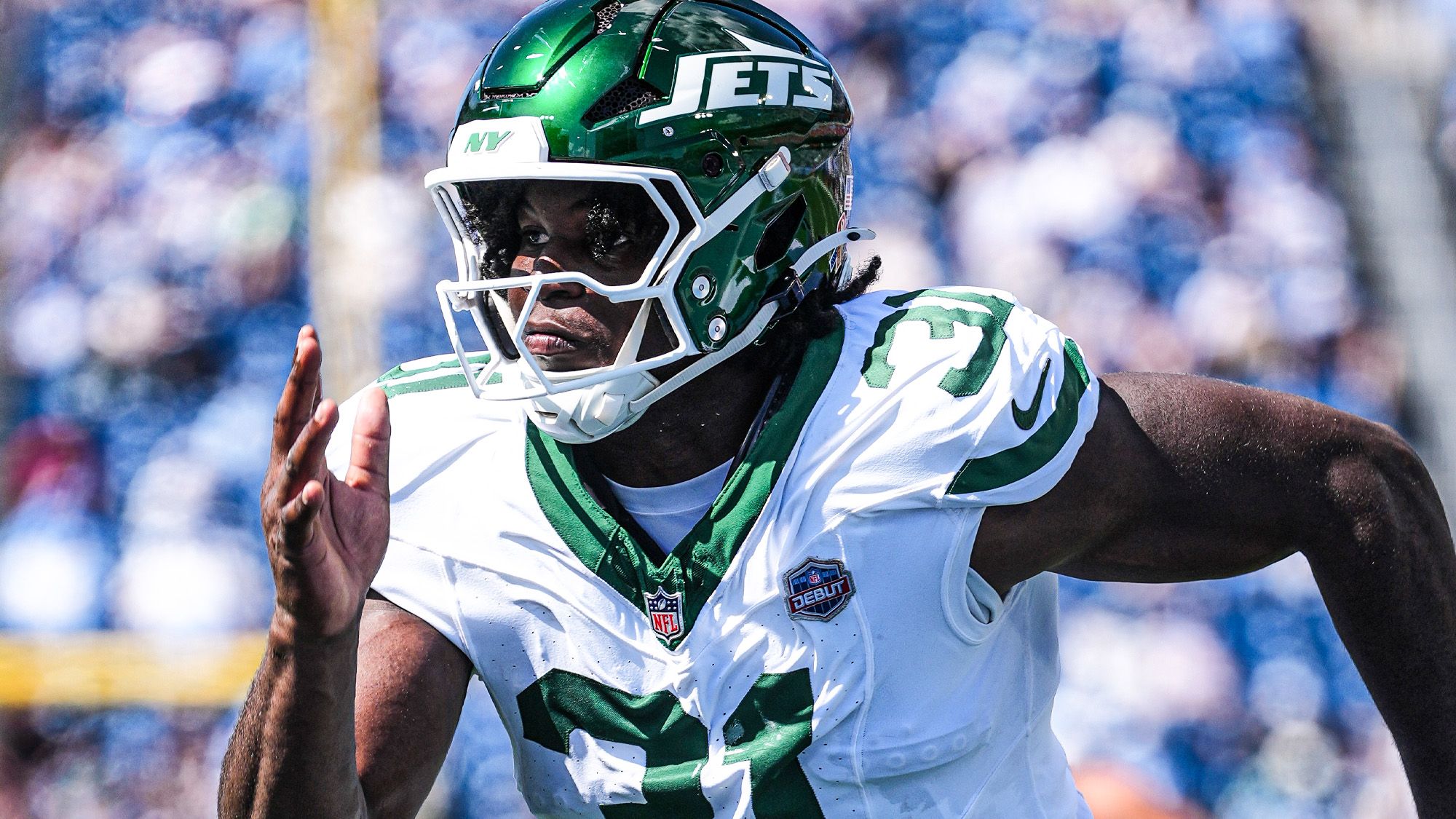
Rookie edge defender David Bailey is having one of the most polarizing rookie seasons in New York Jets history. Opinions on the second overall pick are all over the map, ranging from as far up as Marble Hill to as far down as Wall Street.
Depending on how you feel about Bailey, it’s easy to pick out numbers that back up your narrative. If you love him, there are historic box-score stats right there for the picking, allowing you to paint him as a budding Hall-of-Famer.
Bailey is the first player in NFL history to rack up 7.5 sacks and five forced fumbles in his first eight career games. Aside from their historic status, those numbers would suggest that he is already a Pro Bowl-type player.
Beyond the sacks and forced fumbles, Bailey has been a pressure machine, according to multiple outlets. Pro Football Focus has him 13th among edge rushers with 31 total pressures, while NFL Pro has him in seventh place with 40.
Despite all of these tremendous numbers, Bailey hasn’t quite passed the eye test in certain ways. For those who are less fond of Bailey, their criticisms mostly revolve around the validity of his gaudy production.
It can be argued of Bailey’s sack and pressure numbers tell a slightly misleading story in terms of his true impact, whether it’s his penchant for unblocked sacks and chasedown sacks or how many of his pressures were actually just “hustle pressures” where he chased a scrambling QB long after the snap, rather than quality one-on-one wins where he caused the havoc himself. There are metrics to back up all of these claims, too.
Per PFF, Bailey’s pass-rush win rate of 10.3% ranks just 56th out of 91 qualified edge rushers (min. 100 pass-rush snaps), while his 66.0 pass-rush grade ranks 38th. These numbers paint the picture of a player whose true pass-rush quality is much closer to the middle of the pack than his sack and pressure totals suggest.
On top of that, per NFL Pro, Bailey has an average time to pressure of 3.22 seconds, the second-longest among edge rushers with at least 20 pressures. This backs up claims that much of his production has come long after the snap instead of being the result of quick, destructive pass-rush wins.
Suffice to say, there are numerous factors involved in the analysis of Bailey—and we’ve only talked about pass rushing so far. We haven’t even gotten to the main topic of this article yet.
If nothing else, the polarizing nature of Bailey’s play highlights the complexity of football as a sport, and how difficult it can be to quantify how “good” a player is at a game that involves 22 simultaneously moving parts and two mastermind schemers who script every move of those 22 chess pieces.
Is Bailey as good as his sack, pressure, and forced-fumble numbers? Or as average as his pass-rush win rate, pass-rush grade, and time-to-pressure suggest?
Neither side can be argued as the “real” answer, because both are accurate evaluators in some cases, and inaccurate in others. If you side with sacks as the main way to evaluate an edge defender, you are bound to overrate a player who truly is an overall liability despite those sacks. If you side with the pass-rush win rate, you are bound to overrate a player who simply struggles to make the plays that actually tilt games, no matter how good he looks in advanced metrics.
That all brings us to the aspect of Bailey’s game that is somehow even more polarizing than his pass rushing: his run defense.
Coming out of Texas Tech, few analysts questioned whether Bailey’s pass rushing was worthy of the No. 2 pick. But his run defense, and therefore his all-around game, raised concerns about whether he could be a true three-down game-wrecker in the NFL.
Eight games into his NFL career, opinions on Bailey’s run defense range from “second-best behind Will Anderson” to “unit-ruining liability”.
The curious case of David Bailey’s run defense
Courtesy of Pro Football Network, a stat recently made the rounds on Twitter that claimed Bailey has been the league’s second-best run defender among edge rushers in 2026, trailing only the Texans’ Will Anderson, a notoriously outstanding run defender who earns a $50 million salary.
According to “PFN’s EDGE Impact” metric, Bailey’s 93.9 run defense score puts him second at the position behind Anderson’s 94.6, and one spot ahead of T.J. Watt (91.2).
While there are aspects of Bailey’s run defense that deserve credit, which we will get into, we must be frank here: this is an extreme miscalculation. Bailey is not currently the second-best run-stopping edge rusher in the NFL, or anywhere close to it.
It’s easy to see why Bailey ranked so high, though. There is a certain box-score statistic that paints his run defense in an extremely positive light, explaining why he rates so well in a formula like this.
Bailey leads edge rushers in solo tackles against the run with 26, and his lead is massive; it’s six more than Anderson’s second-ranked 20, and nine more than Arnold Ebiketie’s third-ranked 17.
This stat is the only metric that Bailey really has going for him in the run game. It’s probably the source of why he soared so high in PFN’s formula, but the thing is, it doesn’t actually tell us anything about how good he is at stopping the run.
Making a tackle does not necessarily indicate that the defender did something good on a play. A cornerback can make a tackle after getting beat. In a defensive lineman’s case, he can make a tackle after getting plowed downfield to allow a successful play, and that applies strongly to Bailey.
Many of Bailey’s run-game tackles were far down the field after he was already moved enough to allow significant yardage. Per PFF, Bailey’s average depth of tackle against the run is a whopping 4.6 yards, the highest mark among edge rushers with at least 15 tackles. It’s a half-yard higher than the closest player, Dallas’ Donovan Ezeiruaku (4.1), and nearly double the positional average (2.38).
Compare Bailey’s 4.6-yard average depth of tackle to Anderson’s 1.6. No matter what the tackle column says, these two guys are not the same when it comes to stopping the run. One is stuffing runs near the line, and the other is cleaning things up after he was already moved far enough down the field to let the run gain over four yards in the first place.
So, it seems clear that Bailey is probably not the league’s second-best run stopper on the edge. On the opposite end of the spectrum, though, you have passionate critics of Bailey’s run defense, such as our own Robby Sabo (I write this lovingly, of course).
Sabo and the gang have plenty of valid points: There are some ugly reps on Bailey’s run defending film. These reps explain Bailey’s run-stopping stats quite well, showcasing why he ends up with so many tackles, but also why they tend to be downfield. All in all, it’s easy to see why his run defense can be considered an overall net-negative despite him having a knack for racking up tackles.
In fairness to Bailey, though, while his tackle stats certainly hype him up too much, he generally rates around league-average in most important categories.
While only 10 of Bailey’s tackles against the run were charted as “stops”, per PFF (rather than tackles after a successful result was already attained), that still gives him a decent run-stop rate* of 5.5%, placing 38th among the 66 edge rushers with at least 100 run-defense snaps. So, that places him around average.
*- Run-stop rate = percentage of run-defense snaps in which the player recorded a run stop
Bailey also deserves credit for missing just two tackles against the run despite being in on such a high volume of tackle opportunities. His 6.9% missed tackle rate in the run game ranks 24th-lowest out of 66 qualifiers.
All in all, considering each of the factors we have discussed so far, PFF has Bailey with a 64.5 run defense grade, ranking 33rd out of 66 qualifiers: perfectly average.
That feels like an accurate estimation. The positives and negatives mostly cancel each other out.
To Bailey’s credit, he has a nose for the ball, and we should give him props for that. Not all of those downfield tackles were bad reps; some certainly were, and that cannot go overlooked, but others were valuable cleanup plays in which he showed off his range and hustle to stop the bleeding on a positive play yielded by someone else.
Bailey also has been efficient at finishing his tackles; you don’t see him whiff too often.
On the downside, Bailey definitely has somewhat of a “tackle-chasing” gene, which inflates his stats despite occasionally hurting the team. He also doesn’t hold his ground on blocks as well as you’d like, especially against tight ends. No matter how many tackles he may make, the film undoubtedly shows plenty of examples of plays where Bailey was a culprit for allowing a positive run.
Blend it all together, and “average” seems like an accurate label for Bailey’s run defense. It probably would not be wise to retweet a graphic that claims he is better at stopping the run than T.J. Watt, but it would also be a bit extreme to pretend he is the worst run defender in the history of mankind.
To round it back to Bailey’s pass rushing, we can apply the same line of thinking. Bailey probably isn’t quite the top 5-10 player that his sack and pressure totals suggest (at least, not yet), but placing him outside the top 50 based on his pass-rush win rate also seems excessive for a player who, at the end of the day, is on pace for 15 sacks and 10 forced fumbles (not that he will actually hit the latter mark… or will he?). Thus, it seems fair to say he has been an above-average pass rusher.
Altogether, the second-overall pick is in a strong spot. For a rookie just eight games into his career, no matter the position or draft slot, it’s impressive to already be at least league-average in both phases of the game. Bailey’s average-ish run defense is especially crucial in his development, given how much of a concern it was coming out of college.
More important than anything is the ceiling that Bailey has shown. Even as a player whose game can have plenty of holes poked in it, he is stockpiling splashy plays at an absurd frequency. Imagine what he can do when he masters the fundamentals of his position.
Perhaps that is the best way to look at Bailey. If you love him, denying his flaws would be to deny how much more growing he can still do, on top of how good you already believe he is. If you are down on him, denying his flashes would be to deny how special he will be if he fixes the issues you are criticizing him for.
