
Believing the New York Jets must hire an offensive-minded head coach is akin to saving money on your car insurance — so easy that anybody could do it.
“Not cool.”
Level of coolness and etiquette aside, such a hard stance is hardly anything above caveman-level depth. I mean, think about how such a claim essentially reads…
“Offensive man good.”
“Defensive man bad.”
Even Rob Gronkowski’s like, “Me know this not nuanced thinking.”
Here I am, stomping out the “offensive-minded head coach only” idea for the New York Jets, after having railed about the realities of how the sport of football has drastically changed, particularly as it relates to offensive efficiency serving as every team’s engine.
A modern narrative
At one point last year, I penned an article titled “The New York Jets’ elusive reckoning: The OC nerds have won.” Another one, in the same season, argued that Aaron Glenn was incorrectly pushing his brand of football in a brandless league.
What about the one that explained how conformity, and not experience, is the top trait Woody Johnson should value during his team’s most recent head-coaching search? It’s sort of similar in nature to the one in September 2023, arguing that Robert Saleh’s Jets were playing scared football, in a league where only the bold are rewarded?
The long and short of it is as follows: A consistent and tired narrative has been written about the Jets’ woes, and it’s something that plagues the organization at its core. It’s neither malicious nor intentional, and has little to do with perceived ownership meddling or impatience.
At the end of the day, the New York Jets haven’t enjoyed success for so long because they have failed to recognize what the sport of football has become and just how drastically different it is now compared to the last time the organization experienced playoff football.
As much as that callout seemingly matches up with the demand to only consider offensive-minded head coaches, the two thoughts are wholly separate in nature.
It’s not about the need to hire an offense-minded head coach. It’s instead about the New York Jets, as an organization, fully recognizing how drastically different today’s version of football is from the old-school days.
Offensive efficiency drives the bus
Yes, it’s true: No matter which NFL team is the topic, and no matter the actual personnel strength of that team’s depth chart, each of the 32 franchises must be a slave to one specific idea: Offensive efficiency is the engine that makes everything successful occur.
In an obvious — yet hardly discussed fashion — the last time Jets fans experienced true joy marked the end of balanced football. When Rex Ryan won four road playoff games in 2009-2010, the days of defenses actually dictating the terms of a football game were on their last legs.
The 2012 CBA officially put an end to any chance defensive football could rule the roost.
Due to the decrease in physicality, the inability to touch quarterbacks and wide receivers, and the insane rise in field goal length, football has become more passing-camp-driven. Sure, part of the reason for these changes is the desire to see more points, yards, high-flying acts, and buzzer-beating drama, but much of it was a pivot driven by the NFL’s belief that protecting the game at all costs was required for its long-term survival.
The concussion issue really led us here; let’s be honest. Not pivoting to a safer version of the game could have led to extinction, so reducing overall violence, along with compromising on far fewer practice hours, brought us to this stage, where completion percentage is outrageously high, giving offenses an infinite number of avenues to move the ball in an inch-by-inch-type fashion.
It’s resulted in an efficiency game.
Whether it’s time of possession, the red zone, or something else, most NFL games follow a repeatable pattern: The first 50 minutes or so look structured and more conservative in nature, whereas the final 10 minutes or so go bananas with points and yards.
Why?
Dictating terms
Unlike decades ago, when Ray Lewis’s Baltimore Ravens or Mike Singletary’s Chicago Bears could actually “never give an inch” and were featured as the unit to lead the game plan, today’s defense must decide what to relent on and what not to. Offensive coaches know this, which means they also know that time of possession is critical, and it always serves as the best defense.
Therefore, playing more in structure during the meat of the game, while limiting turnovers and winning the time-of-possession game, is always just the appetizer. How things look heading into the final 10 minutes of the game is the entree.
More often than not, when offenses are forced to let things loose and start to play out of structure (when they have no other choice), the points and yards come fast and furious — in the fourth quarter.
If that doesn’t prove that defenses can no longer dictate terms of the game, nothing will.
Yet, even that doesn’t prove the Jets must hire an offensive-minded head coach.
The realization is what matters
If the New York Jets were to hire Jacksonville Jaguars offensive coordinator Grant Udinski, it wouldn’t matter a bit — if the organization has not yet moved itself away from the football days of yesteryear, that is.
Imagine a head coach who understands the intricacies of today’s football, yet the organization is pushing back in certain ways. This could occur whether it’s intentional or not.
It’s never as simple as “one clean and decisive decision.”
For example, during a critical NFL draft decision, individuals within the organization break into separate camps. Although everybody comes together to present a strong, united front, once the selection is made, that’s not how it works in the lead-up to the pick.
Plus, ownership isn’t the only variable involved. There are his trusted people within his circle, along with executives across the board. Any one or more of these individuals could pass a bug into a power broker’s ear, thus influencing anything and everything the head coach faces.
While it’s absolutely true that the head coach must understand today’s brand of football, the organization must as well.
This is just one of the many reasons why I feel as though the selection of David Bailey over Arvell Reese signaled troubling things from the Jets — in their lack of understanding of what today’s defensive football is (and how different it has become compared to even 10 years ago).
The versatile unicorn defender is far more of a premium than the straight pass-rusher who struggles in far too many other areas — with the way defense is played in this modern brand of the game.
Mike Tomlin is a modern football coach
Those who immediately dismiss Mike Tomlin from consideration simply do not know what they’re watching on the football field. Those who dismiss him simply because he’s labeled as a “defensive coach” are incredibly lost.
Mike Tomlin is a modern football coach. Moreover, he’s neither offensive nor defensive. Much like John Harbaugh, Tomlin’s NFL journey — starting in 2007 and ending or pausing with the Pittsburgh Steelers in 2025 — has taken him from old-school football to new.
Go ahead and look at Ben Roethlisberger’s numbers with Tomlin, and compare them to his years under Bill Cowher. Remember just how successful many of Tomlin’s offensive coordinators were under his leadership (i.e., Ken Whisenhunt, Todd Haley, Bruce Arians, Arthur Smith).
As far as Harbaugh is concerned, the non-offensively minded head coach has done nothing but take an untalented New York Giants team to a 5-3-1 start this season. Oh yeah, he’s done so with his franchise quarterback going down in Week 2, his so-called best defensive player, Brian Burns, going down, and his defensive leader, Tremaine Edmunds, also hitting the shelf.
Was Harbaugh disqualified from properly jumping ahead of the curve simply because he wasn’t an offensive mind? If so, he should have never benched Super Bowl champion Joe Flacco for Lamar Jackson. Yet Harbaugh correctly saw the advantage that the mobile quarterback provided to football teams, and he pivoted brilliantly.
That is a perfect example of what a modern coach does. It’s also an example of making a nut-cutting decision that could have sunk the organization if navigated incorrectly.
This is why each decision must be treated as precious, and the modern coaches understand that importance.
Modern defense matters, too
There’s absolutely no problem with preferring an offensive-minded head coach for the Jets. In fact, the argument that an offensive-minded head coach enjoys a subconscious and/or hidden advantage, purely due to the way the game is played these days, is more than sound.
The offensive coach does have an advantage.
Just don’t make the mistake of confusing “modern coach” with “offensive coach.” That’s precisely where fans run into trouble, and it’s exactly where the Jets have run into trouble in the past, and could run into even more trouble.
It’s how NFL franchises hypothetically view Mike Macdonald’s candidacy, then embarrassingly scoff while dripping with ignorance.
Imagine a guy walking into the interview room, opining about how the pass rush is no longer the pass rush in today’s sport. The individual behind the times, who holds the likes of Kevin Greene and Mark Gastineau in high regard, begins to believe this Macdonald individual is off his rocker.
Yet, one championship later, with none of his defenders ever pass-rushing the quarterback in a way that ever confuses individual statistics with team success in this modern era, the entire league suddenly realizes that this dude got a jump on everybody — as it relates to modern defense.
Go ahead, watch the Seattle Seahawks defense with attentive focus; I dare you. What you’ll find is a team-oriented pass rush that never strays from pass-rush-lane discipline, and never gets behind the quarterback.
“Scheme over superstar numbers” rules the roost these days on defense. It’s what record-quick pass release time and mobile quarterbacks demand.
It’s almost as if the sport has become so generic that all levels of football have never looked so similar. Yet, for some strange reason, many old-school NFL ideas are still romanticized (e.g., the edge pass rusher who pins his ears back and gets after the quarterback at all costs).
Guess what? This is an incredibly important modern football idea, and it has nothing to do with offense. It’s just another example of how thinking about football today can’t ever be limited to offensive ideas.
Narrow-minded thinking is the evil
Those who automatically exclude the likes of Mike Tomlin, Sean McDermott, and others purely because of non-offensive backgrounds are engaging in the same narrow-minded thinking that has plagued the Jets for a decade and a half. They’re simply contributing to further mass confusion through public fandom, too.
Defensive-minded head coaches have never been the enemy. The idea that the Jets’ most recent head coaches haven’t recognized what football has become has remained the true culprit.
Worse yet, the organization as a whole does not understand how drastically different the sport is in 2026, which is the greatest issue, and the reason is simple: The organization must understand its surroundings in order to identify and hire the correct head coach.
My friends … I, too, prefer an offensive-minded head coach for the New York Jets — if all else is equal. But that is not what’s most important.
That idea is not what identifies this franchise’s most recent ills, nor does it address what needs to be fixed as it moves forward.
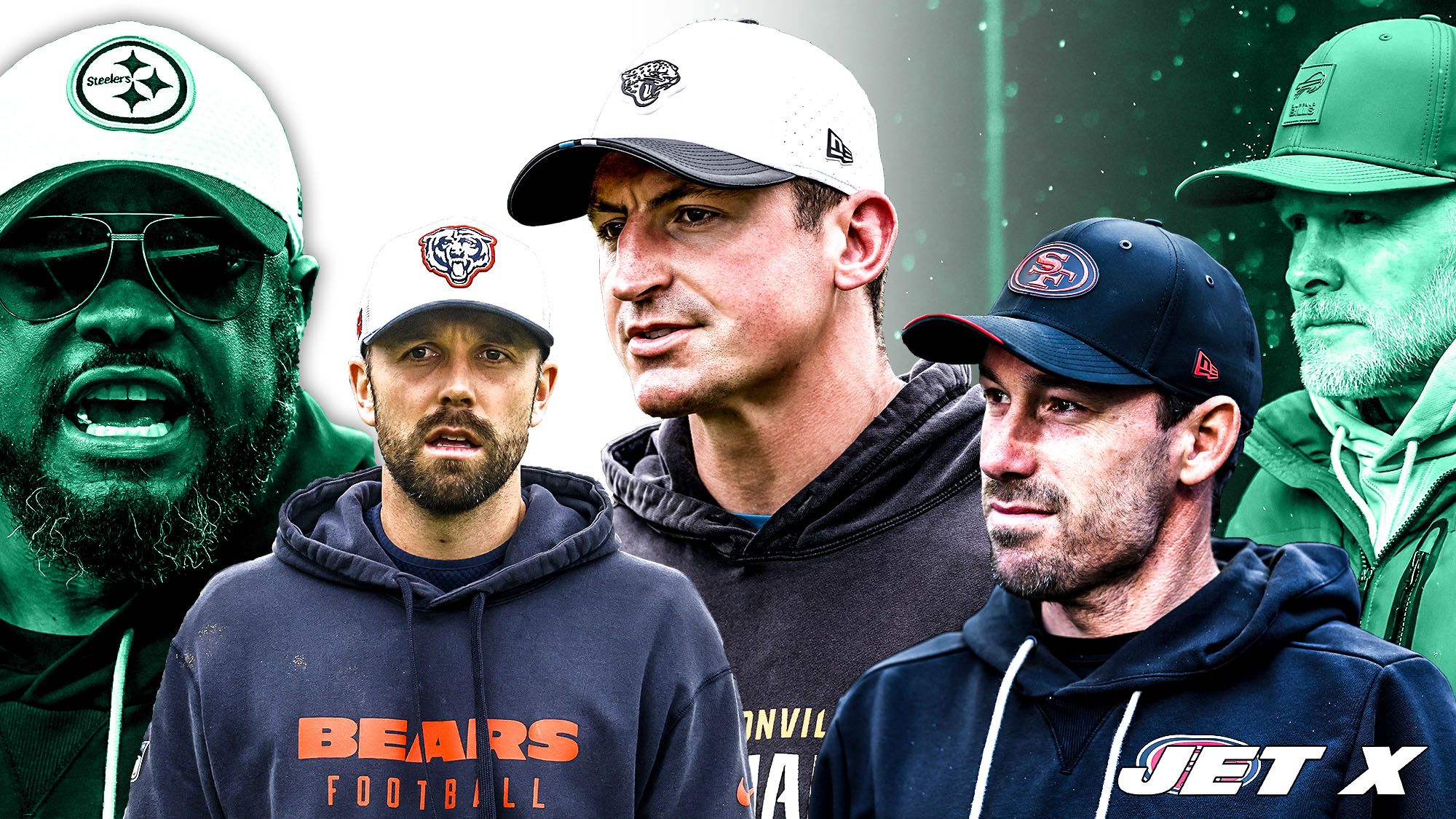
Grant Udinski, Klay Kubiak, and Declan Doyle are all tremendous candidates. No matter how realistic the chances may not be, Mike Tomlin and Sean McDermott are also tremendous options to consider.
To pretend otherwise is to act like the New York Jets over the last 15 years — narrow-minded and stuck in a certain type of mold, while believing you have figured it out already.
