
What is defensive football? What does it mean to play defense in today’s game, really?
What does an elite defensive unit look like? It seemingly changes all the time.
At this point last year, the top defensive units were both obvious and inarguable. DeMeco Ryans’s Houston Texans and Vance Joseph’s Denver Broncos ranked No. 1 and 2 in yards allowed per game last season, respectively, with the former finishing second in defensive DVOA (-19.4%) and the latter finishing fifth (-10.1%), per FTN.
Things are a bit different this season.
Drastic defensive declines
Houston’s 13th-ranked defense (325.5 yards against per game) and Denver’s 28th-ranked defensive unit (356.5 yards against per game) have football fans wondering what went wrong. How could the Texans’ sparkling second-ranked -19.4% DVOA from 2025 plummet to -3.5% in 2026 (which is currently tied for 12th with the Kansas City Chiefs)?
After all, neither team lost much by way of significant personnel, particularly as it relates to pass rushers.
Other than the losses of John Franklin-Myers and Dre Greenlaw (who played in just eight games last season), along with defensive pass-game coordinator Jim Leonhard’s exit, Denver’s defense remained mainly intact.
The big pass-rush statistical names are still standing in Denver.
Nik Bonitto (14 sacks and 39 pressures in 2025, per PFR), Jonathan Cooper (8 sacks and 25 pressures), and Zach Allen (7 sacks and 50 pressures) are all still around. Cooper missed the first six games of the season, while Franklin-Myers has reunited with Robert Saleh in Tennessee.
Meanwhile, Houston has only added reinforcements.
The Texans swapped out safety C.J. Gardner-Johnson for Reed Blankenship and replaced injured middle linebacker Azeez Al-Shaair with Jake Hansen, whose promotion from last season feels drastic.
Last season, Will Anderson Jr. (12 sacks and 36 pressures), Danielle Hunter (15 sacks and 34 pressures), and Sheldon Rankins (3 sacks and 14 pressures) have only missed two combined games this season so far (Rankins’s 2 games missed). Anderson Jr.’s 11.5 sacks in 27 pressures currently lead the NFL in 2026.
Houston’s current team totals of 35 sacks and 103 pressures are on pace to surpass last season’s 47 sacks and 139 pressures. For those not doing the math at home, the on-pace totals are 59.5 sacks and 175 pressures.
Yet, while not as drastic as Denver’s experience, the Texans’ defense — often viewed as the pride of defensive enthusiasts everywhere a year ago — has fallen off a cliff this season.
How? Why? This is the all-important question in the modern age of football.
If pressuring the quarterback is the most important element — as many defensive traditionalists have believed throughout the many years — how could a defense be on pace to obliterate their previous season’s pass-rush statistical output, yet move from first to 13th in total defense?
The Jets’ vastly improved pass-rush production
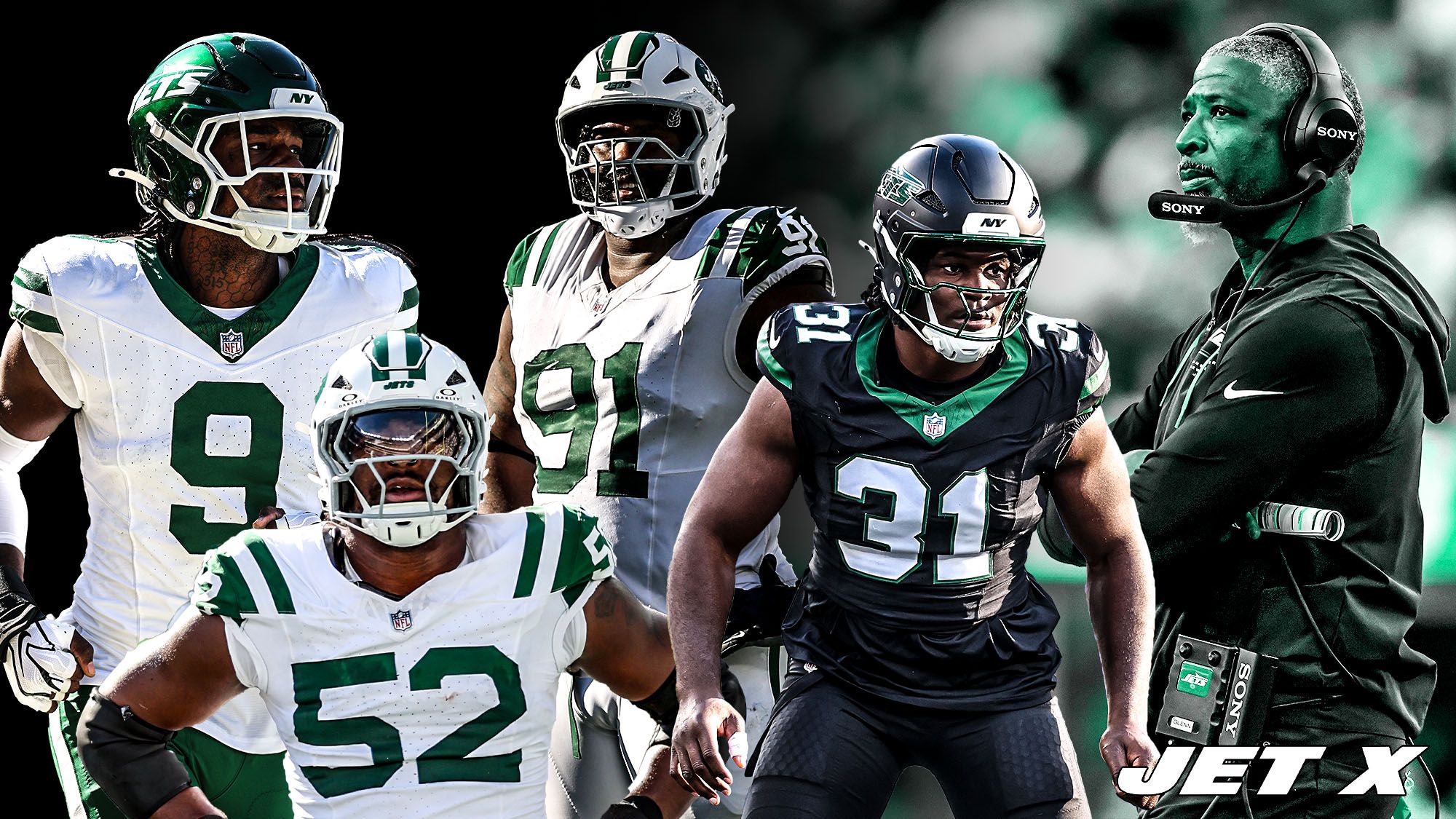
The 2025 New York Jets defense was hardly awe-inspiring, as everyone knows. All told, Aaron Glenn’s first defensive unit as head coach finished with 26 sacks (31st in the NFL) and 88 pressures a year ago.
This season, thanks in large part to the addition of David Bailey, the Jets’ sack total is 29, while their total pressures are 87 — through just 11 games. The projected numbers over a full 17-game season are 45 and 134.
The Jets’ 2025 defense finished 25th in the NFL in yards allowed per game (355.6), and 31st in points allowed per game (29.6). Again, everybody knows the story of the 2025 Jets, particularly the defense, which was marked by the midseason firing of defensive coordinator Steve Wilks.
Let’s talk about happier things, shall we?
Surely, with increased pass-rush production, the Jets defense in 2026 is crushing it. Due to the injection of talent, led by pass-rushing menace David Bailey, leader Demario Davis, disciplined Kingsley Enagbare, and wily vet Minkah Fitzpatrick, the 2026 Jets defense has taken major strides…
Right?
Surely, thanks to the Jets’ offense modestly improving from 29th in yards per game (263.6) and points per game (17.6) in 2025 to 20th in yards per game (318.7) and tied for 23rd in points per game (20.1) in 2026, it has placed the defense in a better position to succeed…
Right?
Surely, courtesy of the Jets’ time-of-possession game improving drastically from 31st in 2025 (28:14) to 13th in 2026 (30:10), thanks in large part to the offense’s efficiency between the 20s, Glenn’s defense has to be just straight-up crushing it…
Right?
Well, not really. At least, they’re not crushing it to the degree they should be.
Although the defense currently ranks 14th in yards allowed per game (325.6), their 22nd-ranked scoring defense (25.3 points allowed per game) skews the overall picture significantly.
Most damning is the unit’s top weakness, which is as fundamental as anything in football. It’s the idea that far too often goes overlooked, yet it’s also the idea that the great coaches never fail to overlook.
The New York Jets’ run defense, or, more precisely, their defensive integrity, is atrocious — as first noted this past August at training camp. This is the reason nothing works for them, and it was completely avoidable this past offseason.
The true measure reveals a gap
Despite the Jets’ defense not slapping anybody in the face with its traditional stats this season, a longer peek under the hood paints a horrific picture.
A Pro-Football-Reference stat called EXP (expected points contributed by all defense) measures each play in a situationally advanced fashion. It takes into account down and distance, field position, and more, using a point system that aligns with football scoring.
Similar to EPA (Expected Points Added), it’s one of the most trusted advanced stats used by folks in and around the league.
The 2025 Jets’ defense finished 30th in the league with a -176.95 EXP (a negative EXP is bad, whereas a positive is good for EPA). The 2026 Jets’ defense currently ranks 28th with an EXP of -91.50. (What’s important are the rankings, not the numbers, considering the difference is mainly due to comparing 11 games with 17.)
The 2025 Jets’ defense ranked 30th in EPA per play at 0.09, whereas the 2026 Jets’ defense has moved up just two places through 11 games this season, ranking 28th at 0.03.
For good measure, the Jets’ 2026 defensive DVOA of 11.1% (ranked 29th) is hardly better than their 19.1% mark in 2025, per FTN.
It’s officially time to cue Vince Lombardi: “What the hell’s going on out here?”
How in the world does the Jets defense still stink, despite its vastly improved pass-rush metrics? How could a defensive unit that added a pass-rushing menace in David Bailey, paired with an excellent pass-rusher in Will McDonald, supported by Kingsley Enagbare and Jowon Briggs, be so terrible?
For those who don’t believe in McDonald’s pass-rush prowess, please do some digging on tape. While it’s the only thing he can do, the man can get after the quarterback when asked to do so on passing downs.
Granted, his numbers don’t match those of last season, but how much of that is McDonald’s fault, as opposed to opportunity and circumstance?
The same can be said for Briggs’s pass-rush abilities, and even Enagbare, who surprisingly ranks 18th at EDGE with a 22% pass-rush win rate, per ESPN.
Actually, how many NFL edge pairings are better than the Bailey-McDonald duo? Will Anderson Jr. and Danielle Hunter certainly qualify, as do others, but, arguably, the Jets already have a top-quarter-of-the-league edge pass-rushing duo (when speaking purely about pass-rush talent).
The interior is where help is needed. But how much of it is not having better interior rushers vs. a defense simply not remaining structurally sound?
Even with the injuries to T’Vondre Sweat, David Onyemta, Joseph Ossai, and Minkah Fitzpatrick, there’s no disputing that the 2026 Jets’ defense is far more talented. The only notable departure was linebacker Quincy Williams, who’s enjoying a nice statistical season with the Cleveland Browns.
So, where’s the gap?
Early-down failures and a lack of structure
In the modern age, the NFL game has become a battle over efficiency. We’ve said it hundreds of times at Jet X, and we’ll say it again: Thanks to the 2012 CBA, which decreased the physicality and practice time while also ramping up offensive production, defenses can no longer truly dictate the terms of any game.
Unlike the 1985 Chicago Bears, 2000 Baltimore Ravens, or 2002 Tampa Bay Buccaneers, the 2025 Houston Texans cannot genuinely dictate the terms of the game. They can accomplish it to a greater degree than other teams, but living purely on the back of a defense is an impossibility these days.
The best football defense is an efficient offense, as measured by time of possession and performance in areas such as third down and the red zone. The NFL’s yards-per-completion average in 2026 is 11.1 — an increase over 2025’s 10.9 mark — yet it still ranks among the seven lowest averages of all time, all of which have occurred in the last seven seasons (dating back to 2020).
Considering that information, the Jets’ porous run defense — ranked 30th in the league, allowing 137.4 yards per game, and facing the most rushing attempts — isn’t the only issue at play. Deploying a modern defensive strategy on all three downs is what’s entirely crucial.
Nobody faces shorter third downs in the NFL than the Jets defense. Opponents’ third-down distance against the 2026 Jets defense is 6.1 yards, which places Glenn’s unit squarely at 32nd in the league.
Yet opponents are currently averaging just 3.9 yards per play on those 145 third-down plays through 11 games this season. Although this places them third in the NFL, by no means is this a good thing.
Shorter third downs equate to more offensive opportunity. Offensive coordinators understand this, and their playbook is wide open.
The Jets’ defense cannot avoid these situations because of their horrendous early-down play, where both the run, pass, and designed quick pass are all prime options.
This further demands all-around ability from defenders.
On second down, the Jets also feature a league-high low distance (7.2 yards). Out of 316 first-down plays, offenses have run 184 running plays to just 132 passing plays, which is an extremely lopsided ratio, and there’s nothing the Jets defense can do about it.
Versatility in personnel and scheme is king
Quite literally, there’s only one way to improve a defense in this modern age…
Versatility.
Because of the sky-high passing completion percentage, which creates more avenues to take short air yards on early downs to play the chain game, defenders must be versatile. Moreover, schemes must be versatile.
But schemes can only be versatile if the players within the scheme are versatile. Oh yeah, by no means is a poorly constructed defense an excuse for the coaching staff or scheme, either; it’s a further indictment.
Recently, I wrote about the Jets having a “player specialization problem.”
On the offensive side, Frank Reich has had a tough time implementing Kenyon Sadiq into the offense due to his work-in-progress inline blocking. On the defensive side, far too many defenders excel in one area while lacking in others, rather than showcasing all-around quality.
As tremendous as David Bailey’s recent three-game stretch has been — which has showcased a much-improved and encouraging balanced-down effort and execution — his pure pass-rushing mentality has hurt the defense in many areas this season (more so before the Kansas City Chiefs game). The same can be said for Will McDonald and Jowon Briggs.
Quite literally, offensive game plans are often designed to exploit a pass-rushing mentality.
The Miami Dolphins’ win over the Jets earlier this season leaned heavily on misdirection rushes and quarterback takeoffs that exploited the Jets’ edge players’ tendency to shoot down the arc (speed-rush the passer with a one-dimensional mindset).
The New England Patriots continuously abused the flat-to-curl area in the short-quick passing game. Ben Johnson’s Chicago Bears blasted the run game through the Jets’ B-gap bubble, while merely working their way to the right-side strength while doing so, time and again.
Everybody has hammered the C-gap, the space between the Jets’ edge defenders and the nearest interior defender, all season. Not until recently has the coaching staff seen real improvement from the edge players in squeezing the tackle box to eliminate space.
Justin Herbert’s rushing touchdown in the Jets’ victory over the Los Angeles Chargers is another example of calling an offensive play meant to take advantage of a specialized action — as the quarterback-designed rush snuck past the ambitious speed rush of Bailey, while the Jets were clearly in a contain defense at the end of the first half.
On the other side, a guy like T’Vondre Sweat is a 0-tech run-stuffer who has trouble moving laterally and sideline to sideline. Although that’s precisely what Sweat was brought in to do, that doesn’t make his skill set any more versatile.
Demario Davis is a heavier linebacker who still fills and spills productively, though he’s slower at age 37. Meanwhile, Jamien Sherwood isn’t heavy at all, but he can run in open space.
Other than Kingsley Enagbare, there really isn’t a truly versatile defender in the Jets’ front seven. Even worse is how soft they are as a unit in total.
This means the defensive scheme and play-calling have far less room for error, and guessing tendencies and plays become more critical.
Look to Seattle
One of the few defensive minds who figured out the modern way of playing defense — before most coaches did — is Seattle Seahawks boss Mike Macdonald. The defending Super Bowl champs once again feature a top-ranked defense for a second-straight season.
In 2025, Seattle finished with the sixth-best defense (285.6 yards allowed per game). This season, the Seahawks rank first by a wide margin while allowing just 236.1 yards per game.
The Seahawks’ -23.6% defensive DVOA leads the league this season, following their strong -24.0% defensive DVOA last season, which also ranked them No. 1 in the NFL.
It’s also about run defense…
After finishing third with 91.9 rush yards allowed per game in 2025, Seattle currently ranks fourth in 2026 while allowing 86.7 rush yards per game.
More importantly, it’s about pressuring the quarterback while preserving the integrity of the run defense in all scenarios (except for a handful of extremely long third-down situations per game).
Seattle routinely ranks high in team defensive pressures, but their sack and quarterback knockdown numbers don’t precisely match.
The Seahawks’ 180 pressures ranked third in 2025, and their 26.1 pressure percentage ranked them sixth. Yet their 47 sacks tied them for seventh, and their 60 quarterback knockdowns ranked them ninth in the league.
This season, Seattle’s 30.2 pressure percentage has them trailing only Brian Flores’s mad-blitzing Minnesota Vikings. Yet their 27 sacks rank them tied for 11th, and their quarterback knockdown percentage of 14.4 places them fourth — both of which could be higher given their extremely high pressure percentage.
Unlike the Jets’ 29 sacks (tied for seventh) from their 23.0 pressure percentage (17th), Seattle’s numbers paint a much different and more responsible picture…
Instead of the top goal of getting to the quarterback, the Seahawks key is to influence the quarterback. Whether that means pushing the pocket in a big-boy way, or remaining disciplined across the board on a gamed-up passing concept, that’s what defensive football has turned into in 2026.
Macdonald realizes that, while pressure on the quarterback is key, it’s nowhere near the most important factor, and that high sack numbers at the cost of structure and discipline (allowing mobile quarterbacks to escape the pocket, allowing the opponent’s rushing game to get going, etc.) equate to a heavy detriment in today’s much-too-quick-to-release-the-ball passing NFL.
Utilizing the cage or mush rush, and/or pass rushing as a team, isn’t just optional; it’s mandatory in order to have defensive success in today’s modern brand of football. Just take a glance at the Seahawks’ top sack defenders last year and this year…
2025:
- T1. Leonard Williams: 7.0
- T1. Uchenna Nwosu: 7.0
- T1. Byron Murphy II: 7.0
- 4. Demarcus Lawrence: 6.0
- 5. Drake Thomas: 3.5
2026 (through 10 games):
- 1. Byron Murphy II: 5.0
- 2. Derrick Hall: 4.0
- T3. Leonard Williams: 3.0
- T3. Earnest Jones IV: 3.0
Final thoughts
By no means are sacks a bad thing; they’re only bad (along with pressures and any other pass-rushing statistic) if they’re achieved through the sacrifice of other defending elements.
This has been one of the Jets’ greatest issues on defense this season.
Though it’s nowhere near their only issue, it’s helped lead to the team’s horrendous run defense. More importantly, they simply haven’t maintained an appropriate defensive integrity since the start of the season.
While it appears promising that the Jets’ pass-rushing metrics have dramatically improved, it shouldn’t be met with automatic optimism; it should instead be seen as an immediate opportunity.
How in the world could our pass-rush statistics be so much better, while our defense hasn’t improved a bit? What other defensive elements are being sacrificed en route to sacks, pressures, and the rest?
This is the all-too-critical question the New York Jets will have to ask themselves about their defense, while fully realizing they need to keep “versatility” and “all-around ability” in mind when they rebuild this unit the correct way.
The football age of “getting to the quarterback equaling playing great defense” died many years ago. Today’s brand of defense is about all-out versatility and scheme over individual pass-rush statistics.
Only the folks who think of football as continuously and rapidly evolving can get down with that idea.
