

All anybody can talk about in the land of New York Jets football is the hoard of assets that the team will put to use in the 2027 offseason.
The highlight of those assets is the team’s trio of first-round picks, each currently projected to land in the top 14. There is also plenty of talk about the idea of a new coaching staff overseeing the usage of those picks.
Often swept under the rug, though, is the Jets’ lofty cap space projection: $95.8 million, per Spotrac, the fourth-most in the NFL.
That number is plenty appealing on its own, suggesting that the Jets will have the spending power to add a plethora of veteran talent. However, it becomes even more appealing when contextualizing it with another all-important number in the free agency world.
The Jets can go big-game hunting
Sometimes, a team’s massive cap-space projection can be misleading because it is largely the byproduct of the team having few players under contract. This means they have to allocate the space toward signing a quantity of players, and might not be able to fit in as many splurges as fans would think based on the enormous number on the surface.
This is not the case for the Jets.
Per Spotrac, New York has 41 players under contract for the 2027 season, tied for the 13th-most in the NFL. Comparatively, the top two teams in cap space, Atlanta ($141.4M) and the L.A. Chargers ($101.9M), have 34 and 37 players under contract, respectively, ranking 23rd and 28th. The third-ranked Dolphins ($97.9M) are in a similarly promising spots to the Jets, tying for 10th with 42 signed players.
So, the Jets are in a rare situation. Not only are they flush with cap space, but they have enough players under contract to allocate that cap space toward a smaller quantity of players. In other words, they are heavily equipped to go big-game hunting.
Let’s take a look at how all 32 teams are shaping up in these two categories. The X-axis represents how many players teams have under contract in 2027 (further to the right = more players), while the Y-axis represents how much cap space teams are projected to have (further up = more cap space).
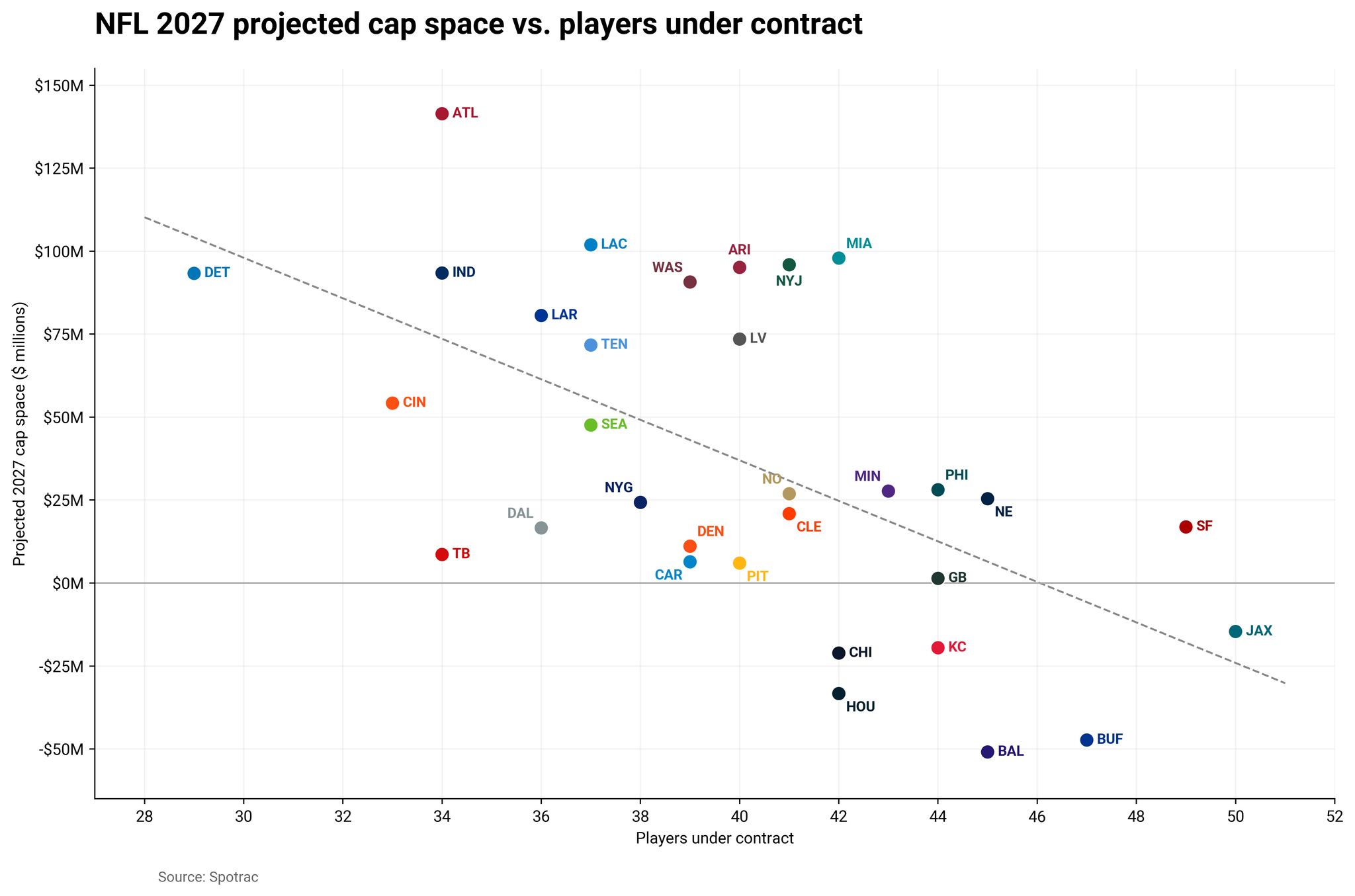
Lying the furthest to the top right, the Jets and Dolphins are clearly in the best position to splurge on blockbuster free agents. Three other teams find themselves in a similar position: the Arizona Cardinals ($95.1M/40 players), Washington Commanders ($90.7M/39 players), and the Las Vegas Raiders ($73.5M/40 players).
Meanwhile, the teams to the top left have similarly tremendous cap-space projections to the Jets, but far fewer players under contract, meaning that, in essence, they have fewer cap dollars to allocate toward each player they bring in. Those teams should be expected to target a high quantity of solid free agents rather than go deep-sea fishing.
Of course, the Falcons can be considered an exception, as their cap space total is so gargantuan that they can still be aggressive despite having only 34 players signed.
The teams in the bottom-right quadrant of the chart do not have a lot of money to spend, but they have most of their roster filled out, so they should be in a solid position to run it back with their current cores. However, the teams in the bottom-left quadrant are in a rough spot; they have many expiring contracts, but little cap space to retain or replace those players. This means teams like Tampa Bay and Dallas could struggle to improve their rosters.
Obviously, all of these numbers are subject to change drastically. Every team will cut, trade, and re-sign/extend players by the time free agency begins.
Still, the Jets find themselves in an extremely promising position relative to the rest of the league. Their gaudy cap-space number isn’t merely a reflection of a hollow roster; they have legitimately tremendous spending power.
