

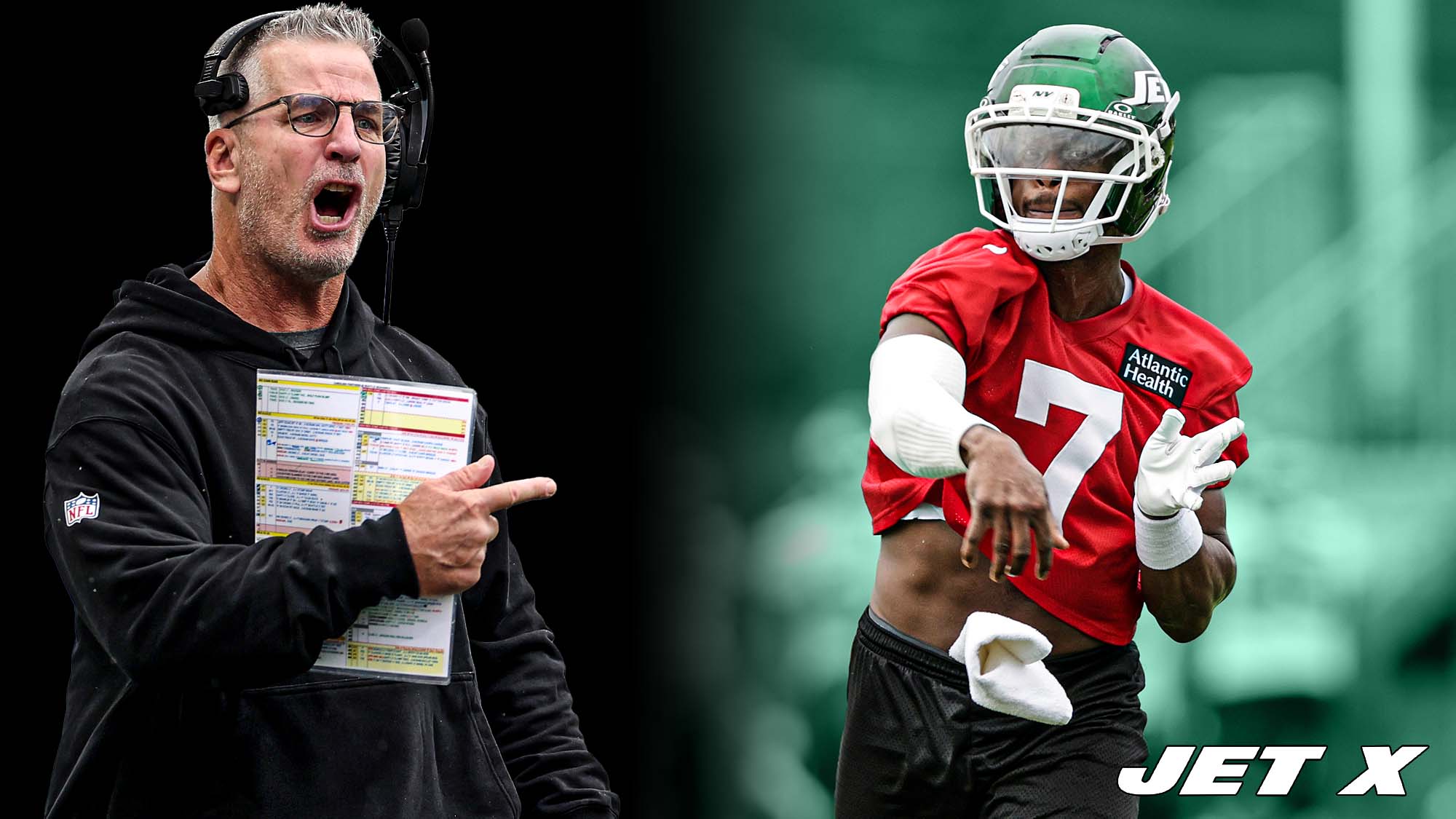
One running back, one tight end, three wide receivers.
It’s a package known as “11 personnel”: 1 RB, 1 TE, 3 WR.
It’s the base package for most offenses in the modern NFL. According to SumerSports, the average NFL team used it on 56.1% of their offensive plays during the 2025 season.
The New York Jets ranked third in 11 personnel usage, deploying it on 67.1% of their plays under former offensive coordinator Tanner Engstrand.
Yet, they were utterly horrendous at using it.
The Jets averaged -0.172 EPA (Expected Points Added) per play with 11 personnel, per RayCarp. Only the Cleveland Browns (-0.176) were worse, and it was by a smidgen.
If the Jets want to be a competent football team in 2026, they have to be far more competent with 11 personnel.
Are they capable of pulling it off?
Their new coach provides a fascinating answer to that question.
Jets’ 11 personnel outlook
After already using 11 personnel at a lofty rate in 2025, the Jets went out and hired an offensive coordinator in Frank Reich who has adored the package in the past.
Across his last six NFL seasons, Reich’s teams averaged a 72% usage rate of 11 personnel, even higher than the Jets’ third-ranked 67.1% from a year ago. He was only trending up over his last two seasons; Reich’s 2022 Colts finished third at 77%, while his 2023 Panthers finished second at 87%.
For both the 2025 Jets and Reich’s last two NFL teams, context is important. Bad teams are bound to use 11 personnel more often since they spend a lot of time trailing. The more teams trail, the more they will be in obvious passing situations, and obvious passing situations call for 11 personnel.
Still, Reich consistently used 11 personnel on well over three-fifths of his plays throughout his time in Indianapolis, even when the Colts were winning. When the Colts went 11-5 in 2020, Reich had their 11 personnel rate at 69%.
Reich’s history suggests that the Jets could be even more 11 personnel-dependent in 2026. However, there is also some evidence suggesting that the Jets’ 11 personnel usage could go down.
The Jets used the 16th overall pick on a tight end, Kenyon Sadiq. This came one year after drafting tight end Mason Taylor in the second round; Taylor went on to have a solid rookie season.
This type of investment in the tight end position suggests that the Jets could be looking to increase their usage of multi-tight end packages, namely 12 personnel (1 RB, 2 TE, 2 WR). It would be a forward-thinking shift, given that in 2025, heavy personnel packages were all the rage among the league’s best teams. 11 personnel might be going out of style.
In fact, the Jets themselves weren’t too shabby when using heavy personnel packages last year, even in the midst of an atrocious overall season. While they averaged a putrid -0.172 EPA per play with 11 personnel, they jumped to -0.033 with 12 personnel (20% usage rate) and -0.036 with 21 personnel (9% usage rate). Those numbers still aren’t stellar, but they are not far off from net-zero offense.
Given the selection of Sadiq, the Jets’ improved play with heavy personnel packages last year, and the league-wide trends, it feels safe to project that the Jets’ 67.1% usage rate of 11 personnel will drop significantly in 2026.
With that said, the Jets will still use the package on over half of their plays, in all likelihood. After all, 23 of the league’s 32 teams used it over 50% of the time last season. Only three teams used it under 40% of the time.
So, even if their philosophy shifts, 11 personnel packages will be a major part of the Jets’ offense, just as they are for every NFL team.
That’s why it is paramount for them to make substantial improvements to their productivity out of 11 personnel. Another 31st-ranked finish in 11 personnel efficiency would be hard to overcome, no matter how solid they are when using the other packages.
Reich’s experience as an 11 personnel-heavy coach should help the Jets in this regard, even if the team tones down its usage of the package. He knows how to field a solid offense with 11 personnel as the bread-and-butter.
Although 11 personnel packages are primarily used for throwing the ball, Reich has done a great job of using them to set up the run game. Back in 2021, the Colts ranked second in the league in rushing yards per game, while using 11 personnel 64% of the time. Running back Jonathan Taylor had an all-time season, rushing for 1,811 yards and 18 touchdowns.
When the offense goes to 11 personnel, the defense typically responds by going to its nickel (5 DB) package, which means a defensive back subs in for a linebacker. This makes the defense smaller and often spreads it out (depending on the formation), opening up running room, even if the offense itself is lighter by having three receivers on the field.
Yesterday, we broke down how the Jets need to drastically improve their outside run game after producing bottom-four efficiency on rush attempts directed to either edge, despite their overall No. 10 finish in rushing yards per game. That connects directly to the 11 personnel story.
Reich’s experience with unleashing Taylor in an 11 personnel-heavy offense can be used to help Breece Hall reach his full potential as an outside runner. The veteran coach knows how to use the pass-first expectations of 11 personnel to set up a speedy running back with the space he needs to hit home runs.
Geno Smith also seems like an ideal quarterback to make plays when the offense spreads things out with three receivers. In each of Smith’s three seasons as the Seattle Seahawks’ starting quarterback, Seattle’s offense ranked somewhere from 13th to 15th in EPA per dropback with 11 personnel on the field. Smith has been aggressively attacking one-on-one matchups in training camp, and that can go a long way in maximizing Reich’s three-receiver sets.
Again, the Jets should be expected to use 11 personnel less frequently than they did last season. They seem focused on increasing their usage rate of 12 personnel and 13 personnel.
Still, in all likelihood, 11 personnel will remain their top package, as it is for most NFL teams, and they must find creative ways to be successful with that grouping.
As things stand today, here is what the Jets’ starting 11 personnel offense could look like:
- QB Geno Smith
- RB Breece Hall
- TE Mason Taylor
- X-WR Garrett Wilson
- Z-WR Adonai Mitchell
- Slot WR Omar Cooper Jr.
- LT Olu Fashanu
- LG Dylan Parham
- C Josh Myers
- RG Joe Tippmann
- RT Armand Membou
The pieces are there for New York to field a league-average 11 personnel offense.
It starts at quarterback. Smith showed in three of his past four seasons that he can anchor slightly-above-average efficiency out of 11 personnel.
The Jets also have an ideal combination of weapons to work against nickel defenses from spread-out formations. They have a top-flight receiver to pull attention away from his teammates, who are each loaded with speed to take advantage of the space Wilson creates; Hall will see fewer defenders in the box, Mitchell will draw some one-on-one matchups without help over the top, and Cooper will have space to work on designed touches underneath.
With a solid offensive line up front, the floor should be high.
Let’s see if Reich can turn back the clock and lead another solid NFL offense that thrives out of 11 personnel.
