

Please accept my apologies in advance, New York Jets fans. The first step in recovery is admitting one’s powerlessness against one’s vice of the moment.
Indeed, I am powerless — at least on this particular day. I cannot help but analyze what’s in front of my face, even if it equates to raining on the premature parade.
As it currently stands, on Aug. 10, 2026, No. 2 overall pick David Bailey is a future Pro Football Hall of Fame player. At least that’s what the media machine would have all fans believe.
Look, I get it: ‘Tis the season of hope. As time marches forward in our digitally-dominated media world, the headlines become more about “everything and everybody is great, all the time,” particularly during the NFL draft and training camp season.
It’s a dirty job to even slightly buck the trend, but somebody has to do it.
How we arrived here
How we arrived at this point makes sense. Bailey’s quickness off the edge is elite, freakish, and impossible to miss. It’s that level of attribute that flashes at practice.
Considering the nature of practice, in which there’s no to-the-ground tackling, onlookers must use judgment to decide whether a play would have resulted in a sack or pressure, or would have continued for the offense. In the great Dickie V. voice, “That’s subjectivity city, baby!”
Therefore, it’s reasonable to suggest that many of the reported sacks were nothing more than run-of-the-mill edge moves that would have resulted in “flash without substance.”
For instance, one play from this past Saturday’s practice was widely reported as resulting in a Bailey sack. Yet, I simply did not see it that way.
To me, Bailey used his hands to get outside of Olu Fashanu, but took a wide angle to do so. At the time Geno Smith unloaded the ball, Bailey was behind the quarterback.
It was a potential “fly by,” folks. And it’s this idea that has run rampant at Florham Park, N.J., this summer, with no focus on how destructive it could be to a defense.
Because Bailey wasn’t “stonewalled,” everybody assumes he won the 1v1 battle against Fashanu. Because he was able to get outside and get near the quarterback’s vicinity, before the ball is released (or in the midst of the release), everybody assumes it’s a sack.
This is simply not the case.
The freakish quickness is legit
Make no mistake about it: David Bailey’s quickness is legitimate. Quite honestly, it’s not a surprise.
We knew what Bailey brought to the table during the NFL draft process. He was dubbed the best pass-rusher in the entire pool, and few would argue with that notion, especially due to his overall body of work at the college ranks.
Onlookers have witnessed this raw attribute time and again this summer and have reacted with awe.
From that specific standpoint, per his quickness, it should be met with awe. He absolutely is outright special from that perspective.
But it’s the back-end symptom that must carry the same weight, and it’s this area that Aaron Glenn must contend with in his defensive scheme.
How does a defensive architect handle not only an edge defender’s quickness en route to the quarterback but his propensity to showcase that one-track mindset as well?
Quickness only matters within structure
As often (if not more often) as a reported Bailey positive flash has occurred at Jets training, an equally negative play transpired. Unfortunately, those are hardly reported; they simply don’t jump out in real time.
For example, last week, Frank Reich’s offense ran something directly at Bailey, off the left side. Had it been a standard dropback pass, the reports would have flown in that “Bailey beat Fashanu to the outside.”
Since the balanced down resulted in a rush, straight at him, Breece Hall popped one for 10-plus yards. The seas parted for the offense, all due to Bailey’s propensity for doing anything possible to get to the quarterback.
Because of the wide path towards the quarterback, Olu never enjoyed an easier run block. He simply guided him further down the arc.
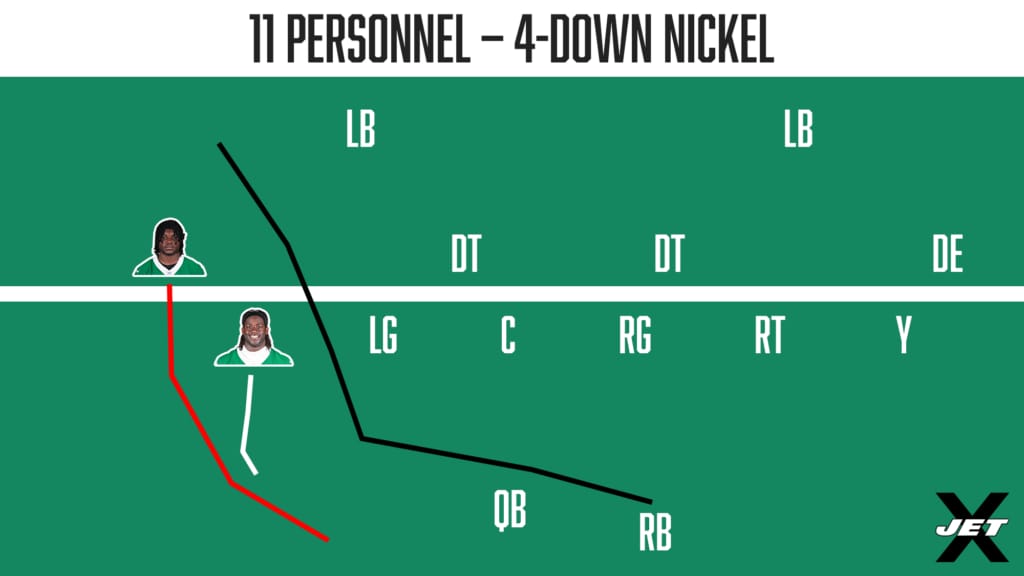
Granted, there’s no replay at camp, but nobody came to replace Bailey near the C-gap, and the interior defensive lineman on his side didn’t even come close to expanding.
Earlier in that very practice, Armand Membou dominated Bailey on a Hall rush. He first sealed him to the outside, and then knocked him back at least a few yards.
It shouldn’t be controversial to consider how damaging these negative plays are to a defense. Those who also believe it doesn’t matter how any defender plays against the run or in any area of defense are just living the “ignorance is bliss” life.
Football just doesn’t work that way. One careless or selfish play by a defender could wreck the entire game for his team.
How to handle Bailey’s skill set
It’s evident that, up to this point in the summer, Aaron Glenn and Karl Dunbar are especially invested in developing David Bailey’s all-around game. This, in itself, is a tremendous positive.
But here’s the thing: It’s not Bailey’s run-game deficiencies that are the issue, per se. It’s his instincts that take him in a certain direction, which, in turn, create the run-game issues.
When his focus is solely on beating the tackle in front of him, things will turn out disastrously. When his focus is both on beating the tackle in front of him while remaining true to his defensive responsibilities, things can become fun.
The Jets’ highest-drafted defensive player in franchise history loves getting after the quarterback. Not only has he freely admitted this publicly, but every instinct he showcases on the field also lends credence to this idea.
It results in plays where Bailey eludes run blocks that would take him out of the play, making things exponentially worse for his teammates. For Glenn and Dunbar, how they signal to Bailey what’s most important in each situation is critical.
Initially, it’ll look a bit disjointed, as it does right now. There are plays that see Bailey do his schoolyard 1v1 thing while having nothing else on his mind but beating the tackle in front of him. If he flies by or takes himself out of the pass play, so be it.
Those are most likely the third-and-long situations. That can and will become a major problem against mobile quarterbacks like Josh Allen and Lamar Jackson, who will torch such a mindset.
Guess what? That simply won’t show up at Jets camp because Geno isn’t about that life. Those eventual negatives we’ll see this season won’t show up at camp.
Positive signs and the ultimate goal
The promising aspect is that, on plays where it’s evident Bailey is precisely focusing on his balanced-down keys, his effort, and sometimes, his leverage and output, per his responsibility, has been notable.
In what I believe was his best play of the summer, by far, Bailey screeched down the line, squeezed it nicely, and met a flashing tight end block in a tidy spot. He then peeled off and got in on the gang tackle.
The goal for Aaron Glenn is to get David Bailey to a point where he combines his all-world quickness with his love for using that quickness en route to the quarterback, while simultaneously handling all the responsibilities that come with edge-defender run fits and pass-rush lane responsibilities.
That could take some time.
At the very least, David Bailey should collect his fair share of pressures and sacks. Whether those plays outweigh the negatives is the heart of this story.
