
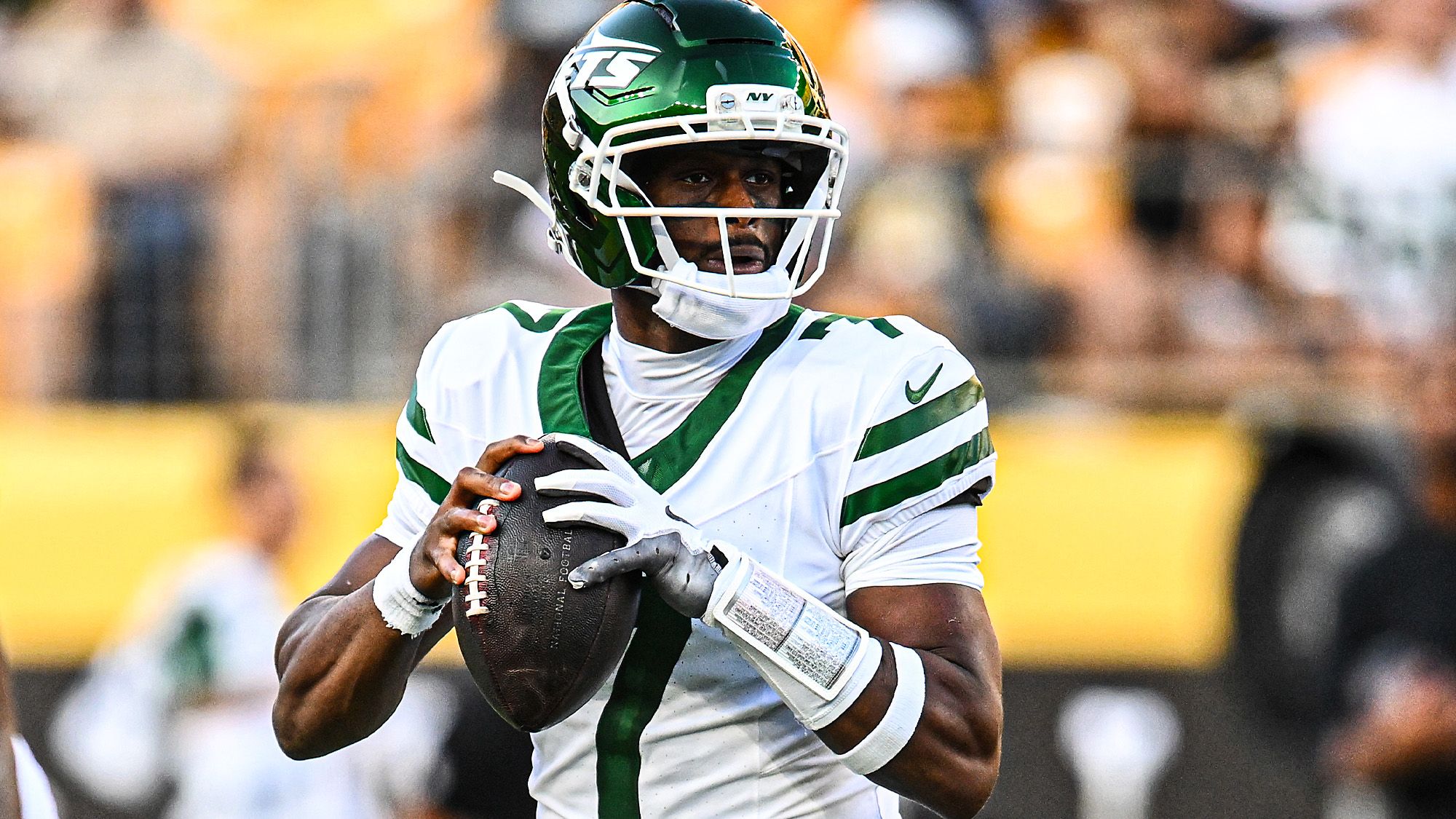
Geno Smith is getting ready for his first season back with the New York Jets. He will be the Jets’ seventh Week 1 starter over the past decade, and he’s looking to switch the narrative of his career in New York after a rocky first stint.
The Jets aren’t expecting Smith to turn back the clock to 2022 and play like a Pro Bowl quarterback. That would obviously be nice, but those aren’t the expectations that Gang Green has in store.
What the Jets need from Smith in 2026 is much simpler: keep them competitive.
After winning just three games in 2025, Aaron Glenn is fighting for his job as he prepares for his second season as the Jets’ head coach. Beyond that, New York has young talent to develop across their offense, and having competent quarterback play makes it much easier to assess young pass catchers like Mason Taylor, Kenyon Sadiq, and Omar Cooper Jr.
What the Jets are essentially asking from Smith is competency. That alone would be a significant upgrade over the QB play Jets fans have been forced to sit through over the past decade.
His 2025 season with the Las Vegas Raiders was ugly; there is no denying that. He finished the year with an 84.7 passer rating (30th of 33 qualifiers) while averaging just 5.2 net yards per attempt (32nd) and leading the league with 17 interceptions.
Once you dig beneath the basic stats, though, it’s easy to spot that a less-than-ideal situation with the Raiders likely played a large role in Smith’s struggles. Since 2022, he’s had three winning seasons and one lackluster campaign. That poor season just happens to be the most recent one.
Which version of Geno Smith will the Jets get? That is the burning question on everyone’s mind, and seemingly, the answer will be discovered pretty early on in the season.
Beneath the surface-level stats from 2025, several intriguing metrics suggest Smith’s struggles were largely due to his poor surroundings.
Let’s dig into those metrics and dive deep down the Geno Smith rabbit hole. Here are the reasons why Smith is poised to bounce back with the Jets in 2026.
Give Geno time, get results
Smith showed in 2025 that he can still play efficient football when protected.
When kept clean, Smith’s adjusted completion percentage (which accounts for drops, throwaways, etc.) was 81.9%, ranking seventh out of 33 qualified quarterbacks, directly between Drake Maye and Sam Darnold. That’s a very encouraging number.
Smith also ranked 10th among quarterbacks in non-disruption EPA (Expected Points Added), a metric that measures a quarterback’s production on plays that weren’t derailed by a quick pressure that forces the QB to abandon his reads or perfect coverage across the board, hence the “non-disruption” label.
That’s a pretty important distinction when evaluating just how “bad” Smith actually was in 2025. When things went according to plan, he remained an efficient quarterback like he was during his time with the Seattle Seahawks.
The issue is that those clean pocket opportunities were few and far between. Smith was pressured on a whopping 40.5% of his dropbacks last season, which was the sixth-highest rate among 33 qualified quarterbacks last season.
Under pressure, he struggled mightily, and that weakness was often highlighted because he was pressured on two out of every five dropbacks.
Here is a look at Smith’s numbers when under pressure.
- -0.71 EPA per dropback
- 6.5% turnover-worthy play rate
- 25.9% pressure-to-sack rate
- -47.6% DVOA outside the pocket
The difference is bonkers. Smith went from +0.24 EPA per dropback when protected to -0.71 when pressured, a massive 0.95-point swing. Furthermore, his 25.9% pressure-to-sack rate was dead last among qualified QBs, along with his DVOA outside the pocket.
The Raiders’ offensive line deserves flak for allowing Smith to be pressured so often. For a 35-year-old pocket passer, being pressured on more than 40% of dropbacks isn’t a recipe for success.
However, Smith deserves blame for how he responded to the pressure. He seems to be declining in this area. Over the past three seasons, his pressure-to-sack rate has progressively risen, indicating that he is getting worse at escaping pressure once it gets home.
- 2023: 13.9% (5th)
- 2024: 19.9% (20th)
- 2025: 25.9% (last)
That’s a notable trend that can’t entirely be ignored. However, Smith has never been confused for a dual-threat quarterback. Even when he was drafted, he wasn’t touted for his mobility. Particularly at 35, he is firmly a pocket passer.
With that in mind, the formula is pretty clear: If Smith has time to operate within structure, the numbers suggest that he is still a capable starting quarterback.
The comparison between Smith’s under-pressure and clean-pocket numbers in 2025 shows that Smith didn’t lose his bread and butter; he just couldn’t rely on it as often.
The Jets have the pieces to change that.
A much-needed change of scenery
Yes, in large part, Smith played poorly in 2025. There is no arguing that.
But the role of his supporting cast in those struggles cannot be understated.
Beyond the offensive line, Smith had to deal with a thin pass-catching corps. The Raiders’ leading receiver was Tre Tucker, with just 695 yards.
New York projects to offer much stronger pass protection and pass-catching. In 2025, the Jets already ranked 15th in PFF’s pass-blocking grade (68.3), 13 spots higher than the Raiders (56.9), and they project for another leap this year. Meanwhile, Garrett Wilson leads a young, explosive group of pass-catchers.
As much as Smith was hurt by his protection and weapons, the coaching staff was an even bigger obstacle—and it’s an underrated area where the Jets might provide a boost for him.
The Raiders brought Pete Carroll out of retirement to become their head coach, and he brought in Chip Kelly as his offensive coordinator—two laughable hires to begin with. Carroll went one-and-done as Las Vegas’ head coach, while Kelly was fired midseason.
The Jets have major coaching concerns of their own, but what makes their staff appealing for Smith is the fit. While New York’s hiring of Frank Reich is questionable for multiple reasons, his compatibility with Smith is evident when considering their respective historical tendencies.
As a play caller, the two routes that Reich has favored at the highest rates above the NFL average are in/dig routes and drags. Conveniently enough, those were also Smith’s two best concepts relative to the average quarterback during his three-year stint as the Seahawks’ starter.
- In/dig routes: +0.285 EPA per attempt above league average
- Drag routes: +0.252 EPA per attempt above league average
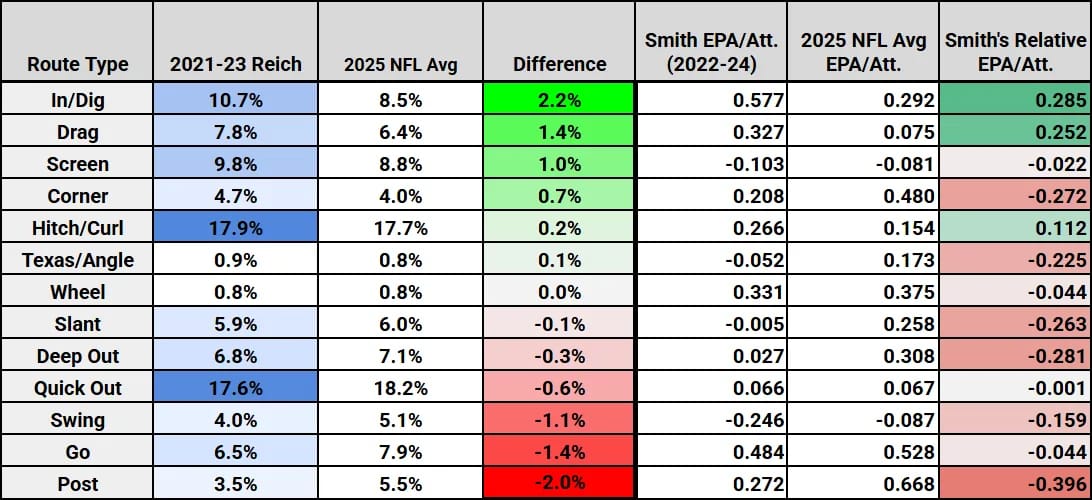
In particular, since his breakout season with Seattle in 2022, Smith has been extremely productive when targeting in/dig routes.
- 97-of-157 passing (61.7%)
- 1,593 passing yards
- 10.1 yards per attempt
- 86 first downs
- 54.8% first-down rate
- +0.483 EPA per attempt
- 2025 NFL average: +0.292 EPA per attempt
That’s not to say that Reich will come in and call dig routes on every play. However, having that schematic cohesion is undeniably valuable.
The goal this year is to simplify everything for Smith. Let him play with timing and attack the intermediate game where he has historically produced his best in his career.
Going from Kelly to Reich as his play-caller will be a boon for Smith.
Smith’s accuracy is still top tier
For all the areas where Smith fell off last season, one part of his game didn’t disappoint: his accuracy.
The Jets haven’t had a QB who could consistently complete passes in quite some time. As simple as that baseline is, establishing it will make a difference for the team in 2026.
Not only has Smith been accurate, but he has also been one of the most accurate QBs in the league. Even during his disastrous season with the Raiders, he completed 67.4% of his passes, which ranked eighth among qualified quarterbacks.
This has been a trend for him over the past few seasons.
- 2022: 1st (69.8%)
- 2023: 12th (64.7%)
- 2024: 5th (70.4%)
- 2025: 8th (67.4%)
In 2025, Smith ranked eighth in EPA per attempt on “zero-graded throws”, according to Pro Football Focus. Essentially, that indicates Smith remained really solid on simple passes in 2025; picture anything that you would consider “routine”, such as a checkdown, screen, or a quick out. Smith was one of the league’s most consistent passers on these throws.
That’s exactly what the Jets need: someone who can do the simple things right. The boring plays win games in the modern-day NFL. It’s the costly mistakes that lose games, and it goes both ways with Smith.
Of course, completion rate doesn’t automatically equal good quarterback play. Smith proved that last year. A quarterback can complete plenty of passes and still take too many sacks while also generating too many turnovers, both of which he did.
That’s exactly why this isn’t an argument that his completion rate should supersede all the bad that went down with the Raiders. The reason his accuracy is so important is that it establishes a floor.
Smith has been excellent with the “layups” and taking advantage of simple reads. The Jets’ offensive baseline will benefit immensely from those skills.
Don’t underestimate his deep ball, though.
Smith’s deep game can be one of the best in the league
If the Jets are going to get the most out of Smith, they need to give him opportunities to do something he has been very good at throughout his career since 2022: push the ball downfield.
During his resurgence with the Seahawks, one of Smith’s top traits was his deep passing.
In 2022, his first full season as a starter in Seattle, Smith was arguably the best deep passer in football. While he has not returned to those heights since, he has still been among the league’s best deep passers.
Here is a look at his deep passing grades from PFF throughout 2022-24.
- 2022: 99.2 (1st)
- 2023: 95.6 (T-6th)
- 2024: 95.1 (4th)
Smith completed 47.1% of his deep passes in 2022, the second-best among qualified quarterbacks, while throwing a league-high 15 touchdowns on those attempts.
While Smith only threw 14 deep touchdowns combined over the next two seasons, he still posted strong completion percentages of 43.3% and 46.2% in 2023 and 2024, respectively.
Smith’s deep game fell off in 2025; he completed 31.9% of his attempts with three touchdowns and five interceptions, while posting a 70.4 deep grade (31st of 32 qualifiers). It was undoubtedly an off year for Smith, although the lack of reliable threats at wide receiver certainly played a role.
The reality is that Smith has been an elite deep passer in three of the past four seasons. New York should look to reestablish that element of Smith’s game, as it was highly effective over multiple seasons. When you consider the Jets’ pass-catching options, it makes a lot of sense.
Garrett Wilson can win at all three levels. Unlocking his deep game would be a new element in his game that has yet to be fully tapped into.
Adonai Mitchell has flashed as a legitimate field-stretcher. Mitchell’s 15.2 ADOT (Average Depth of Target) in 2025 finished as the fourth-highest among qualified wide receivers, and his 80 Open Score from ESPN Analytics over the past two seasons ranks seventh among WRs.
Smith has the right personnel to take some chances. He won’t be forced to just dish the ball out underneath and play conservatively. The Jets should allow him to take shots and see what they could unlock in his deep passing ability, which has at times been among the best in the league.
Protecting the football
Everything we’ve discussed to this point comes with one pretty massive caveat: Smith has to stop giving the ball to the other team.
There were plenty of factors working against him in Las Vegas, but there are no excuses for a league-high 17 interceptions, which was Smith’s highest total since his rookie season with the Jets in 2013.
The advanced numbers weren’t much better.
Smith finished 2025 with a 4.1% turnover-worthy play rate, the third-highest mark among 31 qualified quarterbacks. So, although Smith did suffer from some unlucky interceptions, he was still putting the ball in harm’s way at a top-three rate.
Also, according to NFL Next Gen Stats, 27.2% of Smith’s throws went to wide-open targets, which is when the pass catcher has five or more yards of separation. This indicates that Smith really should not have been throwing so many dangerous passes, given how often he was throwing to wide-open players (mostly on checkdowns or screens).
The Jets don’t need Smith to be overly conservative to avoid interceptions, but his turnovers will certainly need to go down to find success in 2026.
What should the Jets realistically expect?
Ultimately, Smith’s return to the Jets shouldn’t be compared to his first season with the Seattle Seahawks, when he was named a Pro Bowler after throwing 30 touchdowns and posting a 100.9 passer rating.
Obviously, if he gets back to that level, that’d be great. But as he enters his age-36 season after a rough year in Las Vegas, expecting a full return to his peak is unrealistic.
The reasonable expectation is somewhere in the middle, and the numbers broken down above suggest that’s certainly attainable.
Even during the worst season in his career, Smith remained very accurate and efficient from a clean pocket. He is now stepping into a better environment with greater schematic cohesion and a stronger supporting cast at both the pass-catcher and offensive line spots.
There are also concerns, though. He has become very vulnerable to pressure, and his sack rate continues to trend in the wrong direction. Also, the interceptions need to come down.
That’s what makes Smith such an interesting quarterback for this particular team. He was brought in to provide stability and elevate the floor of an offense that has been among the worst in football in recent seasons. In some areas, he is the perfect quarterback to do just that, but his turnover woes can undermine those strengths.
If the Jets can get something closer to Smith’s 2022-24 level than what he displayed in 2025, that should be enough to accomplish what they need from him this season.
All Gang Green should be looking for is a competent starter who keeps the team competitive and allows for the remainder of the roster to be fairly evaluated.
