
Following the New York Jets’ Week 1 win over the Tennessee Titans, head coach Aaron Glenn gave out game balls to running back Breece Hall, quarterback Geno Smith, and special teamer Marcelino McCrary-Ball.
Those were well-deserved game balls. Hall ran for over 100 yards, Smith had an incredibly clean performance, and McCrary-Ball led a special teams unit that replicated its excellent from the 2025 season.
If the Jets could only give out one game ball, though—a game ball that truly represents the primary difference-maker in the game—it is painfully obvious where it should go:
The offensive line.
- LT Olu Fashanu
- LG Dylan Parham
- C Josh Myers
- RG Joe Tippmann
- RT Armand Membou
Split that thing into fifths and divide it amongst the big beauties.
Yep, the “big beauties,” because calling these men “big uglies” would be blatant disrespect after witnessing the artwork they collectively painted on the field in Nashville on Sunday afternoon.
Pass protection dominance
Throughout the offseason, we discussed ad nauseam how important it is for the Jets to protect Geno Smith if they want to be successful.
Protecting the quarterback is an imperative goal for every football team, but it is particularly crucial for the Jets, as Smith’s drop-off between his clean-pocket efficiency and his under-pressure efficiency is larger than most quarterbacks. That is expected; he is a 35-year-old pocket passer with some of the least mobility among current starters.
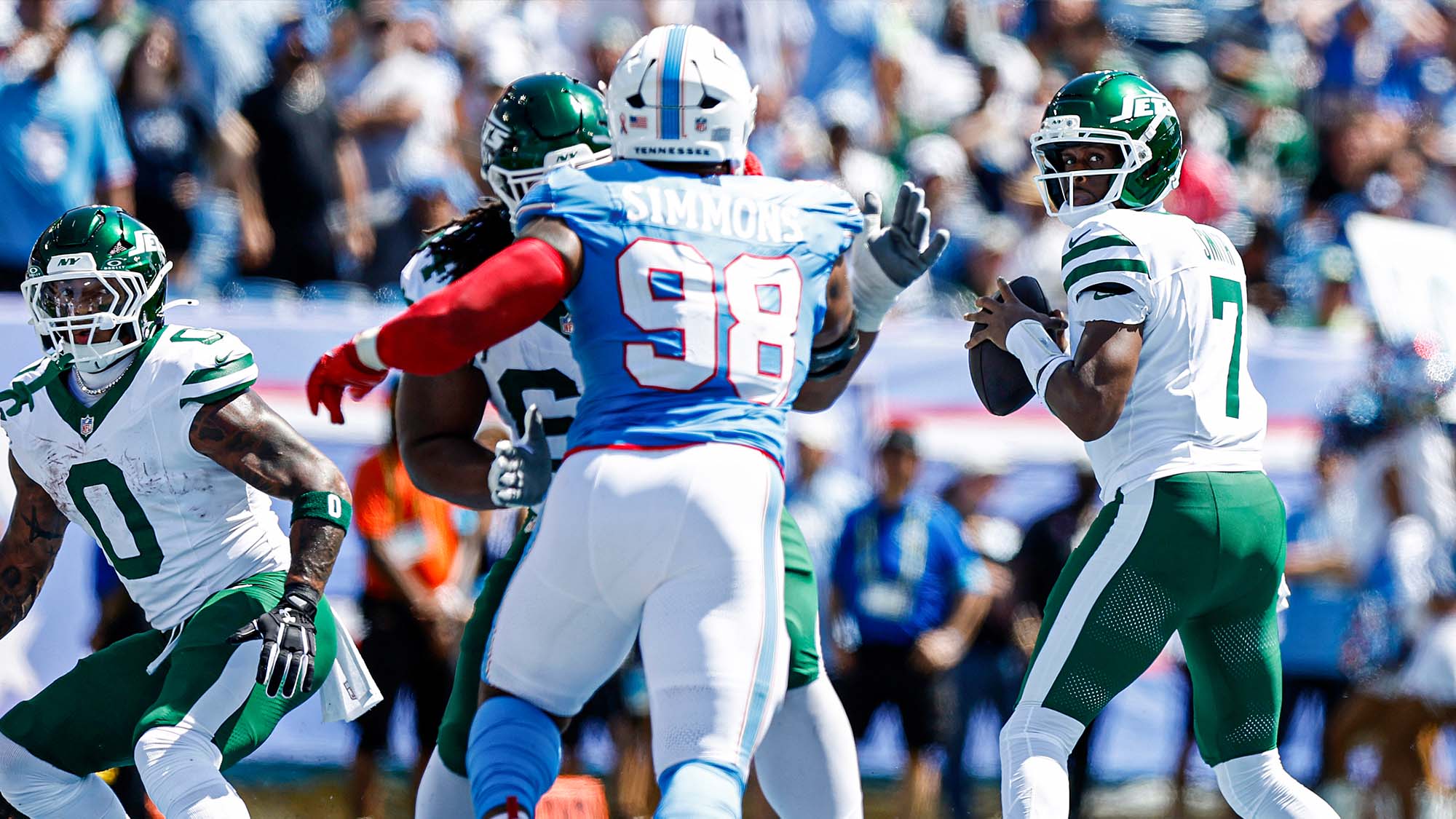
On Sunday, facing off against three-time All-Pro defensive tackle Jeffery Simmons and Robert Saleh’s aggressive four-man front, the Jets’ pass protection was downright dominant.
Across 26 dropbacks, Smith was never sacked, took just one quarterback hit, and was pressured on 23.1% of his dropbacks (per Pro Football Focus), the sixth-lowest rate among 30 quarterbacks in Week 1 thus far.
Here’s the critical piece of context that makes those numbers incredibly impressive: Smith averaged 3.13 seconds to throw, which is a high number. That validates the Jets’ pass-blocking metrics as a legitimate indicator of elite pass protection, rather than a byproduct of New York manufacturing pass protection by getting the ball out quickly.
Smith often stood in the pocket and went through full-field progressions without getting touched. It’s not as if the Jets were racking up screens and quick passes to keep him safe. No, sir. They ran an aggressive, dropback passing game for much of the afternoon, and Smith was able to operate it to its fullest potential because the offensive line was hardly even allowing him to be breathed on.
Two players, in particular, stood out among the Jets’ starting five linemen: right guard Joe Tippmann and Armand Membou.
Both players pitched shutouts, allowing zero total pressures apiece on 28 pass-blocking snaps, while also committing no penalties. For a right side of the line that has the potential to be one of the NFL’s best, this was a statement outing.
Left tackle Olu Fashanu had a strong game. He allowed just two total pressures on 28 pass-blocking snaps, and both were hurries; Fashanu gave up no sacks or hits.
The only player who struggled was left guard Dylan Parham, who coughed up four total pressures (all hurries) on 28 pass-blocking snaps, but given that he was facing off against Jeffery Simmons, he can be cut some slack.
Props are also due to the Jets’ skill-position players, who were credited with zero combined pressures allowed.
Across the board, the Jets did a phenomenal job of keeping Smith protected on Sunday. Pass protection in the NFL hardly gets better than what Jets fans saw at Nissan Stadium.
Run blocking
On paper, the Jets’ 152 rushing yards on 39 carries isn’t the flashiest performance of all time (3.9 yards per attempt), but the eye test told the story: The Jets’ offensive line controlled the line of scrimmage all afternoon.
New York didn’t hit any explosives on the ground, recording a long run of 13 yards, but it wasn’t needed. Consistency was the name of the game for the Jets’ rushing attack in this one. The Jets were rushing for positive gains with such consistency that they were able to methodically march down the field, chew the clock, and keep Tennessee’s offense on the sidelines.
As great as the passing game looked, it was the Jets’ run game that set up the aerial success. New York was racking up successful run plays seemingly at will, keeping them ahead of the chains. It helped them get into favorable situations to throw the ball, ultimately anchoring many sustained drives.
Of course, give some credit to Breece Hall and Braelon Allen for their roles in the Jets’ rushing success, but this was a game where the offensive line, not the running backs, was primarily responsible for the production. Hall and Allen were consistently being presented with multiple yards before they had to do anything.
The Jets’ running back duo combined for 65 yards before contact on 32 carries. That’s a whopping 2.1 yards before contact per carry. Think about that for a second; on New York’s average handoff, the runner did not encounter a defender until he had already gained two whole yards.
That’s the mark of an offensive line that is moving the line of scrimmage.
New York was particularly successful running to the left side. Across 12 carries, the Jets ran for 61 yards (5.1 yards per carry), but more importantly, they gained seven first downs, an absurd 58% rate. Of those 61 yards, 27 came before contact, resulting in a juicy 2.3 yards before contact per carry.
Give immense credit to left guard Dylan Parham for that left-side success. According to PFF, he earned a 91.7 run-blocking grade, which stands as the best mark among NFL guards through Week 1 (pre-Monday Night Football).
Parham had a shaky one in pass protection, but that was expected, given he was facing off against last year’s league leader in sacks among defensive tackles. He’ll be better moving forward. What matters is that he made up for it with a stellar performance on the ground, helping set the tone for the Jets’ offense.
Tight ends Mason Taylor and Jelani Woods were also standouts, earning run-blocking grades of 76.2 and 69.7, respectively, the second and third-best marks on the team.
All hail the Jets’ offensive line
The elite potential of the Jets’ offensive line was touted throughout the offseason. On Sunday, they looked every bit of an elite unit.
The pass protection was pristine, and it was the byproduct of legitimately excellent blocking rather than being assisted by the scheme. The run blocking consistently moved the line of scrimmage.
New York comes out of Week 1 ranked sixth in rushing yards while being one of seven teams to allow no sacks. The San Francisco 49ers are the only other team that ran for over 150 yards without taking any sacks.
For one week, at least, the Jets’ offensive line was elite. As with anything in football, the key now is consistency from week to week.
If that week-to-week consistency looks anything like their down-to-down consistency in Tennessee, the Jets’ offensive line has a bright future.
