

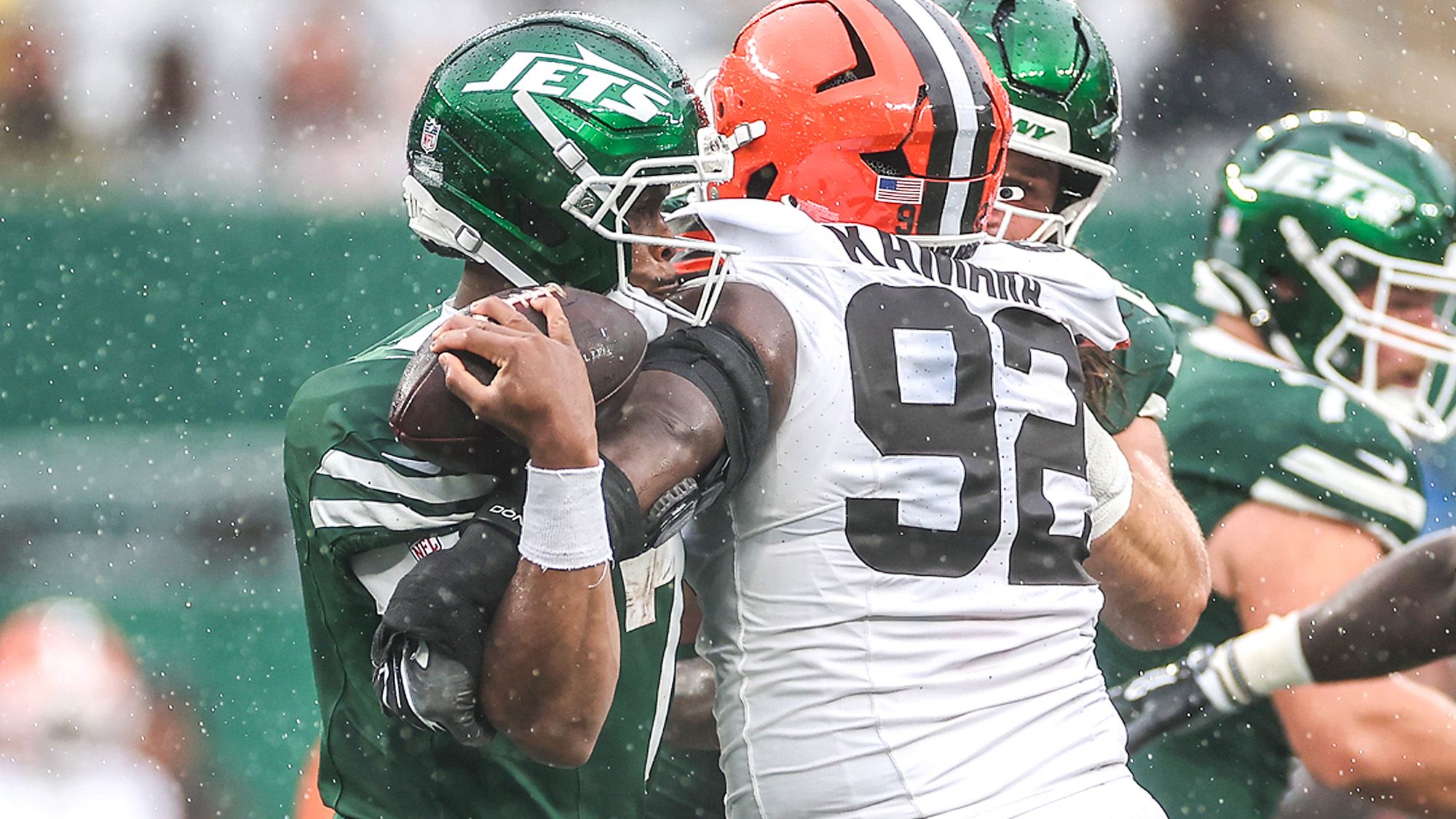
After leading the league with 17 interceptions in 2025, New York Jets quarterback Geno Smith has had a miraculous turnaround in that regard.
Five games into the 2026 regular season, he has yet to throw an interception, joining C.J. Stroud and Jared Goff as one of three QBs with at least 100 dropbacks who haven’t thrown an INT this year.
When you consider everything that comes with not throwing a pick over the first five games, how much does it really matter for the Jets?
What’s the value of Smith throwing no INTs so far?
If you told Jets fans before the year started that Smith would go interceptionless throughout the first five games, they would have been stunned and relieve.
Overall, it’s encouraging that he hasn’t thrown an INT yet, and only a few QBs can say they haven’t by this point in the season. It also highlights how his rough supporting cast with the Las Vegas Raiders last year significantly impacted him.
However, how much does it really matter?
I’m not going to sit here and tell you that quarterbacks not throwing interceptions is a bad thing, because that is utterly ridiculous. Still, it’s not a black-and-white metric.
Think of all the factors that go into INTs. It’s not just decision-making; it also includes aggressiveness and other components.
For example, what if a quarterback has zero interceptions because he is playing an extremely conservative brand of football that is holding back the offense? Don’t forget, Justin Fields didn’t throw an interception for the Jets until his eighth start last season.
That isn’t the case with Smith. His zero-interception number is fairly legitimate.
Through five games this year, Smith has completed 69.4% of his passes, the third-highest mark among starting QBs, for 1,084 yards (7.4 yards per attempt), six touchdowns, and zero interceptions. His 104.2 passer rating is also a drastic improvement compared to his 84.7 clip a year ago, and it ranks eighth among qualifiers.
Smith’s ball security has been solid. It’s not like he is just getting lucky with the zero INT total, which some QBs can.
According to Pro Football Focus, Smith has been tagged with three turnover-worthy plays this year. His 1.6% turnover-worthy play rate is the sixth-lowest among QBs with at least 100 dropbacks, sitting between Patrick Mahomes and Joe Burrow. It’s a massive improvement over his 4.1% rate in 2025, and on pace to be the best of his career as a starter.
While Smith has not completely abandoned throwing downfield, he has been relatively conservative with the ball, which can help limit interceptions. His average pass attempt has traveled 7.2 yards downfield, ranking fifth-lowest. Only 8.2% of his pass attempts have been thrown deep (20+ yards), also fifth-lowest.
There is another side to this conversation, though: the sacks. Just because a quarterback isn’t throwing interceptions, it doesn’t mean they aren’t setting the offense back or putting the unit in tough spots.
In five games, Smith has already been sacked 16 times. That’s an average of 3.2 per game, putting him on pace to endure 54 sacks this year. For perspective, he took 55 sacks with the Raiders last year. So, despite the dramatic improvement in his INT numbers, he is on almost the same pace in sacks, which is an issue.
Smith is struggling to prevent pressure from turning into sacks. This year, Smith’s 25.4% pressure-to-sack rate is the second-worst out of starting QBs, behind only Baker Mayfield at 32.5%. Over the past three weeks, Smith has logged a league-high 29.2% pressure-to-sack rate.
That’s an extremely high rate. There have certainly been moments this year to blame the Jets’ pass protection, but it is inexcusable that approximately every four pressured dropbacks ends in a sack for Smith.
This is exactly why it’s important to separate two things: Smith has been much better at avoiding dangerous throws, but that doesn’t mean he’s been just as good at avoiding costly negative plays. The Jets’ offense is averaging 18.6 points per game, tied for 27th in the league. Smith’s sacks have certainly played a role. Now, it’s not the full story, but it certainly contributed to the lack of finishing drives.
The answer to the article’s original question is somewhere in the middle. Smith absolutely deserves credit for significantly cutting down his turnover-worthy plays. However, that shouldn’t be the only measure of success as a QB.
The constant sacks are still impacting games, and you could argue those are nearly as impactful as throwing some INTs over a five-game stretch.
Smith not throwing an interception to open the season is much more encouraging than the opposite, but it doesn’t mean he hasn’t been at fault for any negative plays this year.
