
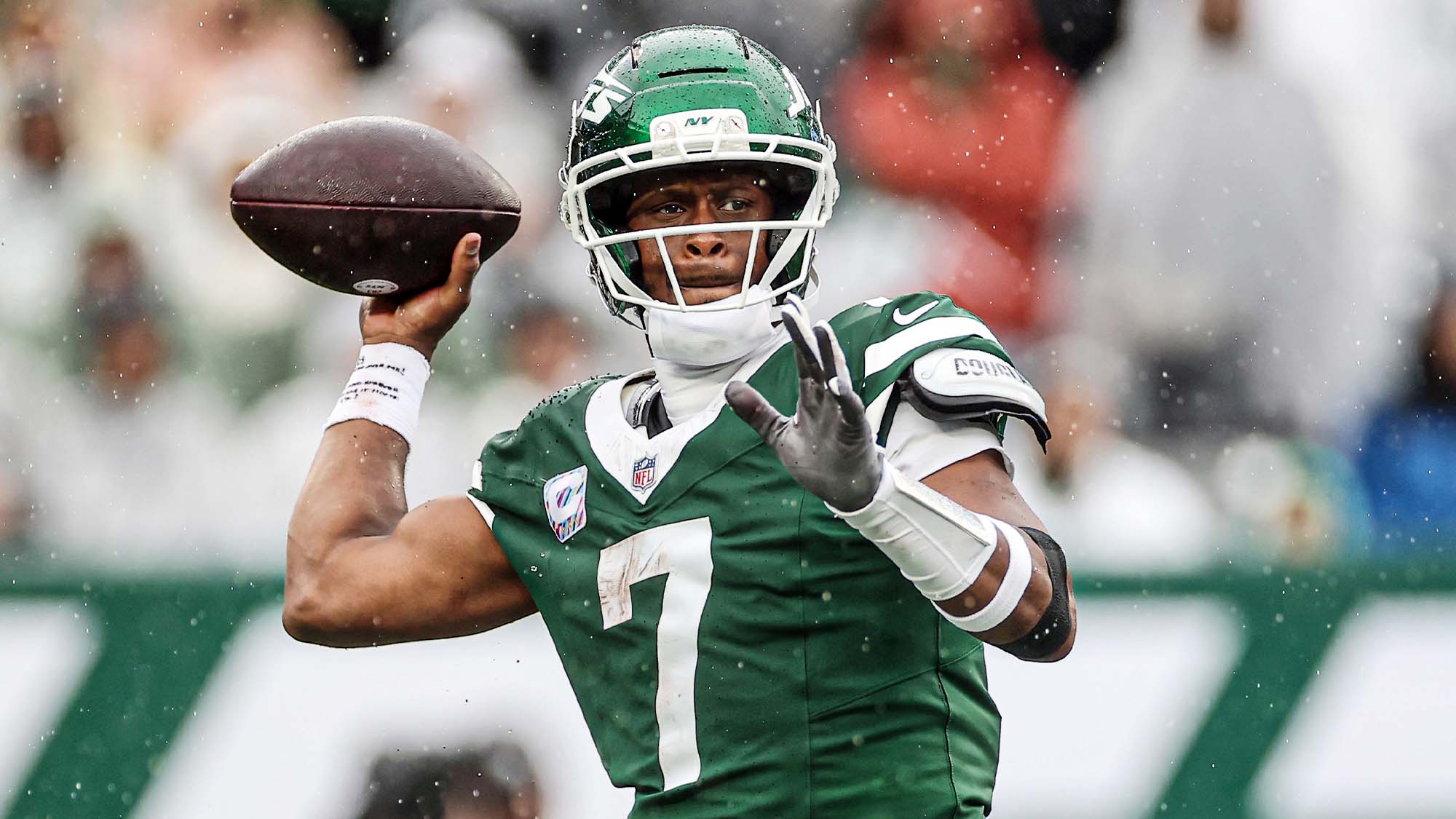
When the New York Jets committed to Geno Smith as their starting quarterback in 2026, they knew there would be limitations to his game. He’s a 36-year-old stopgap quarterback who was acquired for a Day 3 pick swap and has a $3.3 million salary.
Smith’s weaknesses at this stage of his career are obvious. He lacks mobility, struggles to escape sacks, can hold the ball a tad too long, and is occasionally too conservative in hopes of avoiding interceptions.
Despite all of those issues, Smith has performed around the level of an above-average starting quarterback this season, which is Nobel Prize Award-worthy by Jets standards.
Nearly every all-encompassing QB metric agrees that Smith’s performance has ranged from average to above-average among starters. Among 32 qualified starting quarterbacks, Smith ranks:
- 17th in adjusted EPA per play (0.107)
- 15th in passing DVOA (2.6%)
- 12th in PFF’s overall grade (74.3)
- 12th in adjusted net yards per pass attempt (6.8)
- 7th in passer rating (105.2)
How has he pulled that off despite his many glaring deficiencies?
Simply put, Smith has been downright elite in one area: throwing the football.
Sure, Smith takes too many sacks, holds the ball a bit too long, is less dangerous as a runner than most other starters, and can play it too safe to avoid interceptions. But when it comes to putting the ball where it’s supposed to be, he is the class of the quarterback position right now.
Any accuracy metric you look at, no matter how simple or advanced, will tell you the same story: Smith is one of the best pure passers in the NFL.
Take a look at some his rankings in accuracy-related categories:
- 3rd in completion percentage (70.0%)
- 2nd in adjusted completion percentage, per PFF (81.6%)
- 5th in completion percentage over expected, per RBSDM (5.2%)
- 2nd in completion percentage over expected, per NFL Pro (6.4%)
- 3rd in on-target percentage, per Pro Football Reference (81.2%)
For casual fans and television pundits, the most easily understandable and oft-cited metric for evaluating accuracy is the traditional completion percentage, where Smith has been elite, placing third at 70%.
However, completion percentage is a highly flawed metric that doesn’t really capture “accuracy”, since it does not account for where the QB tends to throw the ball, how often his passes are dropped, how often he throws it away, and other variables. It tends to favor QBs who throw a lot of safe passes, while more aggressive QBs tend to have lower completion percentages.
With Smith, though, the same story holds up no matter how much context you add or how complex of a metric you use to account for those variables.
PFF’s adjusted completion percentage accounts for drops, throwaways, spikes, passes broken up by a QB hit, and batted passes. In that category, Smith actually ranks one spot higher than in raw completion percentage.
Completion percentage over expected (CPOE), which is tracked slightly differently by multiple outlets, compares a QB’s completion percentage to what the league-average QB would be expected to produce if he threw the same passes. For instance, if a QB threw 10 wide-open screens, he might have an “expected” completion percentage around 90%, so if he completes seven of them, his CPOE will be a woeful -20%, even though his raw completion percentage would be a dazzling 70%.
This metric does a good job of adjusting for the average difficulty of a QB’s passes. QBs who throw a lot of checkdowns will be expected to have a higher completion percentage, and vice versa for QBs who take a lot of deep shots. Therefore, it allows all QBs’ accuracy to be evaluated on the same plane, since there is no longer an advantage to be gained by attempting easier throws.
Even in this category, Smith’s elite accuracy holds up. He is fifth in RBSDM’s CPOE (5.2%) and second in NFL Pro’s CPOE (6.4%).
This squashes any argument that Smith’s completion percentage (or even his adjusted completion percentage) is only high because he is too conservative. While it is true that Smith has leaned to the safe side this season (he is 28th out of 32 qualifiers with a 7.2-yard average depth of target), that does not fully explain why his accuracy numbers are so good. If Smith were only completing checkdowns, his completion percentage would be much lower.
The reason Smith has such a high completion percentage is that he hits his deep passes at an absurd level of efficiency, even if he does not target them often. Per PFF, Smith has a 61.1% adjusted completion percentage on deep passes (20+ air yards), tying Trevor Lawrence for third-best out of 32 qualifiers.
New York’s receivers have lent Smith a hand in this area. Not a single one of Smith’s deep passes were dropped, so his raw completion percentage on deep passes is the same as his adjusted completion percentage: 61.1%. That’s the best mark in the NFL.
Generally speaking, the Jets’ pass-catchers deserve some credit for Smith’s performance in all of these accuracy metrics. Throughout the season, many of New York’s weapons have consistently stepped up with a litany of contested catches, which have buoyed Smith’s CPOE and deep accuracy. This past week, Mason Taylor secured two marvelous jump-ball touchdowns, for instance.
Smith, though, deserves praise for his incredible ball placement to make those contested catches possible. Look no further than the spike in efficiency from Garrett Wilson.
As talented as Jets fans know Wilson is when it comes to securing seemingly impossible catches, he had only caught 38.5% of his contested-catch opportunities over his first four NFL seasons. That was largely due to poor ball placement from his QBs, making those passes far less than true “50-50 balls”.
But in 2026, Wilson has caught 9 of 12 contested targets, a career-best 75%, which is currently the fourth-highest mark among wide receivers with at least 10 contested targets. Wilson’s contested-catch rate didn’t skyrocket because Wilson suddenly became more talented; it happened because he’s playing with a QB who has been elite at placing the ball in the best spot for his receiver to make a play.
Say what you want about Smith. Say what you want about the Jets. But make sure to say this, too: Geno Smith is one of the best pure passers in the NFL today.
