
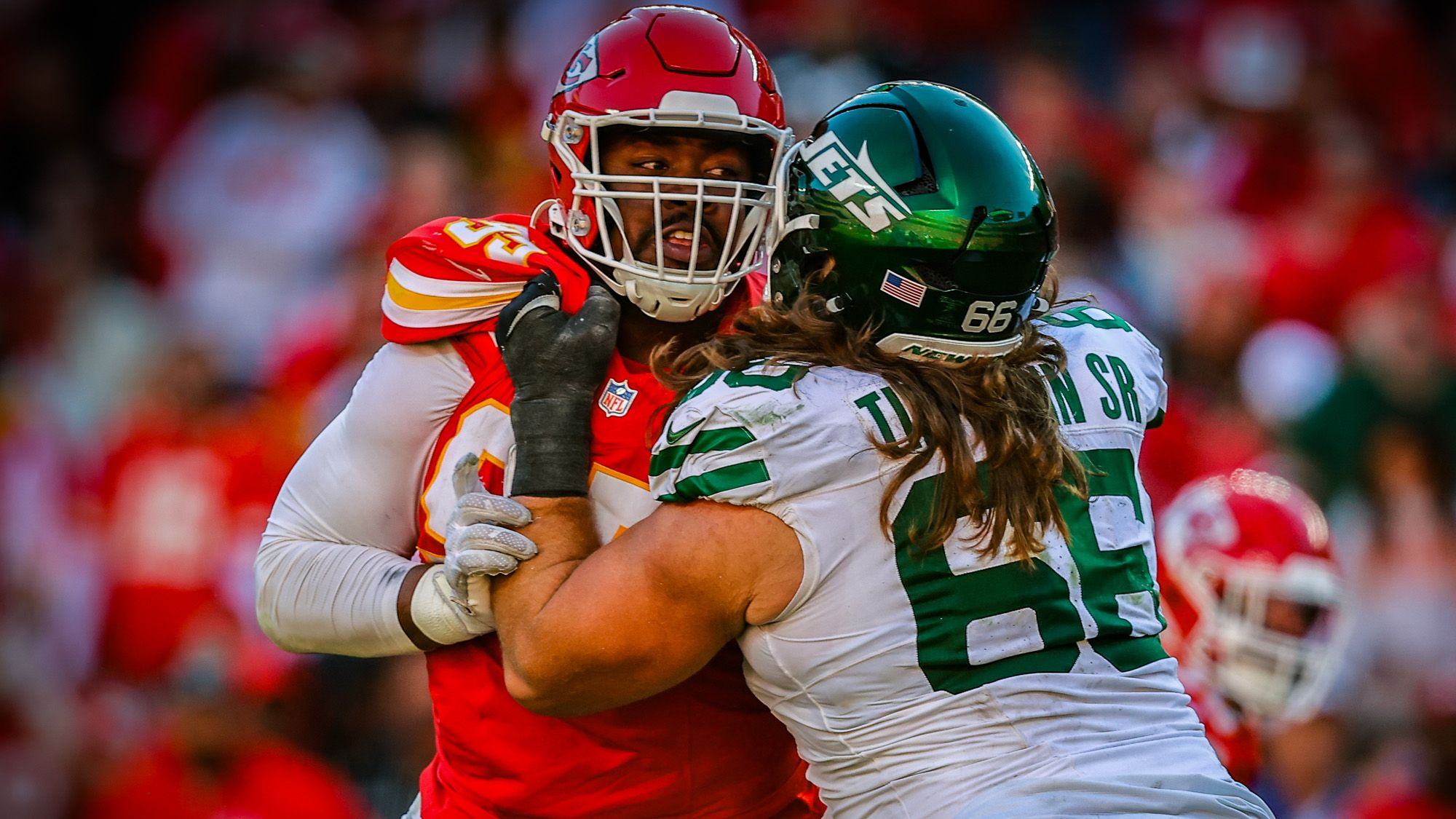
The New York Jets’ offensive line has been widely discussed as an ascending group over the last two seasons. Between the rising output and the assets Gang Green has invested in the group, that assessment is warranted.
However, how close is the group to becoming a finished product and reaching its ceiling? What changes must be made to the current lineup to optimize the unit as a whole?
The changes needed up front
Overall, Gang Green’s offensive line has been solid in 2026. There have been rough patches, notably an early-season stretch where they struggled in run blocking, but the unit has been as good as anyone could have asked for before the season.
Through 11 weeks, the Jets rank fourth in Pro Football Focus’ pass-blocking grade (74.5), and 10th in their run-blocking mark (72.3). PFF’s grades aren’t everything and should only complement the eye test, but in large part, the eye test has backed those numbers up to a fair extent.
While the Jets have allowed 33 sacks this season, the third-most in the NFL, their pass protection isn’t completely at fault. Geno Smith has had a huge hand in that mark. Smith’s 24.4% pressure-to-sack rate is the fifth-highest among starting quarterbacks this season. When protecting an aging pocket passer like Smith, the line can only do so much.
That said, there is really only one spot across the line the Jets should be looking to upgrade this offseason: center. Josh Myers has been the weakest link of the group this season, and that was expected entering the year.
To his credit, he has been better in pass protection lately, and his 74.9 pass-blocking grade from PFF ranks seventh among centers this season. However, his overall impact leaves plenty to be desired, especially in the run game.
One of the Jets’ biggest issues this season has been their inability to generate push up front in short-yardage situations. Myers has been a recurring culprit there when you turn on the tape.
The Jets also have to consider how much more they can really get out of Myers at this point in his career. He’s in his sixth season, and it’s important to remember he was signed as a backup last offseason but started all 17 games at center after Alijah Vera-Tucker’s season-ending injury before Week 1.
After proving serviceable in that role, the Jets rewarded him with a two-year, $11 million extension during the season, and he remained their starter entering 2026.
He is still under contract through the 2027 season with a $6.1 million cap hit next season. That said, the Jets don’t need to move him off the roster entirely. They could keep him on the roster while still adding a legitimate starting center through the draft or free agency.
Other than Myers, the Jets’ OL is pretty much set. Competition could be added at left tackle for Olu Fashanu, given his struggles in the first half of the year, but he has trended in a positive direction recently. If he keeps that up over the next six games, he can secure his starting spot for 2027.
Armand Membou has remained rock solid at right tackle 11 games into his second NFL season. At guard, Joe Tippmann has had some rocky outings, but lately he has started to right the ship. Meanwhile, free agent addition Dylan Parham has ranked as one of the top guards in football.
How high is center on the Jets’ priority list?
Yes, it would be wise for the Jets to replace Myers this offseason, but how serious is the need?
The notion that the Jets are simply a “quarterback and a coach” away from finding success is overblown. Alongside center, the team needs to make many changes on defense, and with the assets they have, it’s certainly feasible to fill most, if not all, of their holes. If they make the right moves, they can line themselves up for a solid 2027 campaign, perhaps even fighting for a playoff spot.
Right now, I’d put center in the middle of the Jets’ priorities. Rebuilding the front seven and figuring out the future at cornerback alongside Azareye’h Thomas are top priorities, but center isn’t completely negligible. To elevate the entire offense, a change there is necessary.
Think of the assets the Jets have invested in their offensive line. They have two first-round tackles and a second-round guard in Tippmann, who re-upped with the team on a four-year, $66.4 million contract extension.
The Jets clearly view the line as a focal point. Why risk putting yourself at a consistent disadvantage with Myers at center? No team will ever have five All-Pro-caliber players up front, but that doesn’t excuse not trying to raise the floor and ceiling of a unit the team has already poured significant assets into.
Gang Green wouldn’t even need to look to replace Myers by making someone the highest-paid center in free agency or even allocating a first-round pick. The beauty is that teams can typically find excellent players at that position for fair value on the FA market, or by allocating a Day 2-3 pick.
The Jets even had the opportunity to do that on Day 3 of April’s draft with players like Connor Lew from Auburn and Sam Hecht from Kansas State, who at the very least could have provided competition for Myers. Instead, with their top Day 3 picks, the Jets selected Darrell Jackson Jr., who has been a very nice find at defensive tackle, but they also traded up to select Cade Klubnik.
What would have been more beneficial: selecting an interior offensive lineman who could compete with Myers and play multiple positions, or trading up for a backup quarterback?
With the Jets looking to select a franchise quarterback in April, putting him in the best position to succeed is crucial. The Jets are actually much further along in that process than most teams.
However, with a chance to take the OL to the next level without breaking the bank, why not capitalize on it?
Look for center to be the Jets’ top offseason priority along the offensive line.
