
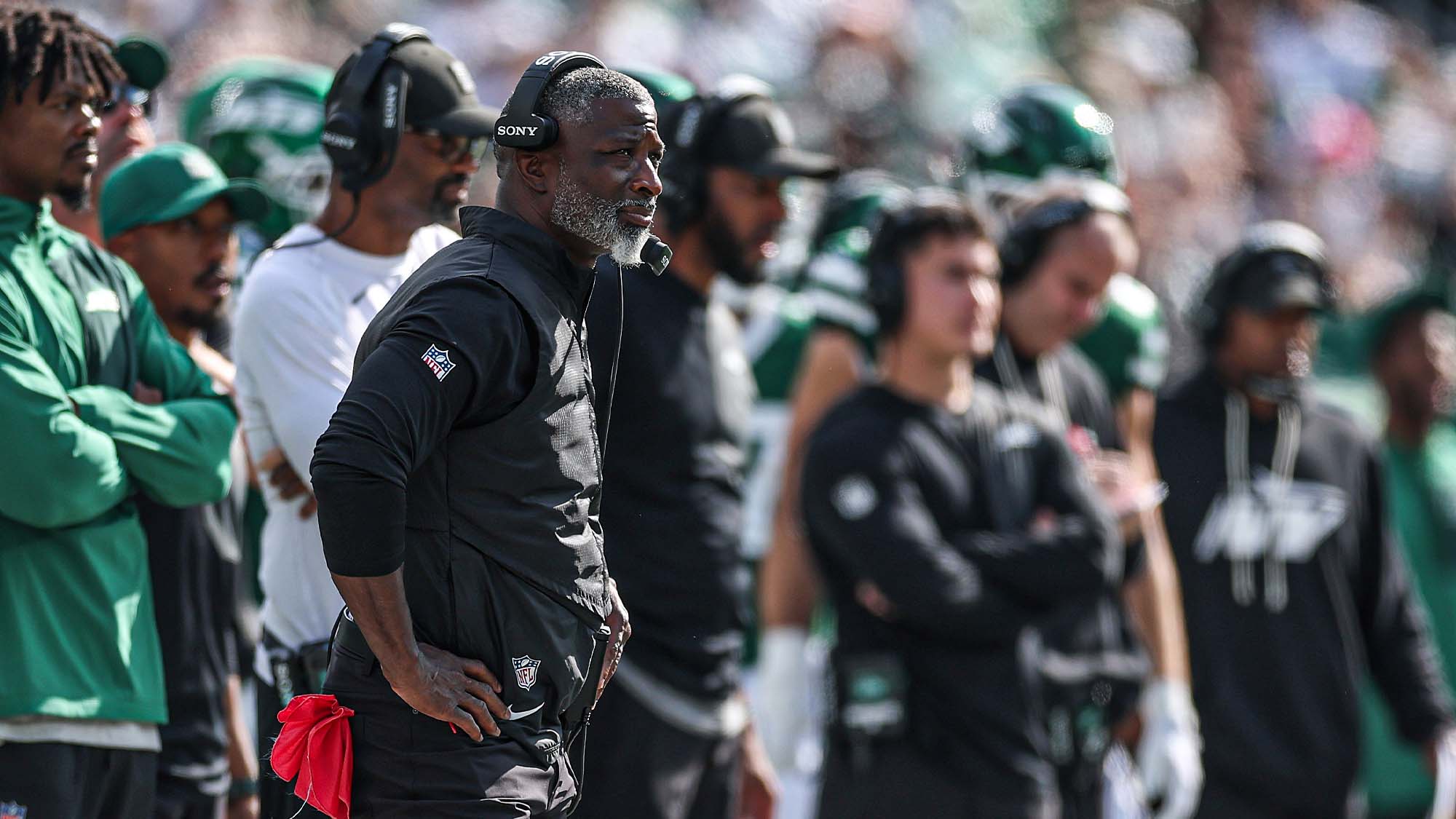
The New York Jets’ 0-7 record is not the worst part of their first seven games under head coach Aaron Glenn.
It’s how they got to 0-7.
There’s no such thing as a “good” way to start 0-7.
There is, however, a spectrum of respectability within the process that led to those losses.
NFL teams can lose games in ways that suggest they are on the verge of consistent winning with a few tweaks.
They can also lose games in ways that suggest the team is nowhere close to consistently winning.
Take a guess which category the 2025 Jets fall into.
If the Jets had gotten to 0-7 with a plethora of “quality” losses, it would suggest the team is potentially building a sustainable foundation, which was the Jets’ goal coming into the season. During Sunday’s loss to the Panthers, the FOX broadcast team continuously used that word when referring to their conversations with Glenn: “foundation,” suggesting it was and still is Glenn’s primary goal with the 2025 squad.
There is nothing foundational about what the Jets have done so far.
And it’s not because of the record. There are conceivable ways the Jets could be sitting here at 0-7 with some semblance of optimism about the foundation Glenn is building.
But outside of the Jets’ season opener, none of their other games felt like quality performances. In six consecutive weeks, Jets fans have exited the game feeling worse about the outlook of the franchise than they did when the ball kicked off.
Fervent defenders of Glenn and the team will argue that the Jets have lost five of their seven games by one score, suggesting the team is, in fact, recording competitive losses.
That factoid could hardly be more misleading.
If you go one-by-one through the Jets’ schedule, applying necessary context to each game, it becomes glaringly apparent how uncompetitive the Jets have been outside of the season opener.
Why don’t we grade the “quality” of each Jets loss thus far?
Where are the quality losses?
Week 1 vs. Steelers (L 32-34): This was the definition of a quality loss. The Jets went back and forth with a quality opponent for four quarters and held a two-score lead in the second half. It is easy to picture the Jets winning if not for a few swing factors going against them (special teams fumble, dropped interceptions, overall fumble luck). You can lose a game like this and feel like it’s something to build upon.
PIT loss grade: A
Week 2 vs. Bills (L 10-30): Total no-show at home. The score belies how one-sided this game was. Buffalo led 30-3 early in the fourth quarter before Sean McDermott took his foot off the gas pedal. This was with the Jets playing at home and the Bills missing two of their best defensive players, Ed Oliver and Taron Johnson.
This blowout remains Buffalo’s only win by 3+ scores throughout a six-game start to the season in which they have performed below their usual lofty standards. Even the lowly Miami Dolphins went into Buffalo and lost by just 10; the Jets lost by 20 (should have been more) at home.
BUF loss grade: F
Week 3 at Buccaneers (L 27-29): This goes down as a two-point loss on the road to a Tampa Bay team that currently leads the NFC. The Jets held the lead in the waning moments, with the Bucs winning on a game-winning field goal.
The Jets deserve plenty of credit for this result. However, it’s worth noting that it required a blocked field goal returned for a touchdown; without it, they were on track to lose by multiple scores. A blocked field goal is unlikely to be repeatable, so it doesn’t contribute much to building sustainability, especially since the defense quickly blew the lead gifted to them by the block.
The Jets spent most of the second half losing by two scores. They did not score a touchdown until nearly 50 minutes into the game and were outgained by 80 yards. They also failed to take advantage of a 7:14 margin in the penalty department or Tampa Bay’s many self-inflicted errors (drops, penalties, missed throws for potential big plays).
Give the Jets credit for a strong comeback on the road against a quality opponent. Still, we cannot overlook that Jets fans were irate with the team’s performance for most of the game until an unlikely comeback, sparked by a massive game-tilting play that would be nearly impossible to replicate.
TB loss grade: C
Week 4 at Dolphins (L 21-27): This one gets uglier by the week. At the time, it was already a Toilet Bowl between two 0-3 teams with grim outlooks. The ensuing weeks have only proven this game’s collective stench, as neither team has won since.
The one-score final margin is misleading. Miami led this game for the final 55-plus minutes. New York spent the majority of the second half trailing by two scores until Miami handed the Jets a garbage time touchdown drive to milk the clock.
That type of performance against an otherwise winless team is nothing short of embarrassing, especially considering Miami’s average margin of defeat in its six losses is 11.8 points. There’s nothing to build on here.
MIA loss grade: F
Week 5 vs. Cowboys (L 22-37): The Jets put forth their second no-show blowout in as many home games. It marked just the fourth time in franchise history that the Jets lost two home games by 15+ points through Week 5.
Once again, the final score belies how lopsided the game actually was. Dallas led 30-6 before New York’s patented garbage time rally.
The Cowboys were playing without four starting offensive linemen and still scored 37 points. Their horrendous defense, which has allowed 30.7 points per game across its other six games, yielded just six points to the Jets before they started allowing free points in garbage time. This same defense gave up 30 points to Bryce Young the following week.
Losing in blowout fashion at home is inexcusable for any NFL team regardless of the opponent. Doing it in two consecutive home games, with the second team being a .500 opponent with one starting offensive lineman, is grounds for relegation.
DAL loss grade: F
Week 6 vs. Broncos (L 11-13; London): Against a solid Broncos team, the Jets’ defense and special teams were dominant for four quarters, nearly lifting New York to victory despite a putrid offensive performance.
The Jets led this game in the fourth quarter, and with under two minutes left, they were a few yards away from a game-winning field goal attempt. Give them credit for sticking with Denver for four quarters. The performance of the defense and special teams should not be brushed aside.
However, the Jets’ offense was historically inept in this game, setting a franchise record with -10 passing yards. Yes, the Broncos have a great defense, but just one week later, the Giants and rookie quarterback Jaxson Dart dropped 33 points on the same defense in Denver, with Dart hurling three touchdowns. The Jets couldn’t even pass for three yards.
Add in the downright incompetent coaching from Aaron Glenn, and it was hard for Jets fans to feel very encouraged about this one despite it going down as a close, competitive loss to a good team.
DEN loss grade: C
Week 7 vs. Panthers (L 6-13): We have another one-score loss that didn’t really feel like one.
The Jets never led in this game and never seriously threatened to take the lead, either. The defense put out another strong performance, but the offense was just as bad as the prior week (even if the stats weren’t quite as grotesque).
At certain points in the Denver game, it felt like the Jets were on the verge of taking control. It never felt that way against Carolina despite the final score being a one-touchdown margin.
This was against a much worse opponent, too. The Jets were only 1.5-point underdogs in this one. Carolina entered with an 0-3 road record, losing those games by an average of 16.7 points.
Simply put, the Jets lost by seven points to a team that previously had an average point differential of -16.7 on the road. That’s about 24 points worse than expected.
CAR loss grade: D
There is nothing to build on
Loss grades:
- vs. PIT: A
- vs. BUF: F
- at TB: C
- at MIA: F
- vs. DAL: F
- vs. DEN: C
- vs. CAR: D
With so many low-quality losses… why should Jets fans believe that any sort of foundation is being built in Florham Park?
Aaron Glenn took a franchise that was already a perennial laughingstock and somehow doubled its comedic value. If only Hollywood writers were as good at writing comedy sequels as Glenn.
The Jets feel like a mid-major team that only exists to fill the schedules of powerhouse schools. Teams put them on their schedules because it’s better than a bye week; they can get some reps in and keep the players conditioned, while the final result is never in doubt. Most teams to face the Jets this year have enjoyed their best performance of the season on one or both sides of the ball.
As low as their expectations already were coming into the season, the Jets continue to fall well below it. And even as the bar continues stooping further with each passing week, they still can’t display a semblance of competency.
They couldn’t win at home against a team that was winless on the road (mostly in blowout fashion).
They couldn’t get positive passing yards against a team that gave up 33 points to Jaxson Dart.
They no-showed at home against a team missing four starting offensive linemen; they also failed to score a pre-garbage time touchdown against a defense that otherwise allows 30 points per game.
They couldn’t come close to winning against a team that is otherwise 0-6.
They no-showed at home against a division rival that hasn’t looked dominant in its other games this season.
So, despite the Jets’ excuse that five of their seven losses were by one score, the quality of their overall performance feels far off from anything resembling a competitive NFL team.
One-score margins be damned; this team has not been falling short because of a bad break or two. They’ve been thoroughly outplayed each week and feel like a team that will need everything to go their way just to get one close win.
That’s not a team building a “sustainable foundation.”
Aaron Glenn is a limbo extraordinnarie. No matter how low the bar gets, he will find a way to get beneath it.
Let’s summarize where we stand after seven games of the Glenn era.
We just looked at the Jets’ first seven games one by one; now, let’s look at them in totality, as if they were all jumbled together into one big game. Analyzing the Jets through this lens is a great way to cut through the win-loss record and evaluate the quality of the overall product.
What does Glenn’s body of work look like so far?
Based on Pro Football Reference’s “Simple Rating System” metric—which, very simply, adjusts a team’s average point differential for its strength of schedule—the Jets are the 31st-ranked team in the NFL, boasting an SRS of -9.9.
The only team worse? The Miami Dolphins (-10.6), who beat the Jets.
All the Jets were expected to do in 2025 was establish themselves as a respectable, competitive team, planting the seeds for long-term growth. It was one of the lowest bars among NFL teams coming into the season, and yet, they have still fallen well short of it.
The scary part is that they easily could have met such a bar while starting 0-7. Their losses, though, are too low-quality to suggest that the team is making any sort of tangible progress under its new head coach.
