

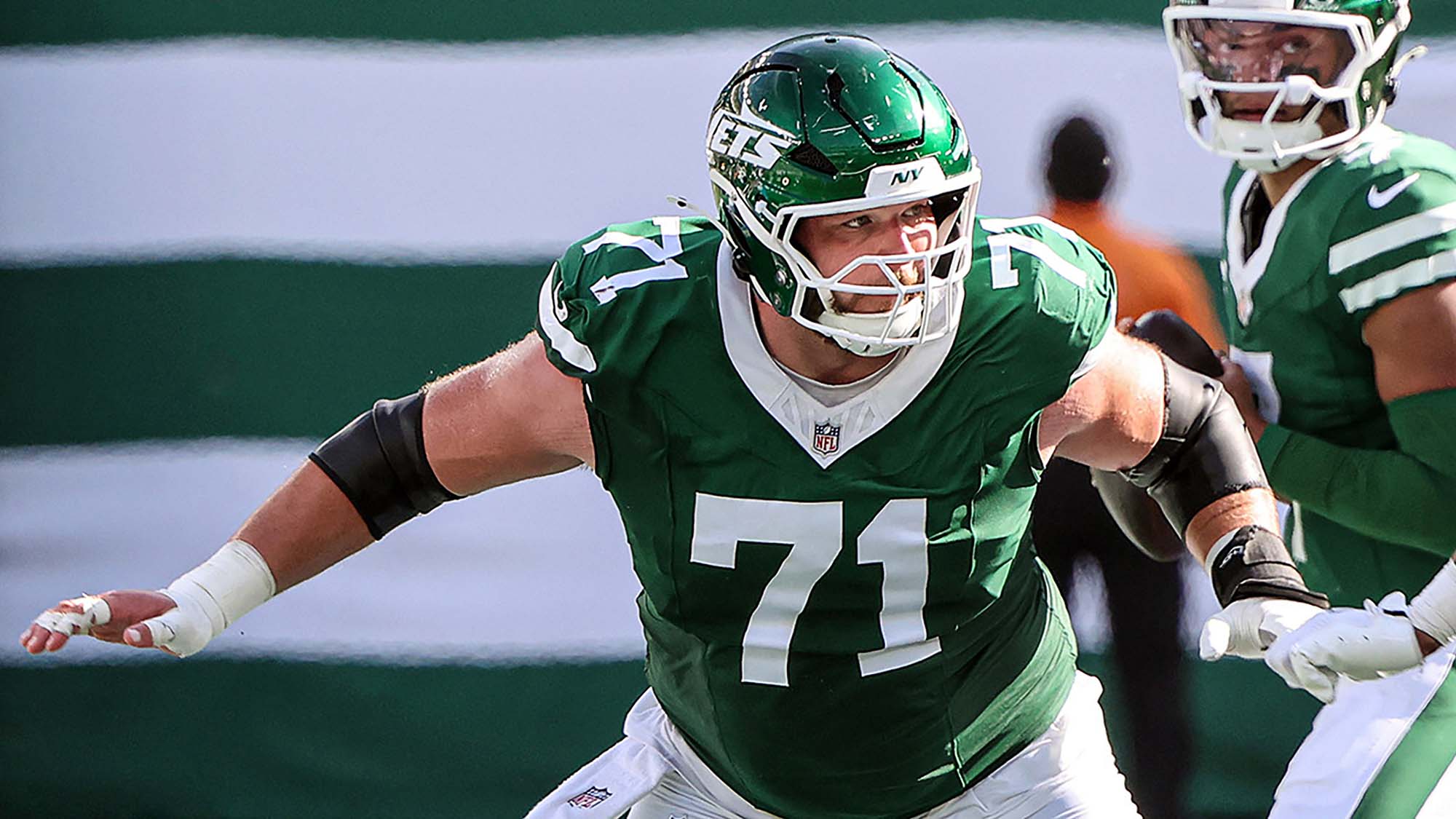
On Friday morning, it was reported by ESPN’s Adam Schefter that the New York Jets have re-signed center Josh Myers to a two-year, $11 million extension, tying him to the team through the 2027 season.
It’s the culmination of a steady rise for the former Green Bay Packers second-round pick, who was signed to a one-year, $3.5 million deal in March.
Expected by fans and media to be a backup, the Jets surprisingly engaged Myers in a competition for the Jets’ starting center job against Joe Tippmann, a former second-round pick who performed admirably as the team’s first-string center throughout the 2024 season. The Jets allowed the competition to drag deep into August, although Tippmann appeared to be the obvious winner after outplaying Myers in the preseason.
Before Jets head coach Aaron Glenn could announce an official victor, the decision was made for him. Right guard Alijah Vera-Tucker suffered a season-ending injury just before the regular season, forcing New York to move Tippmann over to right guard and promote Myers to the starting center role.
Since then, the Jets’ offensive line has emerged as the brightest silver lining from a mostly dismal season in New York. Myers is part of a five-man combination that has managed to start all 13 games together. Using their continuity as a buoy, the unit has steadily improved throughout the season, emerging as one of the league’s better units entering mid-December.
Myers, now 27 years old in his fifth NFL season, has been in the middle of the unit’s success. With Myers as their communicative leader, the Jets’ offensive line has achieved some positive rankings, including 15th in Pro Football Focus’ pass-blocking grade and 11th in ESPN’s run-block win rate.
Given the unit’s progress with Myers at center, the team elected to lock him down for the future before he could hit the open market. It’s a smart decision for a team that has not seen this type of continuity along the offensive front in ages.
However, that does not mean the Jets should pencil in Myers as their starting center going into 2026.
Why the Jets should push Josh Myers
The former 62nd overall pick started for the Packers across each of his first four seasons. He never lived up to his potential, though, consistently generating poor metrics relative to other starting centers. It’s why the Packers let him walk, and it’s also why he could only fetch a one-year, $3.5 million deal on the open market.
So far in 2025, Myers’ individual production has not changed much from his Green Bay days. The Jets offensive line’s success has been more in spite of him than because of him.
Myers is the weak link in the Jets’ offensive front. He owns a 53.6 overall grade at Pro Football Focus, which not only ranks last among the Jets’ starting offensive linemen, but places 30th out of 31 qualified centers.
While Myers is not the league’s worst starting center in either phase, his issue is that he does not offer a particular strength. Myers ranks 25th at his position in PFF’s pass-blocking grade (56.9) and 27th in run-blocking grade (56.5).
Despite his veteran status, Myers is quite mistake-prone. Among centers, he is tied for the third-most pressures allowed (25) and the third-most penalties (7*).
*-Myers officially has been credited with 5 penalties, but PFF properly tacks on two “everyone but the center” false starts, which are officially credited to one non-center player, but are actually the center’s fault in most cases.
Some metrics outside of PFF are fonder of Myers, particularly ESPN’s pass-block win rate, which has Myers ranked eighth-best at the position with a 96% mark. However, ESPN also lists Myers with an 82% double-team rate, one of the highest marks among centers, indicating that he requires a significant amount of help to prevent pressure.
Despite these weaknesses, re-signing Myers does make sense for the Jets. It’s a positive for the offensive line’s long-term potential to sustain the continuity they have built this year. Plus, depth is critical up front, and Myers has the talent level of a low-end starter, making him a high-quality backup. The Jets got him back on a fair price tag that properly reflects his value.
However, as the Jets seek to upgrade their long-suffering offense in any way possible, it would be complacent to settle for a starter of Myers’ talent level just for the sake of continuity. Myers isn’t a good starter—plain and simple. There is only so much talent that is worth giving back for intangible purposes, and Myers’ skill level falls below that bar.
Going into the 2026 offseason, the Jets shouldn’t cross the center position off their shopping list. Having Myers reduces their desperation for a center, but with such a gigantic surplus of assets, they must remain unsatisfied in their quest to raise the offense’s ceiling as high as possible.
If there is a free agent center whom the Jets love, or if there is any point within the first four rounds of the draft where a center is the Jets’ best player available, the Jets cannot allow Myers’ presence to dissuade them from adding the player. Myers is a valuable body to have around, but if the goal is to build the most explosive offense they can, they should add a center who can challenge Myers and potentially provide an upgrade.
After all, Aaron Glenn loves him a good competition, no matter who is involved. It was a minor shock to Jets fans when Glenn forced Tippmann into a competition with Myers. Tippmann had a second-round pedigree and was coming off a quality season as a 23-year-old starter, while Myers was an underwhelming veteran signed to a backup-caliber contract.
If the Jets weren’t going to let Tippmann cruise into the starting center job, there is no way they should let Myers have a free pass.
A smart move for now, but the final result depends on how they handle the position moving forward
Give the Jets credit for their re-signing of Myers. It’s proactive, it values the right things up front (continuity, depth, and durability), and the money is smart.
But the jury is out on the decision until we see how the Jets handle the center position in the offseason. The move will look great if the Jets add some legitimate competition for Myers. If they settle for him as their clear-cut starter, it could go down as a questionable evaluation of their own talent.
With talented, rapidly ascending young players like Tippmann, Olu Fashanu, and Armand Membou, the Jets’ offensive line has the potential to become one of the NFL’s best in 2026. However, as they often say, an offensive line is only as talented as its weakest link—and Myers is quite the weak link. Continuity is great, but not if it means settling for a poor starter.
Let’s be honest about the Jets’ 2025 offensive line: While it’s been solid, and comparatively amazing when stacked against the Jets’ mostly atrocious performance in other offensive areas, it is not close to its elite ceiling just yet. Most offensive line-focused metrics have the unit ranked outside of the top 10:
- PFF’s pass-blocking grade: 15th
- PFF’s run-blocking grade: 17th
- ESPN’s pass-block win rate: 26th
- ESPN’s run-block win rate: 11th
It stands to reason that Myers, the Jets’ lowest-rated starter, is a significant reason why the unit is “fine” instead of definitively “good”.
If the Jets want their offensive line to get as far as Fashanu, Tippmann, and Membou can take it, they’ll pursue an average-or-better center to overtake Myers.
That can be true while simultaneously praising the signing as a shrewd depth move at a reasonable price.
