

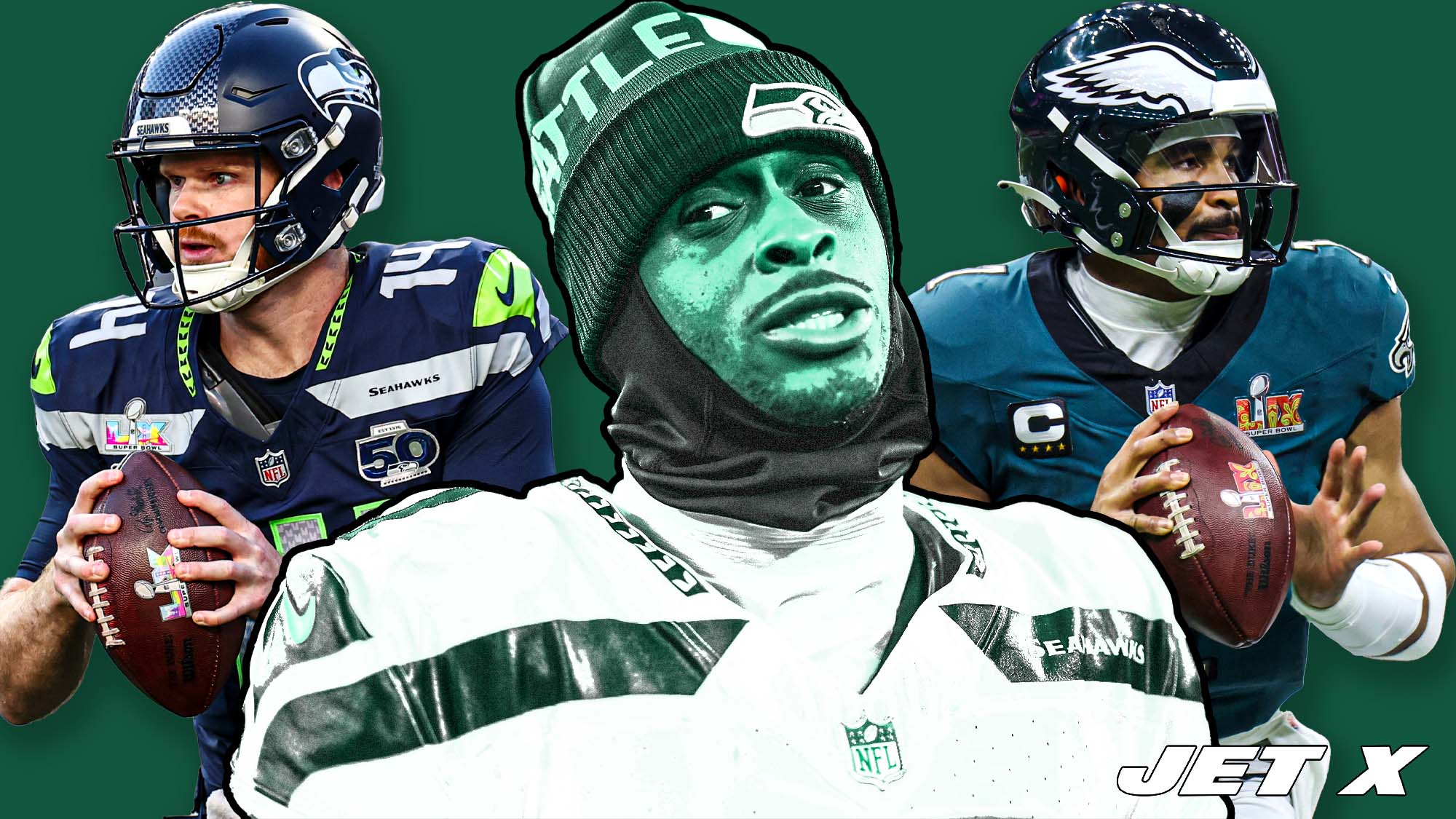
“They must tank for the 2026 season to be successful!”
It’s a common narrative about the New York Jets these days. Some of the Jets’ own fans have subscribed to it.
The fact of the matter is that it’s complete nonsense.
All you have to do to realize it is look at the last two teams to hoist the Vince Lombardi Trophy.
Perhaps some Jets fans missed those ceremonies, which would be understandable given that the last two Super Bowls were among the sleepiest in NFL history. But they surely know who won each of those games: the Philadelphia Eagles (2024) and the Seattle Seahawks (2025).
Who, exactly, were the quarterbacks of those teams? Given how critical it is for the Jets to tank, surely these championship-caliber squads were led by a generational quarterback prospect whom the team chose first overall, right?
Not exactly.
The reigning champion Seahawks were led by Sam Darnold, a journeyman who can be classified as a mid-tier free agent signing by Seattle. Darnold joined the Seahawks in 2025 on a three-year, $100.5 million contract, which currently makes him the NFL’s 15th-highest paid quarterback based on average annual salary ($33.5 million).
The 2024 champion Eagles were led by Jalen Hurts, a second-round pick of Philadelphia in the 2020 draft.
Neither of these teams had to tank to acquire the quarterback who ultimately led them to the promised land.
Now, that is not to say that Geno Smith is the guy who will lead the Jets to the promised land, as Aaron Glenn guaranteed. But haven’t the Seahawks and Eagles provided Jets fans with enough evidence to understand that tanking for a highly drafted quarterback prospect is unnecessary to win a Super Bowl in today’s NFL?
At the bare minimum, a “good” starting quarterback is necessary to win a Super Bowl—that much is indisputable. However, the idea that a future Hall-of-Famer is required has become outdated.
Darnold and Hurts have now combined to win two more Super Bowls than the following quarterbacks combined: Lamar Jackson, Josh Allen, and Joe Burrow. That trio has combined for four MVP awards and 10 top-five finishes in MVP voting, compared to Darnold and Hurts’ zero MVPs and one top-five finish in MVP voting.
It is true that the better your quarterback is, the better your odds are of winning the Super Bowl—especially as it pertains to staying consistently competitive over a long-term span. The point is not that the Jets shouldn’t strive to find the best possible franchise quarterback, nor that settling for an average starter is acceptable.
Rather, the point is that New York does not require another season full of losses to push the franchise forward, all just for the sake of landing that shiny, prized quarterback with the first overall pick.
The Jets have been down this road in recent years. Darnold himself was in their hands. They chose Zach Wilson second overall.
Neither player panned out. There are a multitude of reasons for both players’ failures—some overlapping, some not—but it shows that no highly drafted quarterback is a guarantee to pan out.
It also shows that the odds of a highly drafted quarterback panning out are bound to be much lower if they are thrown into a situation where they are expected to save the franchise.
The Jets expected precisely that of both Darnold and Wilson. Both quarterbacks were thrown into losing cultures with suboptimal weapons, porous offensive lines, and carousels of clueless coaches. It caused both youngsters to endure treacherous runs over the first two years of their careers, inflicting scars that neither could grow out of during their time in New York.
Darnold eventually overcame those scars, although it took him many years, many teams, and many coaches to do so. Wilson simply might not be cut out for the NFL and probably would have flopped anywhere.
Nonetheless, the Jets must learn that it is essential to build a winning program first and foremost. Praying to land a savior in the draft is not a reliable way to go.
It’s a path that has worked for some teams, but far more have selected quarterbacks high in the draft and found themselves right back in the same spot a few years later. Every time it happens, it is because they relied on that quarterback to save them, only for him to prove unable to do so, exposing that the rest of the franchise remained unchanged.
The quarterback is the most important piece of any football team, but he is never the only piece. That’s what the “pro-tank” crowd tends to miss when talking about the Jets’ best-case scenario for the 2026 season.
New York has not made the playoffs since 2010 or even won more than seven games since 2015. A losing mindset has deeply embedded itself within the fabric of the organization. When you put on a Jets jersey, coming up short is the expectation every time you step on the field, and it’s become acceptable after a decade and a half of it.
Veteran defensive tackle Harrison Phillips recognized this culture after just a few months in the building. He described it in great detail at Radio Row in February.
“I think [Aaron Glenn] inherited a very cancerous, truculent group — whole, top to bottom. … It’s not individual people’s fault. I was there for one season — it was a very difficult season — and I almost wanted to waver on some of my thoughts and my beliefs and my optimism. So, I can’t imagine being there for year after year after year after year and not seeing the results that you wanted, and it tainted people.
“[Players get distracted] because my coach is going to get fired, my teammate’s going to get fired, I’m going to be a free agent, I might get fired, I have to play for me, I have to make sure my tape is hot regardless of what the system is asking me to do, what the scheme is telling me to do. Then, young players come in and see, ‘Oh, that’s my vet, that’s how they’re acting, so that’s the way I’m going to act, too.’ It’s a long chain of things and it can’t be fixed like that.”
That mindset will never change until the Jets win some darn football games.
It’s not going to change instantaneously because Peyton and Eli Manning’s nephew brings a famous last name to Florham Park, or because LaNorris Sellers runs really fast in shorts to rack up 15,000 likes on an Instagram clip in August.
Think back to the last quarterback that the Jets aggressively tanked for, Trevor Lawrence.
Today, Lawrence’s stock is high. He led the Jaguars to 13 wins last season and is viewed by many as a fringe top-10 quarterback going into 2026. Undoubtedly, he is lightyears better than Zach Wilson.
But Lawrence was never able to reach this form until the Jaguars allowed him to. He did not change the franchise’s outlook until the franchise changed his.
For four years, Lawrence did little to alter the perception of the Jaguars. Poor coaching and shoddy roster management had Lawrence looking like a comfortably below-average quarterback across the first four years of his career, with Jacksonville going 22-38 in his starts, to boot.
Then, in comes head coach Liam Coen, and, boom, everything changes overnight. With one of the game’s top play-callers setting the table for him, Lawrence suddenly has his best season. Now he is the best thing sliced bread.
It raises a deeper point about the quarterback conversation in today’s NFL: The quarterback position is arguably less valuable than ever.
That is not to say that it isn’t important anymore. It’s still the game’s most important position. The gap between it and the rest of the positions, though, may be smaller than it used to be.
Coaches and supporting casts are gradually taking up more control of pass-game efficiency. Signal-callers are becoming increasingly dependent on external factors to succeed, which diminishes the value of having the most gifted players and emphasizes the importance of simply having the right fit.
Gone are the days when the same quarterbacks (the most talented ones) dominated every year to nearly the same degree. Nowadays, each season, there are surprising stars who come out of nowhere upon joining the right system (Darnold and Daniel Jones being the best examples in 2025), and surprising fallers who seemingly forgot how to play football once their supporting cast fell apart.
More than ever, quarterbacks are essentially becoming bus drivers. Sure, they are the one who gets everyone to the hopeful destination, but they’re just riding along a pre-determined route. They aren’t doing anything that someone with similar experience cannot replicate if put in the same position.
This is an extreme generalization—obviously, there is still a gap between the Patrick Mahomeses of the world and the Sam Darnolds of the world, as well as the Sam Darnolds and the Jacoby Brissetts.
But in a universe that has seen a second-round quarterback and a mid-tier free agent quarterback win the last two Super Bowls, while the “alien” trio of Josh Allen, Lamar Jackson, and Joe Burrow remains ring-less (two of them having failed to even make an appearance)… It’s time to heed the message being sent:
You do not need a superstar quarterback to win a Super Bowl anymore.
Does it help? Yes!
Is it the ideal way to stockpile bites at the apple over a decade-plus? Yes!
So, of course, the Jets, and every NFL team, should strive for their Allen, Jackson, or Burrow.
But to pretend that having an Allen, Jackson, or Burrow is so imperative to winning a Super Bowl that it is worth tanking an entire season is an extreme overexaggeration, one that ignores the trends we’ve seen in the NFL over the last few years.
Geno Smith isn’t going to win a Super Bowl for the Jets; that is not the point here. New York still needs to find that guy, whether it’s Cade Klubnik, their 2026 first-round pick, a 2026 second-round pick, or a free agent/trade acquisition who hasn’t emerged as a possibility yet.
Don’t forget that the Jets have three first-round picks in 2026, which will give them plenty of flexibility to climb the board and get their guy and what is expected to be a deep quarterback class. Stockpiling losses is not necessary for them to land a premium quarterback prospect in 2026.
In the meantime, while New York searches for their next hopeful franchise quarterback, what matters is that Smith is good enough to help the Jets compete for a playoff spot in 2026. In three of the last four seasons, he played like an above-average starting quarterback and led his team to an above-.500 record.
That level of football might sound unappealing to the segment of Jets fans who are so accustomed to losing that they are willing to put up with a few more years of it if the end result is something immaculate. Mediocrity might not be enough to satiate them after all this time, even if it represents a major leap for a team as down on its luck as the Jets.
But what those fans need to understand is that a “mediocre” season—7 competitive wins, 8 wins, 9 wins, one-and-done in the playoffs, however you want to quantify it—can be a stepping stone to that immaculate football they’ve been dreaming about.
You do not have to go all the way to the bottom and draft Andrew Luck to turn your franchise around. It is possible for a middle-of-the-pack season with a bridge quarterback to be the, well, bridge that carries the team to its intended destination.
After all, Smith himself played that role for Seattle.
After the Russell Wilson era fizzled out with a 7-10 season in 2021, it seemed like the Seahawks were headed into the dumpster. But it was Smith’s competency that kept them at wild-card level instead of bottoming out.
For three years, the team’s sustained 9-10-win play was frustrating for many Seahawks fans, who didn’t see a path to Seattle pushing their ceiling any higher. They felt “stuck”. This is the position where many NFL fans would prefer to see their team tank, similar to the Steelers’ predicament over the last few years. It’s what the current segment of pro-tank Jets fans fears will happen with Smith.
But the 2025 season validated the Seahawks’ decision to keep pushing for wins with Smith from 2022-24 instead of tanking. Because Smith helped them stay in the playoff hunt, the Seahawks had enough confidence in their core and coaching staff to continue building it. Then, once they found the right fit at quarterback in Darnold and added a few finishing touches to their roster, they were ready to go win a Super Bowl in 2025.
Thanks to the Smith years, Seattle did not require a meteroic leap to become a championship contender. They had already chained together three consecutive winning seasons. Simply with a better fit at quarterback (not a megastar addition; just a similarly accomplished player to Smith who fit their scheme better) and a handful of upgrades, they improved from a wild card-caliber team to a Super Bowl-caliber team.
That leap wouldn’t have been possible if the Seahawks had committed to tanking. They would have sold off many of the core players who ended up anchoring their championship run. The hope would be that the returning picks would help get them to championship level, but with no remaining talent on the roster, they’d have to start from the ground up, with no supporting cast to aid the young quarterback they’d hitch their wagon to.
That is precisely why there is value to committing to the pursuit of wins, even if the short-term ceiling is below Super Bowl-caliber. It keeps you on the doorstep of title contention. And if you keep banging on the door, eventually, you might kick it down.
The Jets can finally put themselves on that doorstep with the roster they have assembled and the quarterback they have under center.
Getting to that doorstep in 2026 would be a hell of a lot more valuable than perpetuating their losing culture and finding out that their coaching staff, front office, and roster are still No. 1 pick-caliber after two seasons of building, all in hopes of landing a pimple-faced college kid who would have no chance of turning around the dysfunctional billion-dollar organization that was awful enough to secure his services.
Winning, not losing, is what will cure the Jets’ ills in 2026.
What a novel concept.
