

The New York Jets seemingly had a chance to finally address one of their biggest offensive needs: center.
That opportunity came and went. Shortly after it was reported that free agent center Ethan Pocic would be ready for training camp, Pocic signed with the Baltimore Ravens on a one-year deal worth up to $4.5 million.
We don’t know whether Pocic had any interest in the Jets or vice versa, so the “opportunity” may have never actually existed. Nonetheless, Pocic’s exit from the market sheds a glaring spotlight on a major weakness that the Jets will have to navigate in 2026 after neglecting it in the offseason.
Pocic, who is coming off an Achilles injury, has been a solid starter for the Cleveland Browns over the past few seasons. At the very least, he could have provided the Jets with competition and an upgrade to their second-string unit. At best, he could have been a significant upgrade in the starting lineup.
With Pocic gone, the free agent center market is barren once again. Now, the Jets are set to enter 2026 with one of the weakest center groups in the NFL.
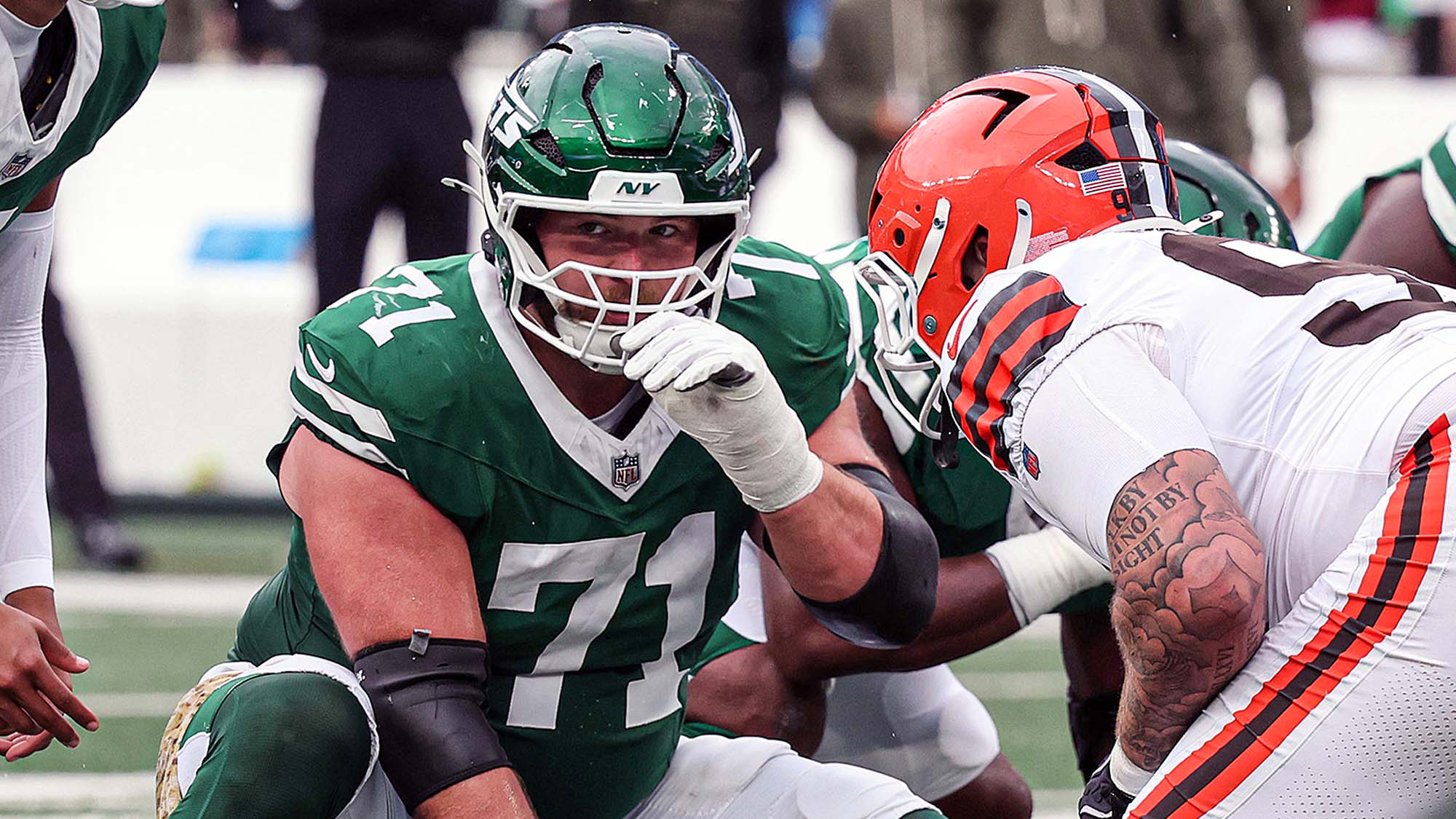
Starter Josh Myers has been one of the league’s lower-end starters over the past four years, and nothing changed in 2025 after he joined the team on a one-year, $2 million contract to be their backup. Across 17 starts, Myers ranked 33rd out of 34 qualified centers in Pro Football Focus’ overall grade (52.9). His 51.7 run-blocking grade was the third-worst, his 28 pressures allowed were the third-most, and his five penalties were tied for the most.
Backing up Myers is Xavier Newman, who has never started an NFL game at center. Across four NFL seasons, he has played 36 snaps at the position, all coming in a 2023 game against the Giants, in which he allowed five pressures and posted a 28.5 pass-blocking grade at PFF.
This… is bleak.
It’s bleak enough to potentially sink an otherwise promising offensive line, one loaded with ascending young players at the other four starting spots.
Why, exactly, did the Jets take such a complacent approach at one of the offensive positions where they had some of the most room to grow?
Let’s examine the road to this point.
Does continuity explain everything?
The Jets’ Week 1 starting offensive line managed to stay in one piece for all 17 games, a rare feat in the NFL.
While they replaced left guard John Simpson with Dylan Parham, the other four starters are set to return. Given how many snaps they played together last season, the Jets’ starting five has an opportunity to walk into Nashville with some of the best continuity of any offensive line in the league.
It’s understandable if the Jets’ decision to run it back with Myers is rooted in their valuation of continuity. Communication and chemistry are critical aspects of offensive line play, and those things become much easier to develop when a group of guys gets the chance to gel over multiple seasons.
New York chose to extend Myers before the 2025 season ended, inking him to a two-year, $11 million deal with $6.2 million guaranteed in mid-December. Considering that the starting five had logged 14 starts together at that point, the Jets may have already been thinking ahead about their plan to focus on continuity with the offensive line.
If this is the Jets’ plan, it does have some merit. There is nothing wrong with prioritizing continuity at the most interconnected position in the sport.
However, continuity should only override talent to a certain extent.
Myers has proven for four straight years that he has the talent of a fringe starter/backup. The Jets themselves admitted this when they valued him at a one-year, $2 million deal on the 2025 free agent market. That’s not the type of player you should willingly commit to as a starter, especially when you are loaded with draft picks and cap space to at least add a competitor, if not a surefire upgrade.
The continuity argument also doesn’t address the second-string issue. Newman is as unreliable a backup center as there is in the NFL.
New York’s crisis at center is not just about Myers; it’s also about depth. Forget about a potential starter for a moment; the Jets have not added a single center this offseason, despite facing the possibility of Newman starting games for them if Myers goes down. No, not even a random undrafted free agent or scrapheap pickup that you overlooked.
That’s where the continuity argument falls apart. Even if the Jets find continuity appealing, there was truly no justification for not at least adding a center who can be an upgrade over Newman in the backup spot while pushing Myers in training camp.
The Jets had plenty of chances to target the position in the draft, as 11 pure centers were selected. That includes eight on Day 3, when the Jets made four draft picks and entered the day with five.
Even in free agency, there were multiple veterans with extensive starting experience who signed for modest contracts, including Lloyd Cushenberry (80 starts, $1.3M guaranteed), Luke Fortner (44 starts, $1.3M guaranteed), and Matt Hennessy (24 starts, $1.3M guaranteed). These guys would at least be upgrades in the backup role, while each being decent enough to give Myers a run for his money.
Nobody is claiming that the Jets should have used a first-round pick on a center, or splurged on a star like Tyler Linderbaum. They have invested enough in the other offensive line positions that they do not need a star center for the unit to thrive.
But they do need someone competent at center to avoid dragging down the rest of the unit. Right now, they don’t have that.
Is continuity enough to override Myers’ lack of individual talent?
The Jets seem to think so, but that theory will be put to the test.
Even worse, though, is the reality that they are one injury away from having a practice-squad-level center snapping the ball.
General manager Darren Mougey has displayed a sound process throughout the 2026 offseason thus far, but his total neglect of the center position is difficult to fathom.
