

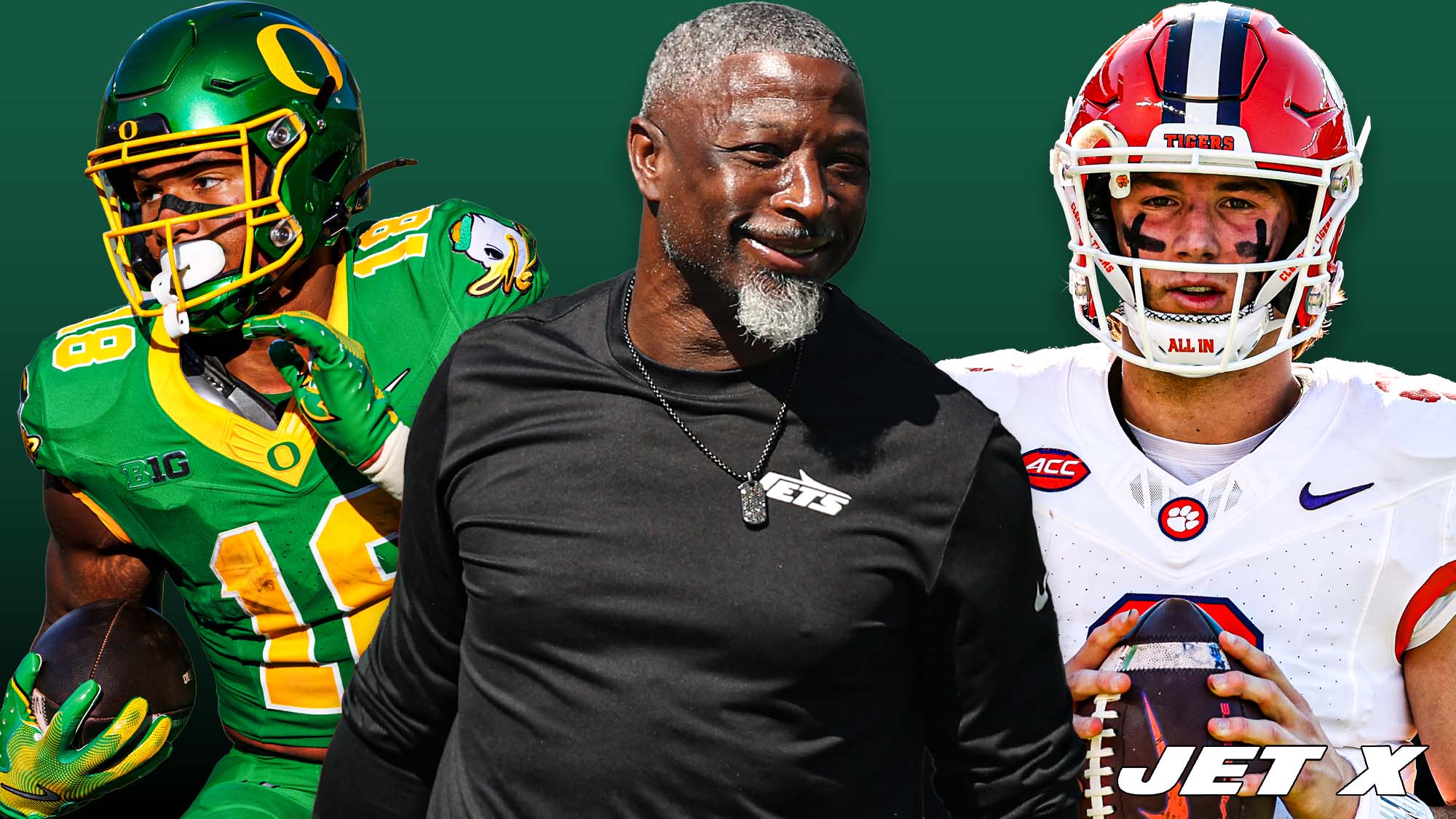
The New York Jets reported for training camp today, and on Wednesday, they will hold their first practice as they prepare for the 2026 season.
Here are 10 of the most intriguing storylines to track as things unfold over the next month.
1. Aaron Glenn’s new operation
The Jets chose to run it back with Aaron Glenn despite a 3-14 season and a -203 point differential. But it wasn’t without sweeping changes.
Nearly the entire coaching staff under Glenn has been revamped. On top of that, Glenn is taking over defensive play-calling after delegating those duties to Steve Wilks in his debut season.
Will the Jets’ culture and day-to-day operations have a different feel in Glenn’s second season? Will we see signs that Glenn is making a concerted effort to address the concerns that sank his first campaign?
All eyes are on Glenn as he enters a season that will find him sitting on a warm seat as soon as the season opener kicks off.
2. The QB2 battle
The Jets are optimistic about the upside of fourth-round rookie quarterback Cade Klubnik, but it’s always wise to be patient with the development of a young signal-caller, especially one chosen on Day 3.
For that reason, Bailey Zappe is the Jets’ current penciled-in backup to Geno Smith. However, for roster-construction reasons, New York would much rather have Klubnik win the QB2 spot so they can keep two quarterbacks and dedicate Zappe’s roster spot to another position.
Glenn stated that Klubnik will have a fair chance to win the backup quarterback spot. The Jets would love for it to happen, but they won’t force it if Klubnik isn’t ready.
3. The rookies’ instant impact
New York is poised to be one of the NFL’s top teams in rookie snaps this season. The Jets chose four players in the top 50, and all four have a chance to be Week 1 starters.
NFL draft classes should not be judged until 4-5 years pass, but the Jets are placing an unusually heavy burden on their rookie class to anchor their short-term success. It is possible that, in Week 1, the Jets’ rookie class will feature:
- 2 of the team’s top 3 pass-game targets (Kenyon Sadiq, Omar Cooper Jr.)
- The team’s most heavily utilized pass rusher (David Bailey)
- The team’s starting slot cornerback (D’Angelo Ponds)
That is a lot of pressure to place on a rookie class. It could pay dividends in the long run, as these reps could prove valuable in each player’s development, but it certainly gives the Jets a low floor going into 2026.
Will the rookies use training camp to prove they are ready for the bright lights? Or will the Jets regret not adding more veterans who could hold the fort down in case the young pups are too green?
4. Development of second and third-year players
The rookie class will attract the most attention, but it is equally important that the Jets’ second and third-year players begin coming into their own.
Rookies aren’t expected to do much in the NFL. It’s not until later that teams expect players to start developing into core building blocks.
That means now is the time for players like Armand Membou, Mason Taylor, Azareye’h Thomas, Arian Smith, Malachi Moore, Francisco Mauigoa, Olu Fashanu, Braelon Allen, Isaiah Davis, and Qwan’tez Stiggers to begin their primes and prove themselves as valuable pieces of the Jets’ long-term vision.
Who will emerge as the Jets’ breakout stars of camp?
5. Run defense on the edge
The Jets are one of the few NFL teams with two edge rushers who have perennial double-digit sack potential.
David Bailey and Will McDonald both have sky-high ceilings as pass rushers. Both players, though, must prove themselves in the run game to reach their ceilings as football players.
McDonald’s shortcomings in the run game have limited his overall impact. They could also limit his snap count in 2026, especially with the Jets having added two solid edge-setters in free agency, Kingsley Enagbare and Joseph Ossai. If McDonald wants to get enough snaps to rack up 10-plus sacks, he must prove he can stop the run well enough to retain a starting role.
Bailey’s pass-rush ceiling was special enough to make him the second overall pick despite clear issues in the run game. For Bailey to earn a starting role from Day 1, he must also show that he won’t be sieve against the run.
6. The underdog stories
There is always a handful of unknown players, particularly undrafted rookies, who make their mark and build a strong case for a roster spot. Some of these players may turn out to be contributors.
This year, the Jets leaned heavily toward the offensive side of the ball with their UDFA class. They have nine offensive UDFAs and four defensive UDFAs, plus a long snapper.
Many of those offensive UDFAs play positions where the Jets lack quality depth. They have a whopping total of four wide receivers: Malik McClain, Caullin Lacy, Jalen Walthall, and DT Sheffield. With the only secure spot on the wide receiver depth chart being Garrett Wilson’s hold on the No. 1 role, the path is open for anybody to push their way up.
The Jets also have two UDFA offensive linemen, tackle Courtland Ford and guard Xavier Hill. With offensive line depth being a significant concern, particularly on the interior, either player has a chance to crack the roster if they shine in camp, especially Hill.
7. The progressing offensive line
The Jets’ offensive line took a big step forward in 2025, improving to around league-average after years of futility.
In 2026, the unit is expected to keep climbing. Three of the five players are aged 25-and-under with strong draft pedigrees. Left guard Dylan Parham was signed to replace John Simpson, and the hope is that the younger Parham can be an upgrade after he had a better statistical season than Simpson in 2025.
The only liability on the unit is center Josh Myers, but his return at least creates a semblance of continuity and chemistry for the unit, which started the same five players in all 17 games last year. Four of those five players are back.
Most Jets training camps feature an endless stream of reports about the defensive line blowing up the offensive line on a play-by-play basis. Perhaps this is the camp when that changes.
8. The wide receiver battle
As we alluded to in the UDFA section, the Jets’ wide receiver depth chart is wide open. Outside of Garrett Wilson being the top dog, every spot is up for grabs.
Will Adonai Mitchell prove worthy of the WR2 spot? Or will first-round rookie Omar Cooper Jr. show that he is immediately ready to step into those shoes?
Could 2025 fourth-round pick Arian Smith emerge as a legitimate deep threat, or is he a lost cause who will leave the door open for one of the UDFAs to take his roster spot?
Where does veteran Tim Patrick fit into the picture?
Anything can happen at that position.
9. Kenyon Sadiq’s technique
No player on the Jets’ roster will command more attention in a training camp setting than Kenyon Sadiq, a world-class athlete who has a case to be the most athletic tight end to ever step on an NFL field.
We haven’t seen someone quite like Sadiq, and that will shine brightly when he’s wearing shorts in a no-contact practice. At 6-foot-3 and 241 pounds, he ran a 4.39 in the forty while posting a 43.5-inch vertical jump and a 133-inch broad jump. The man is an alien at the tight end position.
Surely, Sadiq will look unreal in a practice setting, but the Jets will be focused on the finer points of his game. Sadiq’s hands, route running, and blocking technique all need improvement based on what he showed on his Oregon tape. He must improve in those areas for his athletic traits to translate to any sort of on-field success in an NFL regular season game.
As awe-inspiring as Sadiq will look as he catches-and-runs through arm tackles over the next month, keep a closer eye on the minutiae of his technique if you really want to know where he stands in his development.
10. The vibes
Does this Jets team really believe in itself?
Do things feel differently than they did last year?
The vibes at training camp should tell us a lot about where the Jets are headed—not just in 2026, but in the long-term under Aaron Glenn.
This is a franchise that has become accustomed to losing. In Florham Park, failing is acceptable. This standard has been established for 15 years now.
That won’t change in a matter of one training camp. But it will be fascinating to see whether the organization as a whole can use the next month to communicate to fans that things are different—or, at least, that the organization is trying to make things different through its actions and how it runs football operations, rather than merely speaking about it.
Will physicality be ramped up? Will the offense be run with a more modern strategic approach? Will dramatic sagas and unnecessary press-conference quotes be kept to a minimum? Will high-ranking players be held accountable? Will unheralded players who shine be rewarded? Will favoritism toward veterans or premium investments be avoided? Will creative experimentation occur, or will the operation feel outdated?
These are just a few ways the Jets can project the vibe of a maturing, confident organization headed in the right direction.
Ultimately, fans are justified to avoid buying back in until the team actually wins some football games—they’ve bought into training camp hype too many times to be swayed by what happens in Florham Park over the next month. Still, for a franchise whose culture has descended so incredibly deep into the doldrums, it would be valuable to show off a month of positive cultural progress as opposed to the alternative: a month of “Jetsy” drama.
The former doesn’t guarantee success, but the latter all but guarantees failure. Jets fans certainly don’t need that after all they’ve been through. Even the smallest droplet of hope is all they need to feel satiated going into Week 1, and it’s imperative for the entire organization to play its part in producing that hope over the next month.
