

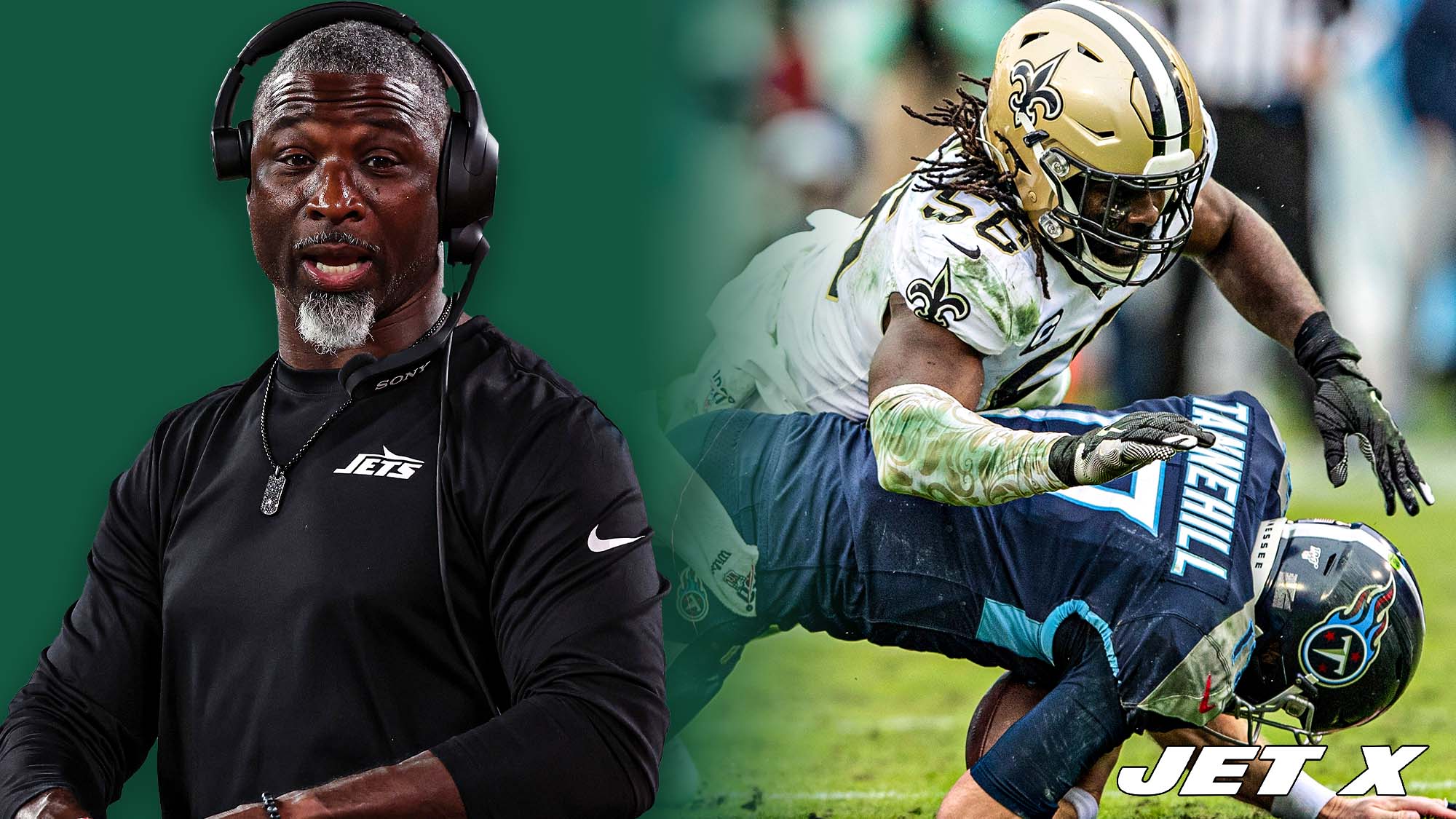
When describing the identity of an NFL defense, blitz rate is one of the first things that comes up. Some defenses love to bring the heat as much as they can. Other defenses are content to sit back and trust their four-man rush to get home.
New York Jets head coach Aaron Glenn is taking over the team’s defensive play-calling in 2026 after handing it off to defensive coordinator Steve Wilks in 2025. Much more so than last year, Glenn’s defensive scheming and play-calling will be put under the microscope, especially after an offseason in which the team spent significant capital to build the roster in Glenn’s image.
So, the question is, what will the Jets’ blitz rate look like in 2026? Should Jets fans expect Glenn to bring back the Rex Ryan days, which were defined by constant blitzing? Will Glenn harken back to the Robert Saleh days, where blitzes only came once in a blue moon? Or will he strike a balance?
Let’s examine Glenn’s historical tendencies as a play-caller and the makeup of the Jets’ roster to understand what type of blitzing approach makes the most sense for the team in 2026.
Aaron Glenn’s blitz rate tendencies
During his time as the Lions’ defensive coordinator, Glenn certainly leaned toward the blitz-heavy end of the spectrum. Detroit ranked no lower than 11th in blitz rate across Glenn’s four seasons at the helm.
Here are the Lions’ rankings in blitz rate from 2021-24, according to Pro Football Reference:
- 2021: 27.3%, 9th
- 2022: 31.2%, 7th
- 2023: 28.7%, 11th
- 2024: 34.6%, 2nd
The most notable takeaway here is that the Lions’ best defensive season under Glenn also happened to be the one where they blitzed the most.
Detroit’s defense struggled in Glenn’s first two seasons, ranking 29th and 27th in defensive DVOA. They ascended to 13th in 2023 and took another leap into the elite ranks in 2024, finishing fifth. That year, they blitzed on 34.6% of opponent pass plays, ranking second-highest in the NFL behind only Brian Flores’ Minnesota Vikings (38.9%).
The Lions’ blitz spike in 2024 is easily explainable. Detroit dealt with some major injuries up front, prompting Glenn to compensate with the blitz.
Superstar edge rusher Aidan Hutchinson played only five games. Nagging injuries constantly affected the rest of the defensive line; there was not a single defensive lineman on Detroit’s roster who played all 17 games. No Lions player ranked higher than 69th among defensive linemen in total snaps played.
As a result, Glenn looked for pass rush production from other places, and he was successful in doing so. Detroit’s linebackers and safeties picked up the slack in a big way, combining for 61 total pressures, 9.0 sacks, and 28 quarterback hits. That’s essentially re-creating a high-level edge rusher in the aggregate.
Overall, it appears that Glenn preferred a high blitz rate in Detroit, but avoided the upper echelon until injuries forced his hand. When those injuries came, though, Glenn was willing to adapt, sending more blitzes than all but one team. Not only that, but those blitzes anchored an extremely successful unit. The Lions were a top-five defense based on DVOA despite having their best player for only five games.
Given Detroit’s success with a lofty blitz rate in 2024, it stands to reason that Glenn may be inclined to try bringing that strategy back to the Jets in 2026.
With Wilks running the show, the Jets deployed a lower blitz rate in 2025 than the Lions did in any of their four seasons under Glenn. New York blitzed 25.8% of the time, ranking 12th in the NFL. So, they were still in the top half, but below Glenn’s Detroit floor, and nowhere close to his ceiling.
Based on Glenn’s track record from Detroit, there seems to be a good chance that we will see the Jets’ blitz rate climb well into the top 10 in 2026.
Do they have the roster to support that style of play?
Let’s examine the career blitz production of the Jets’ linebackers and defensive backs.
Blitz effectiveness of Jets’ roster
Linebackers
For reference, here are the 2025 NFL league averages for off-ball linebackers in a few pass rushing categories:
- Pressure rate (percentage of pass rush snaps resulting in a sack, hit, or hurry): 18.3%
- Sack rate (percentage of pass rush snaps resulting in a sack): 2.9%
- Pressure-to-sack rate (percentage of pressures resulting in a sack): 16.1%
Here are the career NFL averages of the Jets’ linebackers in these categories.
Pressure rate:
- Jamien Sherwood: 21.2%
- 2025 NFL average: 18.3%
- Demario Davis: 18.0%
- Mykal Walker: 9.7%
- Francisco Mauigoa: 6.3%
Sack rate:
- Jamien Sherwood: 4.2%
- Demario Davis: 3.4%
- 2025 NFL average: 2.9%
- Mykal Walker: 0.6%
- Francisco Mauigoa: 0.0%
Pressure-to-sack rate:
- Jamien Sherwood: 20.0%
- Demario Davis: 19.0%
- 2025 NFL average: 16.1%
- Mykal Walker: 5.9%
- Francisco Mauigoa: 0.0%
There are some promising numbers here for Glenn. Both of his starting linebackers have excelled in their career at turning blitz opportunities into sacks. Jamien Sherwood and Demario Davis are comfortably above average in terms of sack rate and pressure-to-sack rate.
However, Davis appears to be falling off when it comes to producing sacks. After back-to-back seasons of 6.5 sacks in 2022 and 2023, he dropped to 2.0 sacks in 2024 and just 0.5 sacks in 2025.
The silver lining is that Davis’ pressure rate was still solid in 2025 (18.6%, above both his career average and the NFL average), but he seems to be getting worse at turning his pressures into sacks, which isn’t surprising for a player of his age.
Sherwood, though, appears to be a valuable piece in the blitz department. An athletic linebacker who converted from safety out of college, Sherwood closes ground quickly, which allows him to rack up both pressures and sacks at a high rate. Perhaps playing in a defense that lets him blitz more often will help Sherwood have a bounce-back season in 2026.
The concern is the depth behind the starters. Neither Mykal Walker nor Francisco Mauigoa has shown any promise as a blitzer thus far in their NFL careers.
Safeties/Cornerbacks
For reference, here are the 2025 NFL league averages for safeties in a few pass rushing categories:
- Pressure rate (percentage of pass rush snaps resulting in a sack, hit, or hurry): 22.9%
- Sack rate (percentage of pass rush snaps resulting in a sack): 4.1%
- Pressure-to-sack rate (percentage of pressures resulting in a sack): 17.8%
Here are the career NFL averages of the Jets’ safeties in these categories.
Pressure rate:
- 2025 NFL average: 22.8%
- Dane Belton: 17.9%
- Minkah Fitzpatrick: 17.2%
- Malachi Moore: 6.7%
- Andre Cisco: 3.4%
Sack rate:
- 2025 NFL average: 4.1%
- Dane Belton: 3.8%
- Andre Cisco: 3.4%
- Minkah Fitzpatrick: 1.0%
- Malachi Moore: 0.0%
Pressure-to-sack rate:
- Andre Cisco: 100.0%
- Dane Belton: 21.4%
- 2025 NFL average: 17.8%
- Minkah Fitzpatrick: 5.9%
- Malachi Moore: 0.0%
These are some concerning numbers for Glenn, considering how much he counted on his safeties to contribute as blitzers in 2024.
That year, the Lions’ safeties combined for 17 total pressures. Meanwhile, the Jets’ safety quartet of Fitzpatrick, Belton, Moore, and Cisco has combined for 34 total pressures in their 18 combined NFL seasons. That’s about two pressures per season for each player.
None of the Jets’ four safeties has a career pressure rate close to the league average for safeties. Belton and Cisco are nearly average at finishing sacks (Cisco has only two pressures in his five-year career, and both were sacks), but that’s about all you can say.
It’s worth noting that Glenn did not like to send his cornerbacks too often in Detroit. Back in 2024, the Lions’ cornerbacks combined for just 18 pass-rush snaps over the entire season. That’s one blitz per game from the cornerback position. Comparatively, the safeties had 48 pass-rush snaps, nearly three blitzes per game.
As for that one pass-rush snap per game from the cornerback spot, though, D’Angelo Ponds is a great candidate to take them on. In 2024, it was the Lions’ slot corner, Amik Robertson, who accounted for 15 of the 18 pass-rush snaps at cornerback. Ponds is the favorite to start in the slot for New York, so he is on track to get about one chance to hit the quarterback each game.
Ponds had six pressures on 33 pass-rush snaps in his college career (18.2% pressure rate).
Takeaways
Glenn’s work in Detroit suggests that he would probably like to use a high blitz rate in 2026. His blitz rate was consistently above average, and it was never higher than it was during his best season as an NFL coach. Thus, it stands to reason that he would probably want to pump up the Jets’ blitz rate after a season in which Wilks coached them to a lower blitz rate than any of Glenn’s Lions teams.
However, it is slightly concerning that the Jets do not seem to have an outstanding lineup of blitzers.
Outside of the athletic Jamien Sherwood, none of the Jets’ other linebackers and safeties will enter the 2026 season with a promising track record in the pass-rush department. Demario Davis still knows how to get pressure at a league-average rate, but his ability to finish sacks has fallen off. At safety, the Jets don’t have any speed demons who have proven they can get into the backfield and take down quaterbacks.
Should this stop Glenn from trying to blitz at a high rate, though?
I would argue that the answer is no, at least to start out.
Glenn is taking over play-calling because he and the Jets believe that it is the best way for him to make an impact as a head coach. It’s an understandable course of action after Glenn’s attempt at a CEO-style approach led the Jets to a 3-14 season and the worst December point differential in NFL history.
After all, Glenn’s defensive strategy and play-calling in Detroit is what landed him this job in the first place. So, it makes sense that he should be putting it to use.
And what did Glenn do more than almost any other NFL coach in the breakout season that vaulted him to a head coaching job?
Blitz.
The best Glenn-led defense blitzed at the second-highest rate in the NFL. That year, Glenn proved he could scheme pressure as well as some of the best defensive minds in the league. For that reason, he should make every effort to tap back into that success in New York.
If it doesn’t work, Glenn can adapt. But to start out, Glenn should be sticking to his bread-and-butter.
This might be Glenn’s make-or-break year as the Jets’ head coach. It may not even be a stretch to say that he is facing a make-or-break first few months of the season. He must go down swinging with the best card he can bring to the table… his ability to scheme a defense to success on the strength of heavy blitzing, regardless of how much talent it has up front.
Keep in mind, too, that the blitzers themselves do not have to finish plays for the blitzes to be successful. One of the advantages of blitzing is that it creates more one-on-one opportunities for the defensive linemen, since the offense has to account for the extra defenders flying into the backfield, which limits their ability to double-team.
That means the Jets can cook up more one-on-one chances for David Bailey and Will McDonald.
Bailey and McDonald’s pass-rush ceilings are two of the most valuable assets on the Jets’ entire roster. Both players have their share of concerns as all-around defenders, but they are each capable of being among the most destructive pass rushers in the NFL. If they can both reach that ceiling, the ceiling of the Jets’ entire defense would rise considerably.
The more often New York sends five instead of four, the more one-on-ones that Bailey and McDonald will draw. The more one-on-ones Bailey and McDonald will draw, the more productive they will be as pass rushers, allowing them to generate more impact and override their potential issues in the run game. That makes them more viable players to be trusted for large snap counts.
So, it’s possible for blitzing to help a defense even if the blitzers themselves are not doing the damage. The Jets have plenty of motivation to blitz, regardless of whether they think any of their linebackers or defensive backs will pick up five sacks on their own.
All signs point to the Jets being one of the NFL’s heaviest blitzing teams in 2026. It’s what Glenn does best as a coach, and it’s the best way for the Jets to maximize the two most valuable ceiling-raisers on their defensive roster.
