

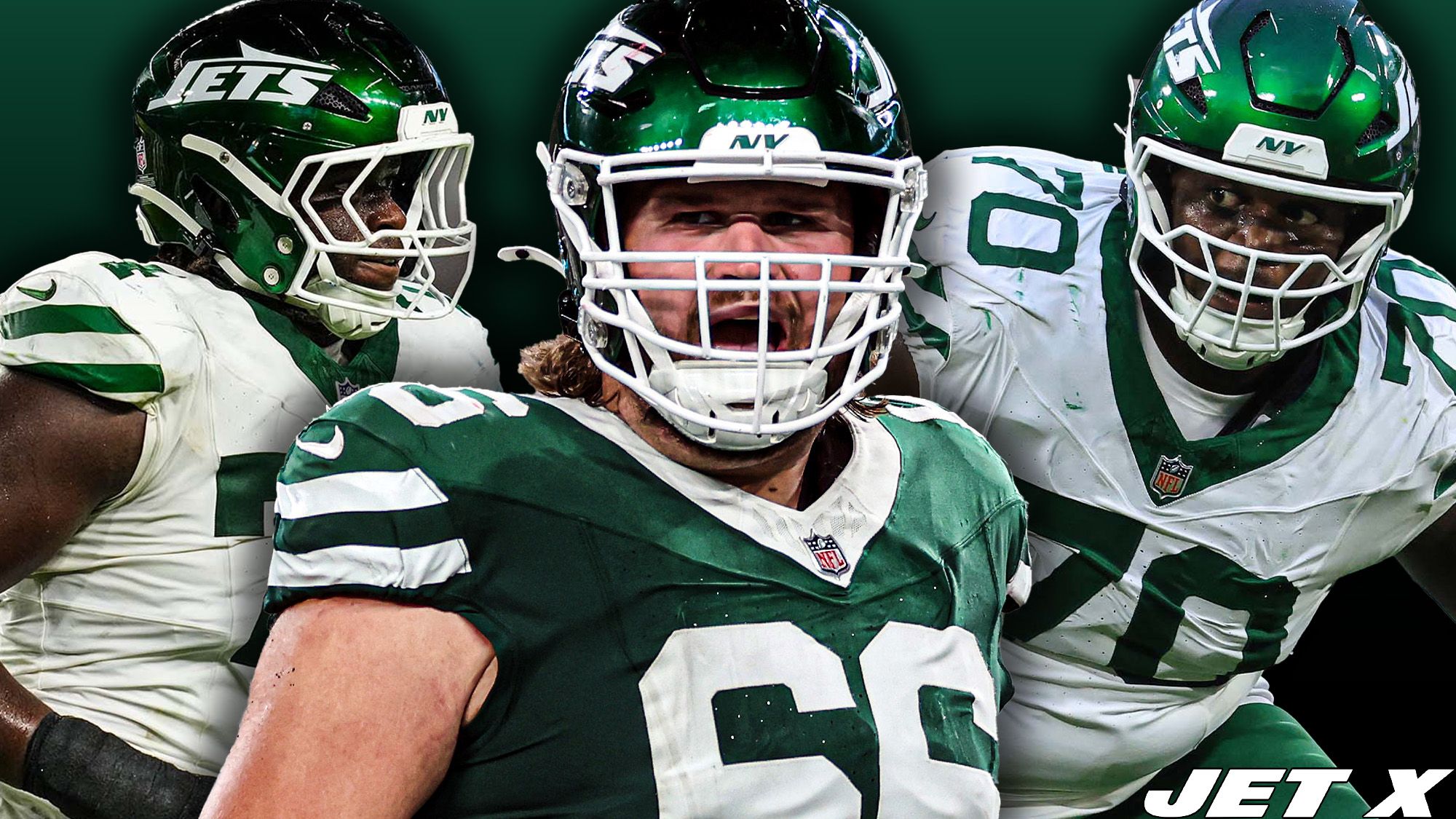
The New York Jets’ offensive line is one of the youngest and most promising groups in the NFL, and it’s still ascending.
The 2026 season appears to be the time for the unit to officially put itself on the map. That doesn’t mean it’s a failure if they aren’t the best in the league, but an improvement over last year’s middle-of-the-pack performance is necessary.
Today, we break down what is needed for the Jets’ OL to hit its ceiling this season.
1. An Olu Fashanu leap
Since being drafted 11th overall in the 2024 NFL draft, we’ve yet to see Olu Fashanu reach his ceiling. He wasn’t a Week 1 starter during his rookie season, meaning 2025 was his first season as a full-time starter.
While he was far from a liability, Fashanu was not a standout in 2025. For the Jets’ offensive line to tap into its ceiling this year, a leap from the Penn State product is necessary.
After a rough start, the good news is that Fashanu finished his second season strongly, posting an 80.2 pass-blocking grade per PFF from Weeks 7-18, which was the 10th-best among tackles over that span.
However, while he thrived as a pass protector, Fashanu’s run blocking remained a work in progress, as his 61.7 run-blocking grade over that span placed him 43rd.
As we broke down, 2026 looks like a perfect year for Fashanu to break out, given that the Jets are expected to throw the ball way more than they did last year, allowing him to lean into his bread and butter more often (pass protecting).
It’s time for Jets fans to start expecting more production from Fashanu. Yes, 2025 was a rough year for the entire offense due to the constraints at quarterback and wide receiver, but now that he enters his second full season as a starter, Fashanu needs to carry his late-season momentum from last year into this year.
Fashanu was the 11th overall pick. When investing that type of capital into an offensive lineman, it’s fair to expect them to become one of the best players in the league at their position in the long term.
For the Jets’ offensive line to hit its full potential this year, a breakout season from Fashanu is needed.
2. Armand Membou continues to ascend
After being selected No. 7 overall in the 2025 NFL draft, Armand Membou had a killer rookie season with the Jets.
Starting all 17 games, he displayed his mauling ability as both a pass and run blocker. He finished the year with a 72.7 overall grade from Pro Football Focus, which ranked 14th among 32 qualified right tackles. Doing that as a 21-year-old rookie sets an extremely high floor moving forward.
The Missouri product just turned 22 this March and is one of the most athletic offensive linemen in the game, with a freakish 9.89 Relative Athletic Score. Already an above-average starter, the sky is the limit for Membou in 2026.
Executives, scouts, and coaches around the league have already begun to take notice of Membou’s talent and upside. In Jeremy Fowler of ESPN’s top-10 offensive tackle rankings, generated by surveys of nearly 70 league executives, scouts, and coaches, Membou was one of seven additional tackles to receive votes.
“One name to keep an eye on for future years: Jets RT Armand Membou,” Fowler added. “He can be the best run-blocker in the league,” per an NFL coordinator. “Just a big, long, powerful man.”
Membou doesn’t necessarily need to have a huge “breakout” year like Fashanu. Given how strong his rookie year was, Membou is already on track to reach a lofty ceiling in the future.
That isn’t to say there weren’t points in the season where Membou struggled; there absolutely were. He certainly needs to fine-tune some elements of his game before fully tapping into his immense potential.
The encouraging part, though, is that his rookie year proved he is much closer to reaching that ceiling than anyone could have reasonably expected at this stage of his career.
If he can continue to ascend in Year 2, Membou could be considered one of the best right tackles in football as he enters his third season in the league.
Currently, he is on an All-Pro trajectory.
3. Move Joe Tippmann to center
This has become a divisive topic among Jets fans.
Some look at Joe Tippmann’s strong year at right guard in 2025, which helped earn him a four-year extension, and argue that the team should keep him there.
In contrast, others believe it’s wise to slide him back to center and remove Josh Myers from the starting lineup, moving the offensive line’s current weakest link to the bench while opening a hole at guard that may be easier to fill in free agency than the hole at center.
I firmly fall in the latter camp.
However, if the Jets were to move Tippmann back to center, they’d need to make a corresponding move at right guard. The most appealing option would be to sign veteran guard Kevin Zeitler to fill Tippmann’s void. Zeitler was an above-average starter in 2025, which means he would be a significant talent upgrade over Myers.
Moving Tippmann to center and signing Zeitler to replace him at right guard would significantly raise the ceiling of the team’s offensive line. It would also finally give the team a competent interior backup in Myers, who would switch from a low-end starter to a high-end backup, improving the team’s weak interior depth.
In 2025, Myers was PFF’s 33rd-ranked center out of 34 qualifiers (52.9 overall grade). A backup spot is where he belongs.
The Jets have invested significant capital in their offensive line. They should be looking for the unit to be as successful as possible this year, and moving Tippmann to center is the best way to maximize their ceiling.
Offensive lines are only as good as their weakest link. Myers currently gives them a very weak link.
The Jets can feel confident about this potential swap given Tippmann’s performance as the team’s full-time starting center in 2024. The Wisconsin product graded out as PFF’s ninth-best overall center with a 73.4 grade, including the eighth-best pass-blocking grade (77.3).
Going into 2025, New York seemed to be dead set on Tippmann becoming the organization’s center of the future. However, Alijah Vera-Tucker’s season-ending injury forced the team to test his versatility and move him to guard.
At guard, there were growing pains early on, but he finished the year on a high note.
The good news is that Tippmann has the flexibility to play both positions. This is something New York would be wise to take advantage of. It can allow them to put the best possible group of five players on the field.
While the Jets can still go back to Tippmann as a guard long-term, it’s necessary to move him back to center to capitalize on the offensive line’s potential this season.
