

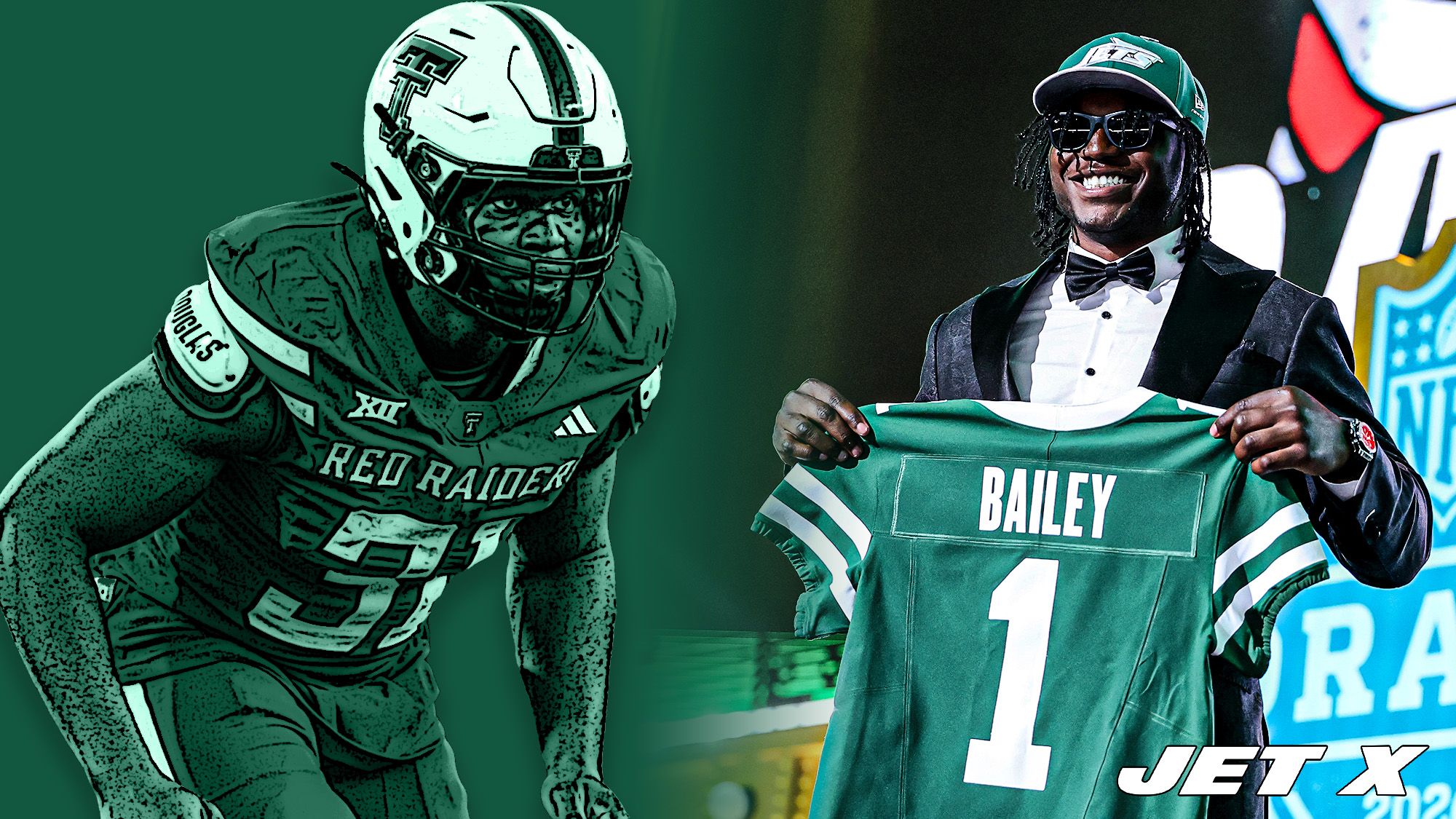
David Bailey is all anyone can talk about in Florham Park.
He should be, after all. He’s the second overall pick. In that case, his development deserves just as much scrutiny and nuanced analysis as a quarterback chosen in that slot would receive.
Not everyone in Florham Park is observing Bailey with that powerful a microscope, though. Many of the reports out of One Jets Drive go no further than essentially repeating, “Wow, Bailey is explosive, and keeps running past tackles,” looking to drive social media interaction from hope-starved Jets fans.
In fairness, yes, it’s true—Bailey is displaying all-world explosiveness off the edge, and he is frequently running around tackles, whether it’s teammates Armand Membou and Olu Fashanu or rock-solid Buccaneers right tackle Luke Goedeke.
But another thing is true: As things stand, there is often a negative countereffect to Bailey’s frequent explosive get-offs and speed-focused wins around the edge.
Jets X-Factor’s Robby Sabo has intensely focused on Bailey throughout training camp, watching for more than simply how many “pressures” and “sacks” he picks up in practices where quarterbacks cannot be tackled. Sabo has been closely analyzing Bailey’s fundamentals, gap integrity, discipline, play recognition, awareness, and more, all in an effort to determine where he stands in his quest to become the franchise-changing, all-around difference-maker that a second overall pick should be expected to be.
From Sabo’s perspective, Bailey has been a mixed bag as an all-around edge defender. There have been moments when the Jets’ offense has targeted him in the run game and picked up large chunks of yardage because Bailey overran the play and compromised the edge.
“For example, last week, Frank Reich’s offense ran something directly at Bailey, off the left side. Had it been a standard dropback pass, the reports would have flown in that “Bailey beat Fashanu to the outside.”
Since the balanced down resulted in a rush, straight at him, Breece Hall popped one for 10-plus yards. The seas parted for the offense, all due to Bailey’s propensity for doing anything possible to get to the quarterback.
Because of the wide path towards the quarterback, Olu never enjoyed an easier run block. He simply guided him further down the arc.”
Additionally, as a pass rusher, Bailey’s all-gas-no-brake style would leave him susceptible to breaking contain against quarterbacks like Josh Allen in a real game; that risk won’t be tested by Geno Smith, especially in a camp setting.
“For instance, one play from this past Saturday’s practice was widely reported as resulting in a Bailey sack. Yet, I simply did not see it that way.
To me, Bailey used his hands to get outside of Olu Fashanu, but took a wide angle to do so. At the time Geno Smith unloaded the ball, Bailey was behind the quarterback.
It was a potential “fly by,” folks. And it’s this idea that has run rampant at Florham Park, N.J., this summer, with no focus on how destructive it could be to a defense.”
None of this is to downplay what Bailey has accomplished at camp. What he has successfully done is prove that his ceiling is certainly worth the second overall pick. He possesses traits and upside that you only see from one or two EDGE prospects each year.
To hit that ceiling, though, Bailey must learn to harness his unique tools and use them effectively within structure. He is talented enough to pick up 10 sacks in his sleep, but if those sacks come at the cost of him frequently allowing chunk runs to his edge and scramble drills by mobile quarterbacks, he won’t make “No. 2 overall pick” impact.
The game’s elite edge rushers aren’t just pass rushers—they’re edge defenders. Pass, run, third-and-long, third-and-short, scramble drill, it doesn’t matter—they dominate within the structure and the situation. Not only do they dominate their matchups and make a ton of plays on their own, but they do it without sacrificing the integrity of the scheme and making life harder on their teammates.
That’s what elite EDGE impact looks like on a football field, and it’s where Bailey is trying to go.
Sabo’s nuanced analysis of Bailey’s development has drawn criticism from some optimistic Jets fans on social media. Outside of Sabo, the media’s coverage of Bailey has essentially painted his performance as flawless. Sabo is the only one painting the complete picture of Bailey’s game.
And it isn’t a bleak picture, not by any means. Throughout camp, Bailey has displayed plenty of promising flashes in the “little things” department, which Sabo always makes sure to shout out.
While the concerns that stem from Bailey’s explosive mentality can hurt him in both the run and pass games, it’s the run game where Bailey’s development is under the most scrutiny. He should generate enough positive plays as a pass rusher to more than make up for a few plays that he gives back in that phase, but in the run game, he needs refinement to avoid being a liability.
The dichotomy between Bailey’s eye-catching pass-rush tools and his presently unpolished run defense raises a fascinating question: Precisely how important is run defense for an edge defender in today’s NFL?
Is Sabo being too harsh on Bailey for his run defense when considering how high his pass-rush ceiling is? Or are Jets fans overlooking how problematic Bailey’s run defense could end up being?
As the second overall pick, many Jets fans are primarily fixated on whether Bailey can become the type of player who produces 10, 12, or even 15 sacks a season. Those are the types of flashy numbers that fans want to see out of a player chosen that early.
Meanwhile, Bailey’s run defense does not seem to draw much attention in Florham Park. As long as he keeps getting “sacks”, the reports will be positive.
No football fan would argue that edge-setting is not important at all. But most of them would tell you that pass rushing is far more important for an edge rusher than edge-setting, and many might even say that they hardly care how well an edge rusher defends the run if he can get at least 10 sacks a season.
Conventional wisdom would tell you that, of course, pass rushing is more important. Sacks are what get edge rushers paid the big bucks, not run stuffs. Plus, pass plays are more common, so it stands to reason that it would be preferable for a player to thrive as a pass rusher than a run defender.
But perhaps the two phases are closer in importance for a modern-day NFL edge rusher than you think.
Examining the importance of pass rushing vs. run defense for NFL edge rushers
I wanted to find out which facet of the game had a closer correlation with NFL teams’ overall defensive efficiency in the 2025 season: pass rushing from the EDGE position, or run defense from the EDGE position?
Using Pro Football Focus data, I calculated the cumulative pass rush and run defense grades for all 32 teams’ EDGE units in 2025. I then calculated the correlation coefficient between defensive DVOA (a measure of overall defensive efficiency, which accounts for strength of schedule, down and distance, score, time, etc.) and the EDGE grades in each phase.
So, did the pass-rush production of EDGE units have a far stronger correlation with overall defensive efficiency than the run-stopping production of EDGE units? Let’s find out.
Here are all 32 teams ranked from first to last according to defensive DVOA, listed alongside the pass rush grade of their EDGE unit.
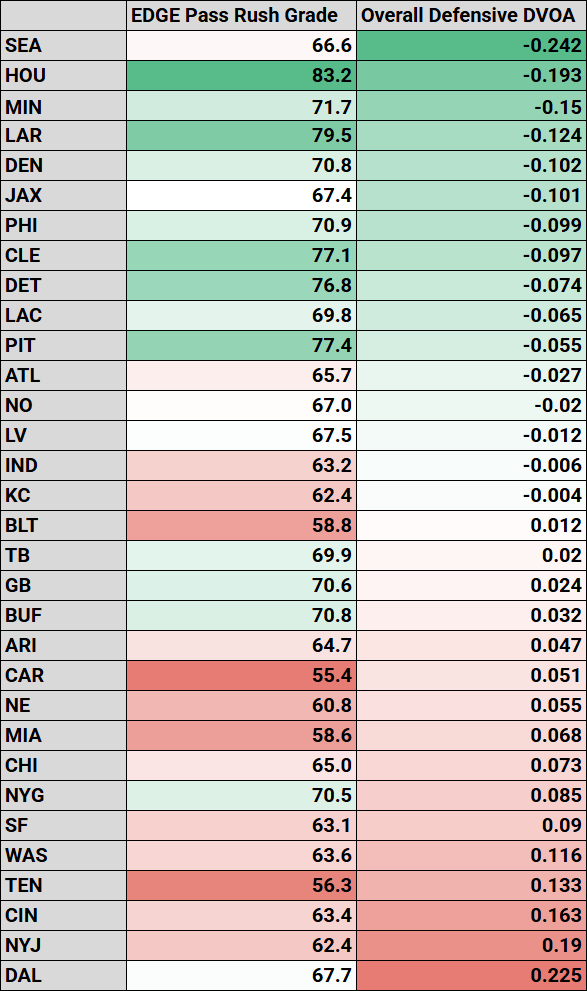
The relationship is noticeable: the correlation coefficient was 0.594, indicating a fairly strong tendency for teams’ overall defensive efficiency to improve as their edge rushers got better at pass rushing. For reference, a perfect correlation would be 1.000, while zero correlation would be 0.000.
Impressive. Very nice. Now let’s see the run defense.
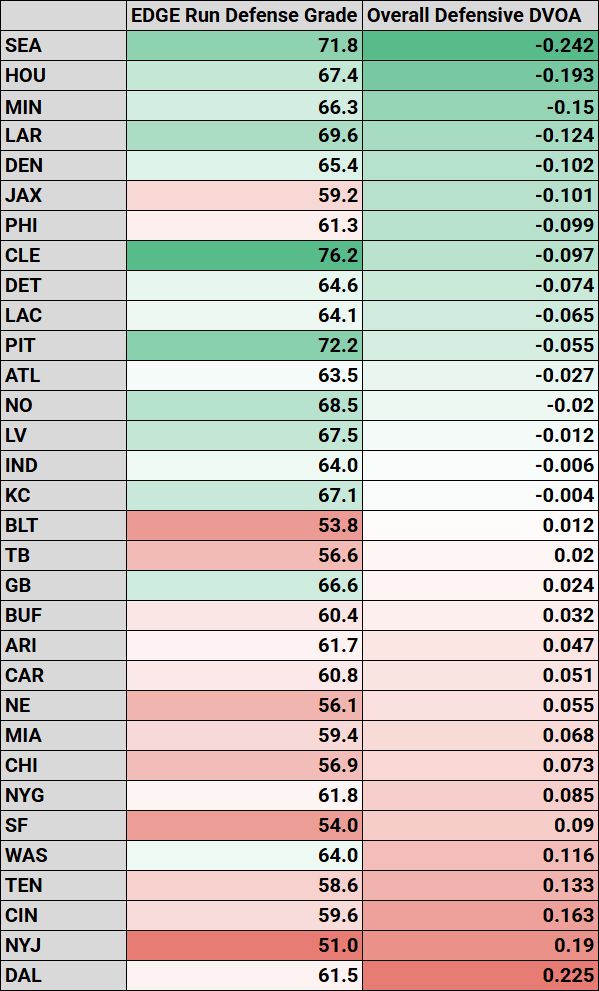
Yielding a correlation coefficient of -0.631, the relationship between EDGE run defense grade and overall defensive DVOA was even stronger than the one between EDGE pass rush grade and overall defensive DVOA (0.594), albeit slightly.
This is a critical takeaway in the David Bailey discussion.
It goes to show that run defense is wildly underrated by fans when talking about the EDGE position. Last season, most teams with poor overall defenses had weak run defenders on the edge, while most top defenses had strong run defenders on the edge.
Of the top 16 teams in EDGE run defense grade, 14 were also top-16 in defensive DVOA, including each of the top eight. Meanwhile, only two of the bottom 16 teams in EDGE run defense grade had a top-16 overall defense, including none of the bottom seven.
If run defense on the edge were relatively unimportant compared to pass rushing, we would probably see more top-tier defenses that overcame weak edge-setters, and more bottom-tier defenses that struggled in spite of strong edge-setters.
Therefore, Sabo isn’t wrong to deeply analyze Bailey’s run defense. It matters greatly.
Perhaps it might be a stretch to treat the numbers in this article as gospel and claim that run defense on the edge is equally or more important than pass rushing; if that were the case, teams would draft sturdy edge-setting defensive ends in the top 10 as often as they draft elite pass rushers with concerns against the run. You don’t see the run-stopping equivalent of David Bailey getting picked in that part of the draft, and for good reason.
Still, the numbers we analyzed today are solid proof that it isn’t merely an “old-school football-junkie yelling at clouds” opinion to weigh an edge rusher’s run defense similar to his pass rushing. If run defense on the edge did not carry significant weight in today’s NFL, we wouldn’t see it correlate more closely with overall defensive efficiency than pass rushing off the edge.
That doesn’t mean run defense is more important for an edge rusher than pass rushing—certainly, an individual edge rusher can make a much more substantial imprint on a game with two strip-sacks than with a couple of run stuffs—but handling business in the run game is probably more important than many fans realize.
So, don’t come at Sabo when he deeply analyzes Bailey’s run defense. It’s an integral part of football, as un-sexy as it may be compared to pass rushing. Any coach at any level would tell you that, and now we have numbers to back it up.
