
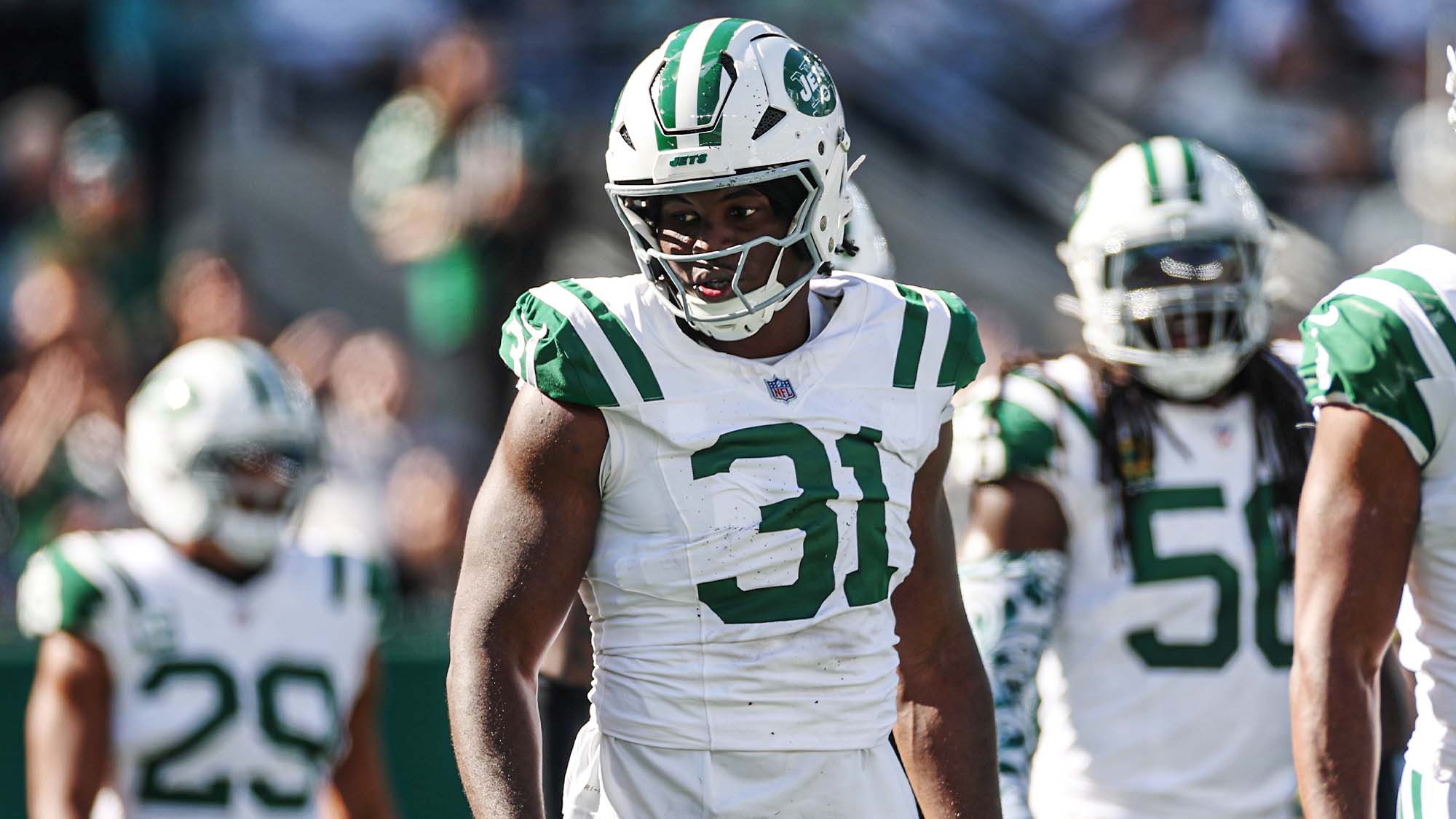
Since they burst onto the scene as one of the most prominent metrics in professional football discourse, Pro Football Focus’ grades have been an endless source of NFL debates.
PFF grades mean well. They attempt to quantify something that football has always been driven by: the eye test.
We all know that football is too complex for players to be evaluated by basic stats like receiving yards or rushing touchdowns—there are too many variables beyond a player’s control for those stats to encapsulate their true impact—which is why we, as well as coaches and front offices, rely on our eyes to measure a player’s true value. But without a number to put to that measurement, it can be challenging to compare players across the league.
That’s where PFF grades come in. They are calculated by a team of analysts who watch the film of every NFL snap and grade every player’s performance on each play, all in a quest to quantify the almighty eye test. The goal is to deliver one-number grades that encapsulate how impactful a player truly is when focusing on what they have done within what they can control.
The idea makes sense, but in practice, the process behind PFF grades raise a litany of questions that make them difficult to trust as definitive measurements of players’ performance levels.
Who is doing the grades, and are they qualified to do them? How do you grade players when you are not in the huddle and don’t know what the exact assignment was or how the player was coached to handle it? How do you account for differences in players’ roles? How do you account for the way that schemes and supporting casts affect the positions that a player is put in?
What happens on a busted coverage or protection when it is hard to tell who was at fault? How come players often receive grades that seem far too high or far too low? Why should we put so much stock into a system that ultimately comes down to subjective grading? Two people can watch one play and come away with different conclusions.
With all of these question marks, PFF grades cannot be treated as the be-all and end-all for analyzing NFL players. They are a useful tool for quantifying the eye test and comparing players across the league in a universe where it is humanly impossible to watch every player’s film and deliver comparable scouting reports for all of them, so they have their role—we use them plenty here at Jets X-Factor. But they should never override the old-fashioned eye test.
As with all sports, analytics and film should exist hand-in-hand in football. Analytics will always misconstrue things that can be debunked by the film, but relying solely on film without data can lead to biases, as analytics have the advantage of quantifying and comparing every play across an NFL season in ways that no human has the time or capacity to pull off. There are useful trends to be picked up from data, but if they stray drastically from the eye test, they shouldn’t be treated as gospel.
Balance is the key. That brings us to today’s topics: The 2026 Jets and their PFF grades.
PFF has been quite fond of the Jets this season. In fact, their players have cumulatively produced the seventh-best PFF grade among NFL teams, making the Jets the NFL’s most disappointing team in terms of their win-loss record compared to their players’ cumulative PFF grades (a way of quantifying “the whole vs. the sum of the parts”).
That type of disparity calls for a closer examination. Are the Jets really that talented, only being held back by coaching? Or are a few players being overrated by PFF’s grading system?
Let’s unpack some of the Jets’ most noteworthy PFF grades through the first eight weeks of 2026 and determine which line up with the film and which do not.
LG Dylan Parham: 87.9 (1st among LG)
The Jets have PFF’s fourth-ranked offense, and their highest-graded offensive player is Dylan Parham, who ranks as the league’s top left guard.
That’s a shock compared to expectations, but the film backs it up quite well. Parham has been remarkably consistent during his time on the field, and his presence alone has completely transformed the performance of the entire unit. With Parham’s presence being the lone change to the lineup between the snaps he played and those he did not, the offensive line has looked night-and-day based on whether he is out there.
Parham’s film features plenty of moments that show he deserves his elite grade. Whether he maintains it beyond three-and-a-half games is another question, but so far, he has played up to that grade.
Dylan Parham = Top LG: Legit
RB Braelon Allen: 82.4 (8th among RB)
New York’s second-highest graded offensive player is Braelon Allen, who stands as the NFL’s eighth-best running back. He has the sixth-best grade in terms of pure rushing, but his lack of receiving impact drops him a couple of spots on the overall leaderboard.
Allen absolutely deserves every bit of this grade. When it comes to the running back eye test, what you’re looking for is self-created production beyond expectations, and Allen has delivered plenty of it. He is ninth among running backs in missed tackles forced as a rusher (26), and among running backs with at least 100 carries, he is sixth in yards after contact per rush attempt (3.6).
Braelon Allen = Top-10 RB: Legit
RG Joe Tippmann: 82.4 (5th among RG)
Freshly extended guard Joe Tippmann is tied with Allen for the Jets’ second-highest offensive grade, which is good enough for fifth among right guards.
This is the first one we will have to call into question.
Tippmann has been more of a roller-coaster ride than his grade lets on. He’s had some rough games, namely a Week 5 performance against the Browns in which Maliek Collins beat him up throughout the afternoon; Collins picked up two sacks and multiple run stuffs on Tippmann. If the Jets lost that game, which was on the verge of happening if not for a botched punt snap by Cleveland, Tippmann would have been among the primary culprits.
On the year, Tippmann is tied for the second-most sacks allowed (3) and the eighth-most penalties (3) among right guards. His overall pass-blocking consistency has been solid, as he ranks 20th among 62 qualified guards with a 3.41% pressure rate allowed, but that certainly isn’t top-five right guard caliber.
PFF doesn’t actually love Tippmann’s pass-blocking, giving him a respectable but middling 61.4 pass-blocking grade, ranking 25th among 62 qualifiers. It’s Tippmann’s 87.4 run-blocking grade, which ranks second among all guards, that props up his overall grade.
That number seems a bit excessive for Tippmann, whose run-blocking film has appeared mostly solid, albeit not quite consistent enough to be considered elite. Even if we give him the elite run-blocking, though, the large disparity between his two grades calls into question the ambiguous formula behind PFF’s overall grade.
If Tippmann has a 61.4 pass-blocking grade and an 87.7 run-blocking grade, and 59% of his snaps were pass-blocking plays, how is his overall grade 82.4? At best, if you averaged the two evenly, you would think his grade should be around 74.6, but given that pass-blocking makes up a higher portion of most players’ reps, it would make more sense if his overall grade leaned toward that number. Instead, it leans heavily toward the run blocking, which doesn’t seem to make much sense.
Compare Tippmann to someone like Cincinnati’s Dalton Risner, who has a 78.6 run-blocking grade and a 77.0 pass-blocking grade with 68% of his snaps being in pass protection, yet his overall grade of 81.4 is lower than Tippmann’s.
Tippmann has been an above-average starter, but PFF seems to be giving him a little too much credit.
Joe Tippmann = Top-5 RG: Overrated
QB Geno Smith: 80.9 (9th among QB)
Coming in fourth for the Jets’ offense is their quarterback, Geno Smith, who is performing at a franchise record-setting pace.
Of course, Smith does not get bonus points for performing well relative to the low bar of previous Jets quarterbacks. Relative to his peers, though, PFF thinks he has performed quite admirably, placing him ninth among the 35 quarterbacks with at least 100 dropbacks.
Based on his overall efficiency, this ranking seems to be slightly overrating Smith. He ranks 18th in QBR, 14th in adjusted EPA per play, and 14th in DVOA, which would make him more of an above-average starter than a borderline elite one.
It’s understandable why PFF has him rated so highly, though. Smith has tossed an abundance of difficult completions this year, which are the type of plays that tend to buoy a player’s PFF grade, since they pop off the screen via the eye test compared to things like easy underneath throws or screen passes. Eye-test-wise, it makes sense that he ranks top-10.
But after accounting for Smith’s propensity for sacks, lack of rushing impact, occasionally safe decision-making, and inefficient production in the red zone, he is closer to a league-average starter than PFF’s grade indicates, so it’s fair to say that he is slightly overrated in terms of PFF grade.
His PFF grade indicates how well he has executed within his role, but Smith brings limitations to the table that show up more clearly in his overall efficiency metrics, which reflect ceiling-limiting factors that are visibly apparent through the eye test.
Geno Smith = Top-10 QB: Slightly overrated
WR Garrett Wilson: 80.6 (15th among WR)
Rounding out the Jets’ top-five offensive players is Garrett Wilson, whose 80.6 overall grade ranks 15th among wide receivers with at least 30 targets.
In terms of box-score stats, the No. 15 spot is a fair place for Wilson; he ranks an identical 15th in receiving yards. PFF grades, though, are supposed to separate a wide receiver from his surroundings. Wilson has arguably played far better than the 15th-best receiver, something that is clearly visible through the eye test.
Wilson has made a plethora of odds-defying catches this year. Anybody familiar with football would attest that his impact goes well beyond the level suggested by his box-score stats, and there are advanced numbers to support that.
According to NFL Pro, Wilson has a catch rate over expected of 9.2%, trailing only Tee Higgins and Jaxon Smith-Njigba among wide receivers with at least 40 targets. This seems like a much more accurate quantification of what Wilson’s eye test has shown this year, and PFF’s grades should be capturing that, but he appears to still be getting rated in accordance with the volume of his receiving production, which isn’t what the grading system is intended for.
Garrett Wilson = Top-15 WR: Underrated
S Minkah Fitzpatrick: 75.5 (13th among S)
PFF is much lower on the Jets’ defense than their offense, placing New York at No. 20 in defensive grade. They don’t have any defenders who are rated as high as any of their top five offensive players, but it’s worth examining some of the most interesting grades.
Minkah Fitzpatrick is the Jets’ top-rated defender with a 75.5 overall grade, ranking 13th among the 80 safeties with at least 200 snaps.
This grade seems a little generous for Fitzpatrick, who has been more up and down than a top-15 ranking indicates. The veteran has made some major mistakes in coverage.
Late in the Jets’ Week 7 loss to the lowly Dolphins, Fitzpatrick took a brutal angle to allow a 63-yard game-sealing touchdown on a pass into the flat.
In the Jets’ Week 6 loss to the Patriots, Fitzpatrick appeared to blow a coverage to allow a 42-yard deep touchdown into his single-high zone (you can fast forward to 1:05 in the clip below if you just want to see the play).
And while Fitzpatrick generated fanfare for breaking the Jets’ interception drought in Week 4 against the Bears, he was otherwise toasted in that game, allowing three receptions for 75 yards and three first downs.
Fitzpatrick has tackled well; the blunder against Miami is one of just two plays on which he was credited for a missed tackle. He has also made a couple of teach-tape pass breakups in man coverage.
Overall, though, the nearly 30-year-old has made too many costly mistakes in coverage over just five starts to be considered a top-15 safety.
Minkah Fitzpatrick = Top-15 Safety: Overrated
David Bailey: 63.9 (56th among EDGE)
Bailey is the Jets’ eighth-highest graded defender; we’re skipping down to him on the list, since as the second overall pick, he deserves a close look.
Among the 85 edge defenders with at least 200 snaps, Bailey’s overall grade ranks 56th, making him a slightly below-average starter. While some Jets fans might have qualms with that, it’s actually fairly accurate.
The good news with Bailey is that he has been extremely active thanks to his motor and athleticism. He is tied for fifth among edge defenders with 16 defensive stops, although part of that is due to his role as an outside linebacker, whereas many of his peers at the position are down linemen who don’t drop into coverage as often. Still, give Bailey credit for his activity.
Bailey also has 5.5 sacks, good enough for ninth at the position. The problem is that most of those were low-quality, being either unblocked or chasedowns near the line of scrimmage on QB scrambles, but again, give him credit for getting involved.
Three forced fumbles are also a feather in Bailey’s cap.
The issue is that, from down to down, Bailey has been unreliable for the Jets. He rarely wins in high-quality fashion as a pass rusher, and as a run defender, he is too prone to gap-integrity mistakes, often coughing up large gaps for opponents to run through.
Given the positives and negatives he has shown, it makes sense to label Bailey as a below-average starting edge defender so far. He has one of the highest activity levels in the league, which pulls him up from being a liability, but his down-to-down consistency in both phases needs plenty of work.
Bailey clearly has a high ceiling, though, given how productive he has been before even mastering the fundamentals of his position. It’s obvious why he was drafted second overall, but he has a long way to go to reach his NFL ceiling.
David Bailey = Below-Average Starter: Legit
EDGE Kingsley Enagbare: 63.9 (56th among EDGE)
Kingsley Enagbare has been the Jets’ best edge defender by far, and one of their best defenders overall, making it dubious that he has the same grade as Bailey.
Enagbare is thriving in all of the areas where Bailey must improve. While Bailey can be erratic against the run, Enagbare is sturdy and disciplined. And while Bailey is a sack magnet but inconsistent as a pass rusher overall, while also dealing with issues in rush-lane discipline, Enagbare is a decently consistent source of pressure without sacrificing rush-lane integrity.
PFF has Enagbare with a 74.1 run-defense grade, which rightfully leads the Jets’ edge defenders and is also good enough for 15th among 85 edge defenders, which feels accurate. It’s Enagbare’s 76th-ranked pass-rush grade of 57.0 that drags him down the overall rankings, but that feels too harsh, even if Enagbare is no Lawrence Taylor.
In terms of PFF’s pressure rate, Enagbare ranks 47th out of 85 qualifiers with a 10.9% mark, putting him right around average. His 9.8% pass-rush win rate is less impressive, placing 60th, but that’s still well above his 76th-ranked pass-rush grade.
It’s probably fair to say that Enagbare has been a below-average pass rusher and a well above-average run defender for a starting EDGE, making him around an average starter overall. That’s better than his PFF grade indicates.
Kingsley Enagbare = Below-Average Starter: Underrated
CB Azareye’h Thomas: 64.2 (35th among CB)
Serving as a full-time starter for the first time in his career, 2025 third-round pick Azareye’h Thomas has looked the part of a starter, and his PFF grade seems to reflect that. He ranks 35th among 86 qualified cornerbacks with a 64.2 overall grade.
Thomas is a tenacious tackler in run support, tying for eighth among cornerbacks with five run stops. However, his physicality as a tackler is washed out by his inconsistency; Thomas has been credited with seven missed tackles. His 15.6% missed tackle rate is below-average, ranking 56th out of 86 qualified corners.
In coverage, Thomas has shown solid consistency overall, but the problem is that he is susceptible to the crushing mistakes.
With 245 yards allowed on throws into his coverage across 289 coverage snaps, Thomas is allowing 0.85 yards per coverage snap, which ranks 26th out of 86 qualifiers. This lines up with his film; Thomas isn’t beaten too often, as he wins with his physicality and length to throw off route timing and disrupt catch opportunities.
However, Thomas has already coughed up four touchdowns, tied for the second-most among cornerbacks. All of those have come in the red zone; he is particularly vulnerable to getting beat on in-breakers.
In fairness to Thomas, the touchdown he was credited for allowing to Las Vegas’ Jalen Nailor this past week was also at least partially on Jarvis Brownlee for not providing enough inside help. This calls into question the validity of TD charting at PFF and other outlets; it’s possible for touchdowns to partially be the fault of multiple parties, but they are always blamed entirely on one player, which isn’t fair.
Thomas has also been called for three penalties this season, with one for pass interference and two for illegal use of hands. The pass interference call was arguably the biggest turning point in New York blowing a 10-point fourth-quarter lead to the Packers in Week 2; with under 10 minutes left and the Jets up by 10, New York had Green Bay buried in first-and-25 on their own side of the field with zero offensive momentum, until Thomas’ 38-yard DPI put them on the Jets’ side of the field, leading to a touchdown.
Three penalties, though, is not a terrible number for a starting cornerback through eight games. With three flags on 565 defensive snaps, Thomas has a 0.565% penalty rate, placing 46th among 86 qualified corners, per PFF’s charting. So, it’s about average. Still, the DPI against Green Bay aligns with his propensity for missed tackles and red-zone touchdowns in terms of his tendency to make some big mistakes, even if his general coverage consistency from down to down is quite solid.
With some above-average traits and some below-average traits, Thomas has generally been about a league-average starting corner overall, which his PFF grade seems to accurately reflect. That’s a good spot for a third-round pick to be just 13 starts into his career, especially at 22 years old, so Thomas can build on this to become a great player. For now, though, he isn’t a surefire cornerstone just yet.
Azareye’h Thomas = Slightly Above-Average Starter: Legit
Takeaways
Some Jets players seem to be overrated by PFF, while others seem to be underrated. Others seem to be accurately graded.
Overall, things to seem wash each other out, making the Jets’ No. 7 ranking in PFF’s cumulative team grades feel accurate. That only further validates the flak sent toward New York’s coaching staff for creating a whole that is significantly less than the sum of the parts.
PFF grades are imperfect, but they at least inspire fans and analysts to dive deeper into the context behind players’ performances, which is a good thing. Twenty years ago, most fans were content to rank players at every position by fantasy points and call it a day. We’ve come a long way.
Not everybody uses PFF grades properly—some fans take to PFF immediately after a game, jot a list of the Jets’ best and worst-graded players, and call it a tweet, as if that “analysis” has any sort of value. If you just throw grades around without using them as a basis for deeper dives, you are putting too much stock into them.
But when used as just one of many tools, alongside the eye test and other complementary advanced metrics, PFF grades can lead to some interesting conversations.
