

In all likelihood, the New York Jets’ 2026 safety unit will be the franchise’s best in quite some time.
That will happen by default thanks to the addition of Minkah Fitzpatrick, provided he stays healthy. Fitzpatrick is still one of the most impactful safeties in the game, even if his interception productivity has declined.
Who starts next to the three-time All-Pro, though, was one of the most fascinating storylines going into Jets training camp.
Three contenders were set to compete for the role: returning starter Andre Cisco, 2025 fourth-round pick Malachi Moore, and the most unheralded player of the bunch: one-year, $4 million free agent pickup Dane Belton.
Cisco started all eight of his appearances for the Jets in 2025 after signing a relatively hefty one-year contract, worth up to $8.5 million. After snagging eight picks with the Jacksonville Jaguars over the previous three seasons, he was a somewhat familiar name around the NFL. But his first season with the Jets was plagued by injuries and tackling woes, leading to Cisco only netting a one-year, $2.5 million deal to return in a competing/backup role.
Moore, though, was arguably the fan-favorite of the trio entering the summer. Due to injuries, the Alabama product started 14 of the Jets’ 17 games and finished the year with 950 defensive snaps. He used the ample snaps to rack up 101 total tackles.
Naturally, fans are inclined to root for the youngster of the bunch to win the starting role. If Moore could rack up such lofty numbers as a rookie, it is easy to assume that he is a candidate for a substantial leap in Year 2.
But what if I told you that the highest-upside competitor in the group is not the second-year man in Moore, but the fifth-year man in Belton?
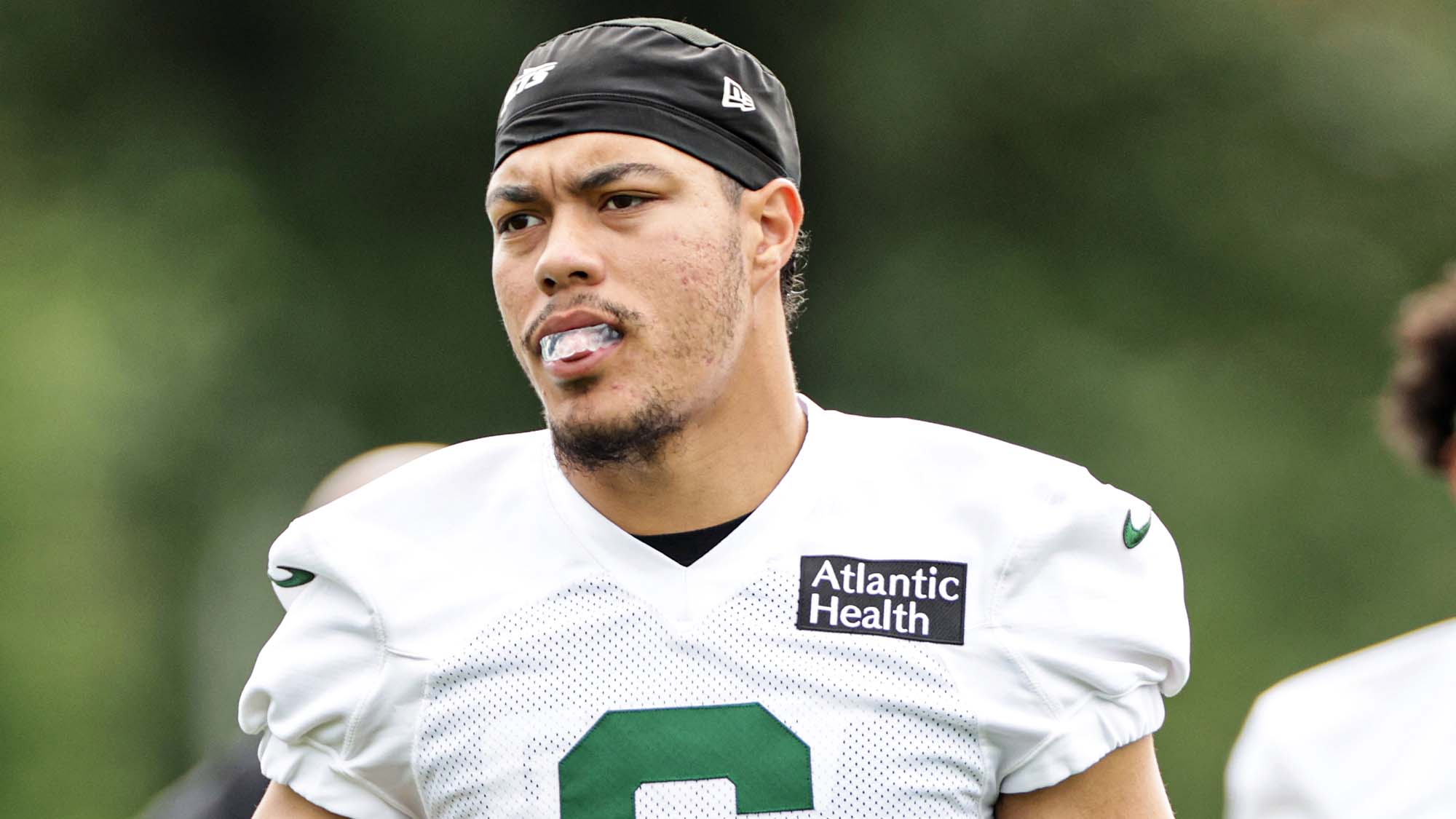
Dane Belton is making a name for himself in the Jets’ secondary
Despite entering Year 5, Belton (born December 7, 2000) is actually just nine months older than Moore (born September 13, 2001). Moore was already 24 by his second career game, while Belton did not turn 22 until December of his rookie year.
Belton, a 2022 fourth-round pick of the Giants, was a valuable rotational backup and special teamer for Big Blue across four seasons. He played in 66 games, starting 22 of those, while logging 1,850 defensive snaps, an average of 28.1 per game.
There were stretches where Belton took over as an every-down starter, but even when he was not starting, he often played a decent chunk of snaps as the third safety. He also played over 70% of the Giants’ special teams snaps in each of the last three seasons.
At first glance, Belton is a fifth-year player who mostly served as a rotational backup and special teamer across four seasons with a franchise that struggled defensively. There’s no way that he could have more upside than the second-year Moore, right?
Well, given the small age gap and the production that Belton has generated when given opportunities, it is most certainly an arguable claim—one that the Jets themselves seem to believe.
Belton has a tremendous nose for the football. Across his 1,850 career defensive snaps, he has logged six interceptions, four forced fumbles, and two fumble recoveries (he also has two fumble recoveries on special teams). Here is how those numbers would project over 1,000 defensive snaps, which is about how many you’d expect your typical starting safety to play over a full season:
- 3.2 interceptions
- 2.2 forced fumbles
- 1.1 fumble recoveries
That’s a career average of 6.5 combined interceptions, forced fumbles, and fumble recoveries per 1,000 snaps.
Precisely how good is that? Well, consider that in the 2025 season, only one safety in the entire league exceeded the 6.5 mark in that category: Chicago’s Kevin Byard, who earned first-team All-Pro honors with seven interceptions but no forced fumbles or fumble recoveries.
Given that Belton accumulated these numbers steadily across four seasons and nearly 2,000 snaps, his sample size is fairly reliable.
In each of the last four seasons, Belton had at least one interception and at least one fumble recovery or forced fumble, despite being a backup for much of that time. In fact, if you include only his appearances with a defensive snap-count threshold as low as just 10 snaps, he never went more than seven straight games without registering an interception, forced fumble, or fumble recovery.
The most intriguing aspect of Belton’s profile is that, as his snap count has increased, so has his per-snap playmaking efficiency, which bodes extremely well as the Jets consider him for a starting role. In 21 career games where he played at least 40 defensive snaps, he picked up six interceptions, two forced fumbles, and two fumble recoveries (10 total “big plays”) on 1,211 defensive snaps. That equates to an absurd 8.3 per 1,000 snaps.
Compare Belton’s playmaking to that of Moore, who had no interceptions, one forced fumble, and one fumble recovery (2 total “big plays”) on 950 defensive snaps last season.
Even in college, Moore was not much of a playmaker. He amassed a gigantic sample size of 3,121 defensive snaps across five college seasons, and could only collect seven interceptions, three forced fumbles, and two fumble recoveries, an average of 3.8 combined per 1,000 snaps. That doesn’t even sniff Belton’s rate against NFL competition.
Of course, though, playmaking is not the only mark of an NFL safety. The quiet fundamentals are key, too.
In that regard, Belton is no superstar, but he’s been solid by starting safety standards, both in terms of his tackling and his coverage.
For his career, Belton owns a missed tackle rate of 9.1% and an allowed passer rating of 92.4, per Pro Football Focus. For comparison, the 2025 NFL averages for safeties were 12.7% and 101.5, respectively. If you isolate only the top-64 safeties in snaps (“starters”), the league averages were 12.2% and 98.2, which would still make Belton above-average among starters.
Moore’s tackling as a rookie was solid; his missed tackle rate was 10.7%. His coverage, though, has a long way to go, as he allowed a 116.1 passer rating on throws into his coverage.
The difference in the two players’ career track records has translated to the practice field so far. This summer, Belton has turned heads in training camp, looking like the Jets’ clear-cut second-best safety behind Fitzpatrick.
It’s a stance that Jets X-Factor’s Joe Blewett has been pushing since breaking down the film of both Belton and Moore this offseason.
In their preseason opener, the Jets displayed an interesting hierarchy at the safety position. Fitzpatrick, as expected, played all eight snaps with the first-team defense, but it was Cisco who joined him on those reps. However, Cisco stayed in after the rest of the first-team defense exited, ultimately playing 21 snaps as the Jets continued evaluating him. Replacing Fitzpatrick with the second-team defense was Belton.
Moore, meanwhile, did not come in until midway through the second quarter.
It appears that Cisco and Belton are currently the clubhouse leaders to win the starting safety spot next to Fitzpatrick. Moore seems to be on the outside looking in at the moment.
Cisco’s extensive starting experience makes him worth the look, but it’s Belton who has flashed more often in camp, and those practice-field flashes are backed up by the impressive per-snap productivity he has displayed throughout his career. While Cisco seems to have a firmly established NFL ceiling, there could be plenty of untapped potential left to be unlocked in the 25-year-old, who has yet to earn a Week 1 start in the NFL despite his strong production when given opportunities to play.
If things continue heading in the same direction, it may only be a few more weeks until Belton finally gets the season-opening opportunity he’s been waiting for. And if his career numbers are any indication, Jets fans should be excited to see that come to fruition.
It’s a low-hanging fruit to always assume that the homegrown, inexperienced draft pick is the highest-upside player in an NFL position room. Sometimes, though, greater potential can be found in unexpected places.
