

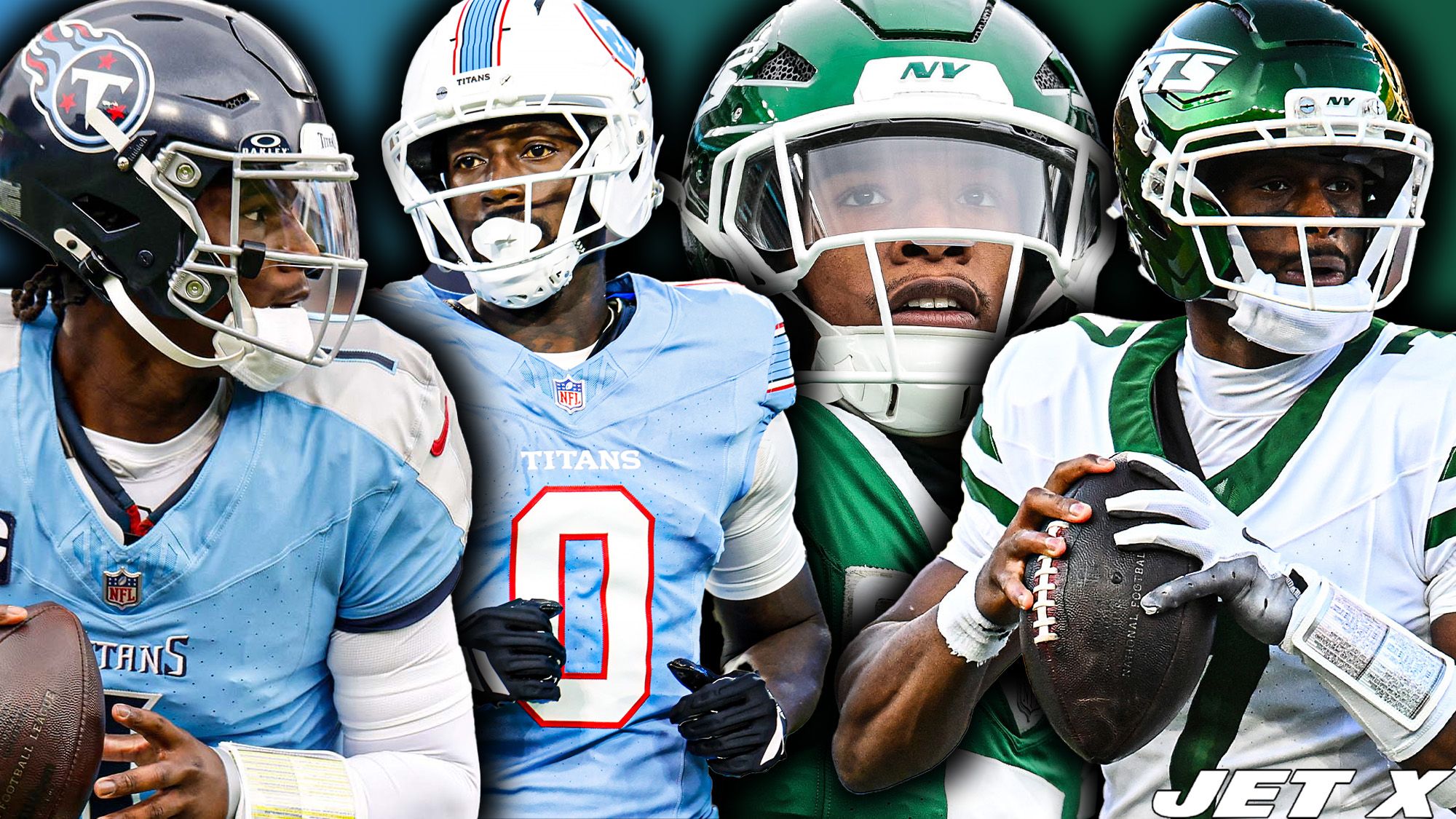
As we recently broke down, the New York Jets arguably have a coaching disadvantage against the Tennessee Titans in Week 1.
But how do the teams compare from a roster standpoint?
Today, we compare the two rosters position by position and dissect who has the upper hand in on-paper talent.
QB
Both teams face uncertainty at quarterback.
Cam Ward, the 2025 No. 1 overall pick, is coming off a rough rookie season, although his supporting cast was among the worst in football, and he experienced a coaching change amidst his first year in the league. No matter the draft positioning, that is a lot to overcome.
However, it still can’t be overlooked that he was the worst QB in the league per net yards per attempt (4.6), and it will be his first game in a new system under first-year offensive coordinator Brian Daboll.
With the Jets, Geno Smith is coming off a far-from-stellar 2025 campaign, but his experience as a solid starter in the league provides a higher baseline than with Ward. In three of the last four seasons, he posted a passer rating over 90 and led his team to a winning record.
The chances of Smith bouncing back in 2026 are much higher than commonly discussed.
With the Jets drawing Ward in Week 1, before he has had the chance to show improvement from his rookie season, New York has the advantage at quarterback.
Verdict: Smith, 1-0 Jets
RB
Breece Hall and Tony Pollard have each established themselves as productive RB1s.
Pollard has proven to be a more consistent rusher, surpassing 1,000 yards in every season since 2022. Hall, on the other hand, collected over 1,000 rushing yards for the first time in his career during the 2025 season. It’s important to note, however, that Pollard entered the league in 2019, whereas Hall entered in 2022.
Despite that, Hall has been more productive overall due to his impact as a receiver. In each of Hall’s three full seasons (2023-25) in the league, he has collected more yards from scrimmage than Pollard.
Since 2023, Hall has 4,359 yards from scrimmage and 22 total touchdowns (49 games), compared to Pollard’s 3,921 yards and 16 touchdowns (50 games). Hall is also averaging more yards per touch over that span (5.2 vs. 4.4). So, all-around, Hall is certainly the more formidable weapon in the RB1 spot.
Behind Hall, 2026 is a make-or-break season for both Braelon Allen and Isaiah Davis. Allen and Davis seem comparable to Tennessee’s backups: Tyjae Spears, Nicholas Singleton, and Julius Chesnut.
Chesnut is a special teams ace, only earning 11 carries last season. In the RB3 spot, Davis is averaging 5.6 yards per attempt on 76 carries, while he adds reliable pass-blocking and pass-catching on third down (30 catches for 261 yards and a touchdown). Meanwhile, Singleton is a fifth-round rookie, so the Jets have the edge here.
Allen is returning from a season-ending knee injury sustained in Week 4 of the 2025 season. Across 110 rushes in 21 career games, Allen has collected 410 yards and three touchdowns (3.7 yards per attempt). So far, Allen has yet to prove himself as more than a short-yardage back.
Spears, entering Year 4, is a more reliable rusher in the RB2 spot, rushing for 1,048 yards and eight touchdowns on 256 carries (4.1 yards per attempt). He is also an excellent receiver out of the backfield, catching 127 of 155 career targets for 873 yards and two touchdowns. That gives Tennessee the edge at RB2.
Although it’s close, the Jets have the advantage here. Spears may be an upgrade over Allen as the RB2, but more importantly, Hall is a more dynamic all-around weapon than Pollard, and the Jets also have better depth thanks to Davis in the RB3 spot.
Verdict: Jets RBs, 2-0 Jets
WR
If it were “WR1,” the Jets would easily have the advantage. Garrett Wilson has proven to be the top receiver from either team.
However, Tennessee’s depth is better than the Jets’. While you can make the case that Adonai Mitchell will emerge as the Jets’ WR2 this season, Tennessee has a more proven WR trio.
Carnell Tate remains an unknown as a first-round rookie, especially after a rough preseason. However, before playing in just seven games last season due to injury, Calvin Ridley had back-to-back 1,000-yard seasons, while free-agent addition Wan’Dale Robinson led the NFL with 675 receiving yards out of the slot last season.
Ridley and Robinson give the Titans two proven starters to the Jets’ one, while Tate’s potential usurps any of the Jets’ unproven wideouts.
The starting trio is superior for Tennessee. Wilson is the best on either roster, but the combination of Ridley, Robinson, and Tate is more complete than the Jets’ group of Wilson, Michell, and first-round rookie Omar Cooper Jr. Beyond that, Isaiah Williams, Tim Patrick, and Arian Smith haven’t proven to be reliable depth options.
Verdict: Titans WRs, 2-1 Jets
TE
The Jets’ and Titans’ tight end rooms are both led by second-year players in Mason Taylor and Gunnar Helm.
Taylor, a second-round pick last year, put up similar box-score stats to Helm when comparing their rookie seasons. Taylor hauled in 44 receptions for 369 yards and a touchdown in 13 games, while Helm went for 357 yards and two touchdowns across 44 receptions in 16 games.
The separator, though, is how well Taylor performed in contested situations. He caught 11 of his 14 contested targets, a 78.6% catch rate, ranking second-best among qualified tight ends behind only George Kittle.
The Jets also have first-round rookie Kenyon Sadiq, although his role for Week 1 will most likely be limited. He missed a fair amount of training camp and the entire preseason, making it tough for him to take on a significant role right away.
Depth-wise, Jeremy Ruckert and Jelani Woods are essentially a wash with Daniel Bellinger, Kylen Granson, and David Martin-Robinson.
At the end of the day, however you want to look at it, the Jets have the stronger tight end room.
Verdict: Jets TEs, 3-1 Jets
OL
This is one of the Jets’ top advantages.
It’s all about consistency with left tackle Olu Fashanu, but he finished the 2025 season on a high note as a pass protector, and his upside is undeniable. Keep in mind, 2026 will just be his second season as a full-time starter, and he is in a prime position to firmly establish himself.
Armand Membou could very well solidify himself as a top right tackle in football by the end of 2026. He is just 22 years old with freakish athleticism, and he displayed incredible play throughout his rookie campaign.
The interior is solid, too. Dylan Parham profiles as an upgrade over John Simpson at left guard, while Joe Tippmann thrived after settling in at right guard last season. Josh Myers remains the weak link at center, but Tennessee has multiple weak links across their line.
The Titans have two legitimate building blocks in left guard Peter Skronski and right tackle JC Latham, but the rest of the line has questions.
Dan Moore Jr. remains highly inconsistent at left tackle, having allowed a position-high 48 total pressures last season. Center Austin Schlottmann and right guard fifth-round rookie Fernando Carmona are extremely questionable as starters. Schlottmann is a career backup, and Carmona will be vulnerable as a Day 3 rookie starting in his NFL debut.
Overall, the Jets have a far more complete unit.
Verdict: Jets OL, 4-1 Jets
DL
This is where Tennessee starts to catch up.
Defensive tackle Jeffery Simmons is the best defensive lineman from either team and one of the best at his position in the league. Then, there are two former Jets in John Franklin-Myers and Jermaine Johnson.
That is a very solid foundation. Franklin-Myers is a versatile all-around piece who can play both inside and outside, while Johnson possesses elite traits in both phases; he just needs to prove that he’s healthy after struggling in 2025 coming off an Achilles tear.
The Jets have talent of their own with Will McDonald, who has logged 18.5 sacks over the past two seasons, while T’Vondre Sweat has an opportunity to dominate against his former team. Jowon Briggs is also looking to pick up where he left off in 2025 as one of the league’s top pass-rushing defensive tackles, and No. 2 overall pick David Bailey will be making his NFL debut against Tennessee.
Overall, the Jets have a solid foundation for their run defense with Sweat, Harrison Phillips, David Onyemata, Joseph Ossai, and Kingsley Enagbare.
However, the Jets lack an established all-around dominant defensive lineman like Simmons. McDonald is a pass-rush specialist, while Sweat, Phillips, and Onyemata are best suited against the run. Ossai and Enagbare offer a little of both, although they lack jaw-dropping pass-rush juice.
Tennessee has the edge here.
Verdict: Titans DL, 4-2 Jets
LB
The Jets make up for the gap at the line of scrimmage with their linebacker unit.
At 37, Demario Davis is the definition of an ageless wonder, remaining one of the league’s most reliable linebackers despite his age. He is also expected to wear the Jets’ green dot, which will give Jamien Sherwood more opportunity to play freely.
Without a doubt, New York has questions beyond their starting duo, with waiver-wire pickup Trevin Wallace, 2025 fifth-round pick Kiko Mauigoa, and special teamer Marcelino McCrary-Ball rounding out the unit.
The Titans, though, lack any proven presences at linebacker.
Starter Cody Barton ranked 66th among 88 linebackers at Pro Football Focus in 2025 and is on his fourth team in five seasons. Cedric Gray and James Williams Sr. have yet to prove themselves as serviceable starters, while second-round pick Anthony Hill Jr. enters his rookie season.
Davis is the best linebacker on either team, and Sherwood is arguably the second-best despite a rocky 2025 season. This one is pretty simple.
Verdict: Jets LBs, 5-2 Jets
CB
Neither team should feel particularly confident with their CB rooms.
The Jets have uncertainty with their boundary trio of Brandon Stephens, Azareye’h Thomas, and Nahshon Wright.
In the slot, there is Jarvis Brownlee Jr., a former Titan, who has struggled with penalties and in coverage but remains a solid run defender. Ponds, a second-round rookie, is expected to be the Jets’ starting slot CB this season, but missed almost all of training camp and the entirety of the preseason due to a calf injury. If he does even suit up for Week 1, it would be tough to expect him to take on a big role.
Tennessee’s room isn’t dramatically better, but Alontae Taylor is the most established cornerback on either roster, while Cor’Dale Flott adds further starting experience. Marcus Harris has also proven to be serviceable in the slot.
This is much closer than the linebacker rooms, but Tennessee has the best individual corner and fewer questions among the starting group. Neither team has a great group at CB, though.
Verdict: Titans CBs, 5-3 Jets
S
The Jets have the advantage at safety, largely because of Minkah Fitzpatrick.
Fitzpatrick remains one of the top safeties in the league despite his interception total dropping over the past few seasons. He will help the Jets dramatically in an area where they struggled last season.
Dane Belton also profiles as a very solid No. 2 safety and starting strong safety. Belton has flashed excellent turnover-generating upside and can play all over the defense.
Tennessee has a fine starter in Amani Hooker, and after him, there isn’t much. Kevin Winston Jr. is entering his second season after being a third-round pick last year, and Jets fans know all about Tony Adams’ struggles.
Without a doubt, the Jets have the superior safety room.
Overall verdict: 6-3, Jets
Recap
The final tally gives the Jets an advantage in six of the nine position groups.
There is no doubt the Jets have the roster to take down Tennessee. On paper, the Jets have the better team. The question is, can their coaching staff make it count?
For the Jets, Week 1 is as close to a must-win as the first game of the season can be. It’s up to Aaron Glenn and Frank Reich to put their players in a position to succeed.
