
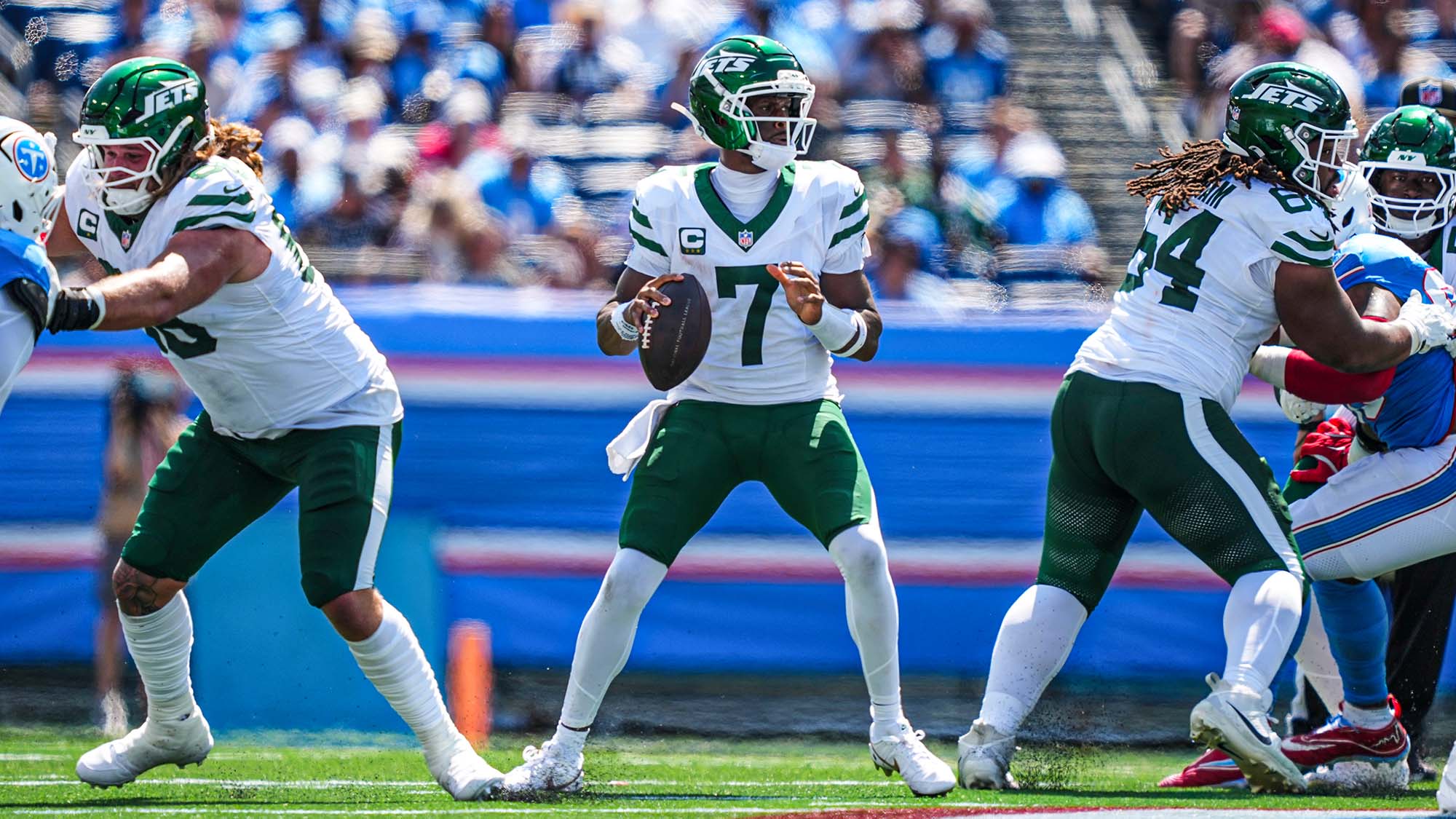
Great NFL teams never rest on their laurels. Even after near-flawless victories, their focus remains on the issues that demand improvement.
The New York Jets have had some nice wins over the years, even across a 15-year playoff drought. However, those wins are often treated as playoff wins. The team celebrates how much progress it has made for winning one measly game, and then the underlying issues in those wins go unaddressed and rear their ugly heads the following week.
Since 2020, the Jets are 8-18 (.308) coming off a win. They have struggled mightily to build upon their victories.
If the 2026 Jets want to separate themselves from the sad Jets teams of yesteryear, they must learn how to be greedy. One win shouldn’t be satisfying. Instead of touting the things that went well, the Jets should be obsessive over the things that went wrong, ensuring they don’t come back to bite them.
Here are three problems that New York must address after a one-sided season-opening victory in Nashville.
1. Third-down offense
The Jets moved the ball with relative ease against the Titans, collecting 367 total yards and maintaining possession for nearly 39 minutes. However, they left points on the board throughout the afternoon, and their third-down offense played a big role in that.
New York converted just 2 of 12 third downs (16.7%), although one of those was a game-ending kneeldown, making it really 2 of 11 (18.1%). This was partially mitigated by the Jets going 2 for 2 on fourth down, negating two of the nine failed third downs, but New York won’t want to count on perfect fourth-down success every week to sustain drives.
The good news is that the Jets don’t seem far off from fixing their third-down offense. Three of their nine failed third downs fell just one yard shy of the marker, while a fourth was two yards shy.
The opportunities were there; it just comes down to execution. On top of the just-short plays, one failed third down play came on a botched snap exchange. Another was a well-placed wheel route thrown to Braelon Allen, but the defender made a perfect punch-out to jar the ball loose. Additionally, the Allen throw came on third-and-5, whereas it should have been a much more manageable third-and-1 until Mason Taylor committed a false start penalty.
The Green Bay Packers allowed 8 of 15 third downs (53.3%) to be converted in Week 1, while their opponent third-down conversion rate across five full games without Micah Parsons is 46.7%, so the Jets have a favorable chance to get back on track here.
2. Containing the QB
As long as the Jets kept Cam Ward in the pocket, the Titans’ offense went absolutely nowhere. The pressure was getting home, the coverage in the back end was tight, and Ward wasn’t making the necessary tight-window throws to overcome that predicament.
However, the Jets’ edge rushers tended to overpursue to the inside and allow Ward to get outside of the pocket. Much of the Titans’ offensive success came on plays when Ward was able to escape toward the sideline.
Ward rushed four times for 21 yards and two first downs, while he also threw two chain-moving completions outside the pocket. Those four conversions made up over one-third of the Titans’ total offensive first downs (11) in the entire game.
This week, the Jets will be facing a much more dangerous quarterback in Jordan Love. While Love is only slightly more willing to run than Ward (Love averages 3.0 rushes per game since 2025 versus Ward’s 2.4), he is far more prolific as a passer when allowed to roam outside of the pocket.
It is also important for the Jets to sharpen their habits in this area early in the season, as they won’t want to be dealing with the same problems when they face Josh Allen and Drake Maye later on.
3. Runs to the left
New York didn’t have to deal with Tennessee’s run game very often. Since the Jets dominated the scoreboard and the time of possession from the jump, the Titans had to go into pass-first mode for much of the afternoon, finishing the game with just 10 designed runs.
When the Titans did decide to run the ball, they exposed a minor wart that is worth monitoring: the right side of the Jets’ run defense.
When Tennessee ran to the left (New York’s right), they picked up 36 yards on just five carries (7.2 yards per carry), including two first downs.
These are the Jets defensive linemen who logged the most reps on the right side of the defense:
- EDGE Kingsley Enagbare (24)
- EDGE Will McDonald (19)
- DT Harrison Phillips (16)
- DT David Onyemata (16)
- EDGE David Bailey (10)
- DT Jowon Briggs (8)
- DT T’Vondre Sweat (7)
- DT Darrell Jackson Jr. (2)
Many Jets players had some shaky reps that they can study on tape.
Titans running back Tony Pollard had a 13-yard run to the left in which Will McDonald Darrell Jackson Jr. were pinned inside, while linebacker Jamien Sherwood was unable to scrape over the top and close the gap in time, getting walled off by a tight end at the second level.
Tyjae Spears had a 10-yard run to the left in which David Onyemata and David Bailey were both driven multiple yards off the ball. Spears ran right by Onyemata as the veteran DT failed to shed his block and make the stop, while Bailey made the stop 10 yards downfield after already allowing the hole to open up.
Pollard also had a 5-yard run on second-and-8 through the left A-gap; Kingsley Enagbare made a great move off the left edge to get into the backfield, but he missed the tackle. T’Vondre Sweat was initially lined up at 1-technique in the gap that Pollard eventually ran through, but Sweat overpursued the play to the opposite side, vacating the gap for Pollard to rumble through on his way to a solid pickup.
The silver lining is that New York’s run defense was dominant when Tennessee ran right (to the Jets’ left). On five carries to the right, the Titans picked up just 11 yards (2.2 yards per carry).
Overall, the Jets had a so-so game against the run from an efficiency standpoint, allowing 47 yards on 10 designed carries (4.7 yards per carry). The sample was too small to yield any major takeaways, but on the carries New York did face, they are capable of better, even if their performance was far from alarming.
If the Jets want to field a strong defense this year, they should strive to allow fewer than 4.7 yards per designed run. The run defense did not get much attention in Week 1 due to the minimal volume of attempts, and it was definitely not a major enough issue to raise any bright red flags, but it deserves to be mentioned among areas where the Jets can seek to play even better after a game in which little went wrong.
