
Gotham City is as well known for its notorious villains as it is for its watchful protector.
In the real-life Gotham City (well, a few miles west of it), there lies a cruel, villainous entity known as the New York Jets. While they have yet to be convicted of any bank robberies to the degree of The Joker’s brilliantly executed heist in the opening of “The Dark Knight” (if only the Jets’ offense could operate that smoothly), they are guilty of robbing millions of fans of their happiness each fall.
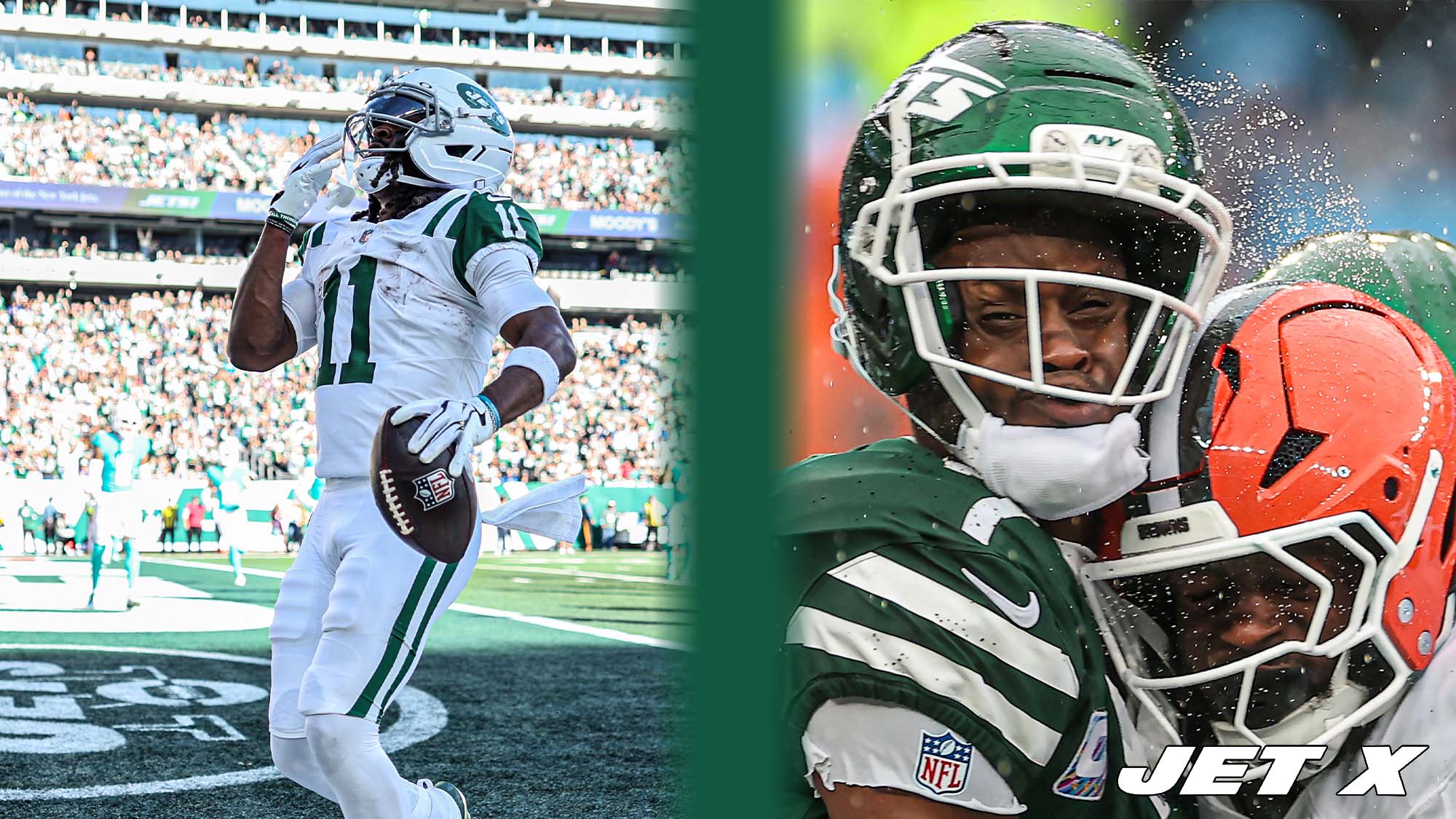
The 2026 iteration of the Jets has brought upon familiar suffering over the first seven weeks of the latest NFL season, losing five of their first seven games. In the process, their offense has looked highly reminiscent of another one of Batman’s most famous adversaries: Two-Face, the alter ego of Harvey Dent.
Two-Face’s origin story varies (like any comic book character), but the end result remains the same: a traumatic event leaves his body half-scarred and half-intact. Akin to the perfect 50-50 split of his face, he relies on a coin flip to determine the fate of his foes.
When analyzing the 2026 Jets offense, you see a perfectly balanced, 50-50 split between two completely different identities: one as charismatic and inspiring as Gotham’s former district attorney, and one as grotesque as his newer half.
New York’s offensive success can be split straight down the middle of the football field. Before reaching the 50-yard line, they’re about as good as it gets across the NFL. After they cross that line, a different guy shows up.
According to FTN Fantasy, the Jets are averaging 0.097 EPA (Expected Points Added) per play from their own goal line to the 50-yard line, ranking fifth-best in the NFL. They are joined at the top of the list by some elite company.
EPA per play on snaps from own goal line to 50-yard line:
- San Francisco 49ers (0.179)
- Kansas City Chiefs (0.129)
- Buffalo Bills (0.116)
- Dallas Cowboys (0.114)
- New York Jets (0.097)
- Jacksonville Jaguars (0.080)
- Detroit Lions (0.072)
- New England Patriots (0.071)
That’s a who’s who of the NFL’s best offenses.. and the New York Jets.
Seven of those eight offenses currently rank top-15 in scoring based on points per drive. The exception is the 21st-ranked Jets.
Why? Well, on plays from the 50-yard line to the opponent’s goal line, the Jets’ EPA per play nosedives to -0.155, the worst mark in the NFL. They are right behind the Los Angeles Chargers (-0.146) and the Tennessee Titans (-0.131), which is not the company you want to keep.
Simply put, the Jets’ offense has been tremendous at pushing the ball out of their own territory, but after that happens, they smack into a wall, which prevents them from putting points on the board even though they excel at getting into scoring position in the first place.
Why is this?
Well, when you break down the Jets’ offensive strengths and weaknesses, it makes sense why they thrive with an open field but gradually fold as the field condenses.
The best aspect of the Jets’ offense this season has been their deep passing. Geno Smith is completing a league-best 61.1% of his deep passes, a completely absurd number; that’s better than the overall completion percentage of seven qualified quarterbacks.
Since his elite deep passing is most accessible when he has ample room to work with, Smith has been absolutely prolific before reaching the 50-yard line. From the Jets’ goal line to the 50, Smith has completed 91 of 127 passes (71.7%) for 1,108 yards, a touchdown, and no interceptions. His 1,108 passing yards are the fifth-most, while his 100.8 passer rating on these throws is the second-best, trailing only Jared Goff.
Due to threat of their deep passing game, the Jets have also been able to run the ball at around a league-average level on their own side of the field, thanks to Smith backing defenses off. The Jets are 14th in EPA per rush attempt up to the 50-yard line.
Everything falls apart after the Jets hit the 50, with each weakness influencing the next.
For starters, the Jets gradually lose access to their dominant deep passing game, so defenses become more comfortable playing man coverage as their fear of getting beat over the top decreases. This is a major problem for the Jets, as they have struggled to win against man coverage in high-leverage spots.
When facing man coverage after reaching the 50-yard line, New York ranks last with -0.239 EPA per dropback. Sacks are an enormous issue on these plays, as they lead the league with both 10 total sacks and a 27% sack rate. Think about that: Once the Jets get to the 50, if the opponent calls man coverage, there is a more than 1 in 4 chance of a sack.
While Geno Smith has been at fault for many of the Jets’ sacks this season due to his tendency to hold the ball a beat too long (and his inability to escape sacks due to immobility), these particular sacks have been mostly the offensive line’s fault.
Against man coverage past the 50-yard line, the Jets are averaging just 2.62 seconds to throw, well below Smith’s overall season average of 2.96, so he’s doing what he can to get the ball out. The problem is that opponents start man-blitzing the heck out of the Jets after getting backed into on their own side of the field, and New York’s offensive line can’t handle it.
From the 50-yard line onward, the Jets have faced a blitz on 48.6% of man-coverage dropbacks, the league’s fourth-highest rate. On those plays, the pressure got home in an average of 2.73 seconds, so the offensive line is letting people get in Smith’s face fairly quickly.
With defenses playing more aggressively as the field gets condensed and the Jets’ deep game disappears, life gets tougher for the run game. After reaching the 50-yard line, the Jets drop from 14th in EPA per rush attempt to 30th.
Short-yardage runs have been the Jets’ nemesis in this area. From the 50-yard line onward, the Jets have converted just 4 of 10 third or fourth-down designed rushes with one yard to go, a conversion rate of 40%, lightyears below the league average of 71%.
New York’s obsession with running in these situations has made them predictable. On third or fourth down with one yard to go at or past the 50-yard line, the Jets have called a run 10 of 12 times (83%). Each of the two times they called a pass, they converted.
There is an overall theme here: The Jets’ offense isn’t afraid to chuck up bombs when they have a sea of grass to work with on their own side of the field, but once they get to the 50, they curl up into a ball. They stop being aggressive through the air, defenses clamp down, and the Jets play into their hands.
Through a blend of an inability to beat man coverage, an offensive line that cannot handle man blitzes or run-block in short yardage, and a play-caller in Frank Reich who plays it a bit too safe and predictable in high-leverage spots, the Jets are a horrifying sight on the opponent’s half of the field. To their credit, they are quite tantalizing on the other half, but it won’t translate to many points if they continue their Two-Face act.
