

The ironic part of a heartbreaking NFL defeat is that a lot of things must have gone right in the first place for the loss to qualify as heartbreaking. It’s just that the pain of the heartbreak overrides those positives, so the negatives understandably overtake the headlines throughout the week.
But those positives should not be tossed to the wayside. They still happened. Therefore, they should still be covered.
Your team. Your decisions.
Jet X Game Simulator
Win a Free Lifetime Membership
Beat any of the five Legend challenges without simulating.
Play the weekly matchup or relive a classic. All four current-matchup modes are free. Log in to save Coach Points; members unlock every Classic game and challenge.
Play NowOpens the full-screen game in this tab. Free current matchup · Premium Classics.
The Jets were on the verge of starting 2-0 with an upset win over the Green Bay Packers. They held a 17-7 lead with under 10 minutes to go in the game and had Matt LaFleur’s team on the ropes before things suddenly collapsed.
Most of the credit for that lead is owed to the defense, which played a phenomenal game, holding Green Bay to 199 total yards.
Offensively, though, the Jets did enough to control the game, even if they struggled to finish drives. They racked up 21 first downs and held the ball for 37 minutes and 40 seconds.
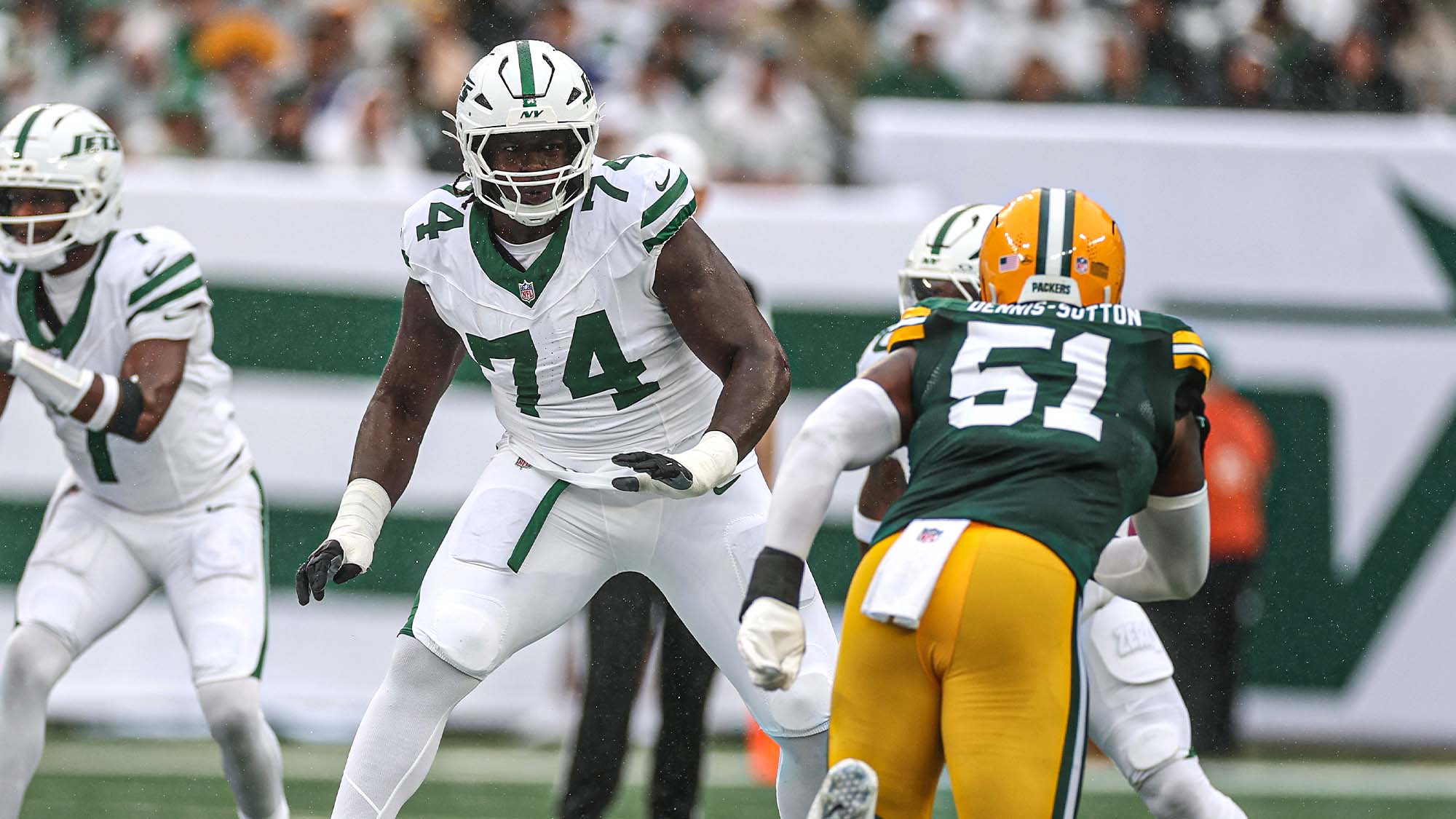
Much of the credit for that is due to a facet of the Jets’ offense that is starting to emerge as a potentially elite unit through two weeks: the pass protection.
The New York Jets are an elite pass-blocking team?
The Jets’ pass protection hasn’t been known as anything but a colossal liability since the glory days of 2008-10. Outside of quarterback play and coaching, it’s arguably been the next-biggest reason for the team’s 15-year playoff drought.
Going into 2026, there were hopes that the Jets might finally be on the verge of returning to the league’s upper echelon in pass protection. The team had a middle-of-the-pack pass-blocking season in 2025, which was a noticeable step up from their usual horrid performance in that area.
Considering that the unit was led by a trio of highly drafted, homegrown young players, and would be maintaining excellent continuity (four of five starters returned after playing all 17 games together in 2025), there was legitimate optimism around a possible leap into top-10 status this season.
So far, the Jets’ offensive line has accomplished that and then some.
Through two weeks, these are the NFL’s top teams in Pro Football Focus’ pass-blocking grade:
- New York Jets (77.4)
- Carolina Panthers (76.7)
- Las Vegas Raiders (74.9)
- San Francisco 49ers (74.1)
- Cleveland Browns (73.9)
Nope, you aren’t dreaming—that’s the New York Football Jets ranked first in a metric related to pass protection.
Despite the Week 2 loss to Green Bay, the Jets’ pass protection put on another show. For the second straight week, starting quarterback Geno Smith was consistently able to stand tall in the pocket and go through multiple progressions without being hindered by the pass rush.
The numbers back it up. In both games this season, Smith averaged over 3.00 seconds to throw (comfortably above the 2025 NFL average of 2.87), yet was still pressured on under 36.3% of his dropbacks, which was the 2025 NFL average.
- Week 1 at Titans: 3.12 seconds to throw, 23.7% pressure rate
- Week 2 vs. Packers: 3.05 seconds to throw, 32.7% pressure rate
Through two games, Smith has taken the fifth-lowest pressure rate among 32 qualified quarterbacks at 29.3%, despite averaging the 10th-highest time to throw at 3.07 seconds. He is the only quarterback who has been pressured on under 30% of his dropbacks while averaging 3.00+ seconds to throw.
These types of numbers are strongly indicative of high-quality pass protection, backing up the Jets’ PFF grade in that area (since PFF grades are so hotly debated).
Typically, there is a correlation between time to throw and pressure rate, which is why neither metric can tell you much about a team’s pass protection without being used in conjunction with the other.
If a quarterback gets the ball out quickly, he tends to take pressure less frequently, making the offensive line look great even if their actual blocking isn’t moving the needle. The opposite is true, as shown by the Justin Fieldses of the world; if a quarterback tends to hold the ball too long, he will make his offensive line look worse by taking pressures on plays when the ball should’ve been out.
A higher time to throw typically causes a higher pressure rate, and vice versa. So, if you have a quarterback with a high time to throw but a low pressure rate, it shows that the offensive line is holding up well on its own for extended periods of time. They are keeping the quarterback safe through their own blocking success, rather than being buoyed by quick passes.
To be clear, this isn’t even to say that Smith is holding the ball too long, a la Justin Fields last year. Smith’s career-average time to throw is 2.87, identical to the 2025 league average, so he is holding it longer than he usually does. That’s because he has simply been taking advantage of the time afforded to him by his offensive line. The protection has been good enough for him to comfortably hang in the pocket and trust that he can go through his reads without panicking.
The Jets’ pass protection certainly was not perfect against the Packers. It fell apart in overtime, yielding back-to-back sacks on Smith to start the opening drive of the extra period.
For most of the game, though, the pass protection was the offense’s saving grace. With New York’s run game stuck in the mud, the passing attack had to bail the team out of numerous long-distance situations. Smith was able to do that on many occasions, thanks largely to the pass protection allowing him to stand in the pocket and scan through his progressions.
As for the run-blocking woes, the offensive line itself actually graded well in this game, whereas it was the skill-position blockers who were tabbed as the primary culprits for New York’s lack of space in the run game.
The Jets’ offensive line is emerging as a potentially elite unit through two games. There are questions to be answered in the run game after a rough Week 2, particularly when grouping in the entire blocking scheme (rather than just the five linemen), but in pass protection, New York has been nothing short of a brick wall up front.
