
One of the things that makes football great is the plethora of one-on-one matchups that go into determining the outcome of each play.
Unlike baseball and basketball, plays on a football field are rarely determined by a single one-on-one matchup. Usually, there are 11 different matchups happening simultaneously, each influencing another, ultimately forming a chain reaction that leads to the final result. Every rep is an enormous chemical equation.
Television broadcasts and fantasy football have trained viewers to ogle at the ball, but football is often the most fascinating when you take your eye off the pigskin.
Without further ado, here are three overlooked matchups to watch in today’s Jets-Browns game.
Browns C Elgton Jenkins (No. 74) vs. Jets DT T’Vondre Sweat (No. 99)
Cleveland missed starting center Elgton Jenkins last week due to a concussion, but he will return at MetLife Stadium, looking to continue his strong start to the season.
Jenkins has been the league’s top pass-blocking center so far. Through three starts, Jenkins has allowed one total pressure, including no sacks or hits. His 82.4 pass-blocking grade from Pro Football Focus ranks first at the position.
Meanwhile, Jets nose tackle T’Vondre Sweat is off to a solid start this season. Sweat had been up-and-down through three games, but after an excellent Week 4 in Chicago (a rarity across the Jets’ roster in that game), his season-long numbers are quite good.
The 366-pound Sweat does not get much attention for his pass rushing, but he is actually effective in that area for a player of his size. Against Jenkins, Sweat’s pass-rush game will be put to the test.
As the Jets look to get their edge rushers going in the sack department, they need to generate some interior cave-in to flush quarterbacks toward Will McDonald and David Bailey. Sweat has a tall task in front of him today as he aims to accomplish that goal.
Keep an eye on those Sweat-versus-Jenkins matchups in the middle. If Jenkins consistently stalls Sweat, it could be another long day for the Jets’ pass rush. But if Sweat can push the pocket and make Deshaun Watson retreat backward, he may set up a sack or two for Bailey or McDonald, who haven’t been able to do much in recent weeks besides quickly run themselves behind the quarterback.
This matchup is a compelling one in both phases. While Jenkins has the edge in the pass game, Sweat is favored in the run game.
Throughout his eight-year NFL career, Jenkins has consistently fared better as a pass protector than a run blocker, and that’s been no different in 2026 so far. His 52.9 run-blocking grade from PFF ranks 26th out of 32 qualified centers.
Sweat, of course, is renowned for his ability to eat space in the run game.
On run downs, Sweat will be expected to hold his ground against Jenkins, building a wall that allows his teammates to rally and stuff runs in the backfield. That would help set up more manageable second and third-down situations.
Last week against the Bears, the Jets constantly allowed at least four yards on first down runs, which prevented the defense from entering second and third-down situations where they could tee off on the quarterback. They need Sweat to take advantage of his run-game edge against Jenkins to help create those favorable pass-rush situations.
Browns tight ends vs. Jets EDGE Kingsley Enagbare (No. 52)
Despite their 3-1 start, it hasn’t all been pretty for the Browns. They have plenty of weaknesses to address, namely a run game that ranks 25th with 3.7 yards per rush attempt.
Cleveland has been particularly awful at running outside of the tackles, averaging 3.2 yards per attempt. Much of the blame for that goes to their tight end unit, which has been utterly abysmal in the blocking department.
Cumulatively, the Browns’ tight ends have combined for a 45.0 run-blocking grade at PFF. Not only does that rank last among tight end units, but the gap between them and 31st (New England, 52.3) is larger than gap between 31st and 16th (Houston, 59.0).
All of Cleveland’s tight end snaps have been taken by Harold Fannin Jr. (No. 44) and Blake Whiteheart (No. 86), with Fannin being the starter and primary receiving target while Whiteheart is the blocking specialist. Both players, though, have posted sub-50.0 run-blocking grades this season, and if you don’t trust the PFF grades, the Browns’ terrible YPC on outside-the-tackles runs speaks for itself.
This is the perfect day for the Jets to bring back Kingsley Enagbare, their best edge-setter. Enagbare missed last week’s game in Chicago and was sorely missed. The Jets’ run defense simply could not hold up with David Bailey and Will McDonald starting alongside one another and both playing the majority of the snaps.
Enagbare will bring much-needed sturdiness back to New York’s outside run defense. His presence should ensure that the Jets punish the Browns’ tight ends for their lackluster blocking skills, producing consistent stuffs on outside runs.
Standing at 6-foot-4 and 258 pounds, Enagbare brings a broad build to the defensive end position, which he uses to set a firm edge. Watch him closely against Cleveland’s tight ends today. This should be a major mismatch in the Jets’ favor. If Enagbare takes advantage of it, Cleveland’s outside runs should frequently be redirected back toward the inside, where the Sweat-versus-Jenkins matchup awaits.
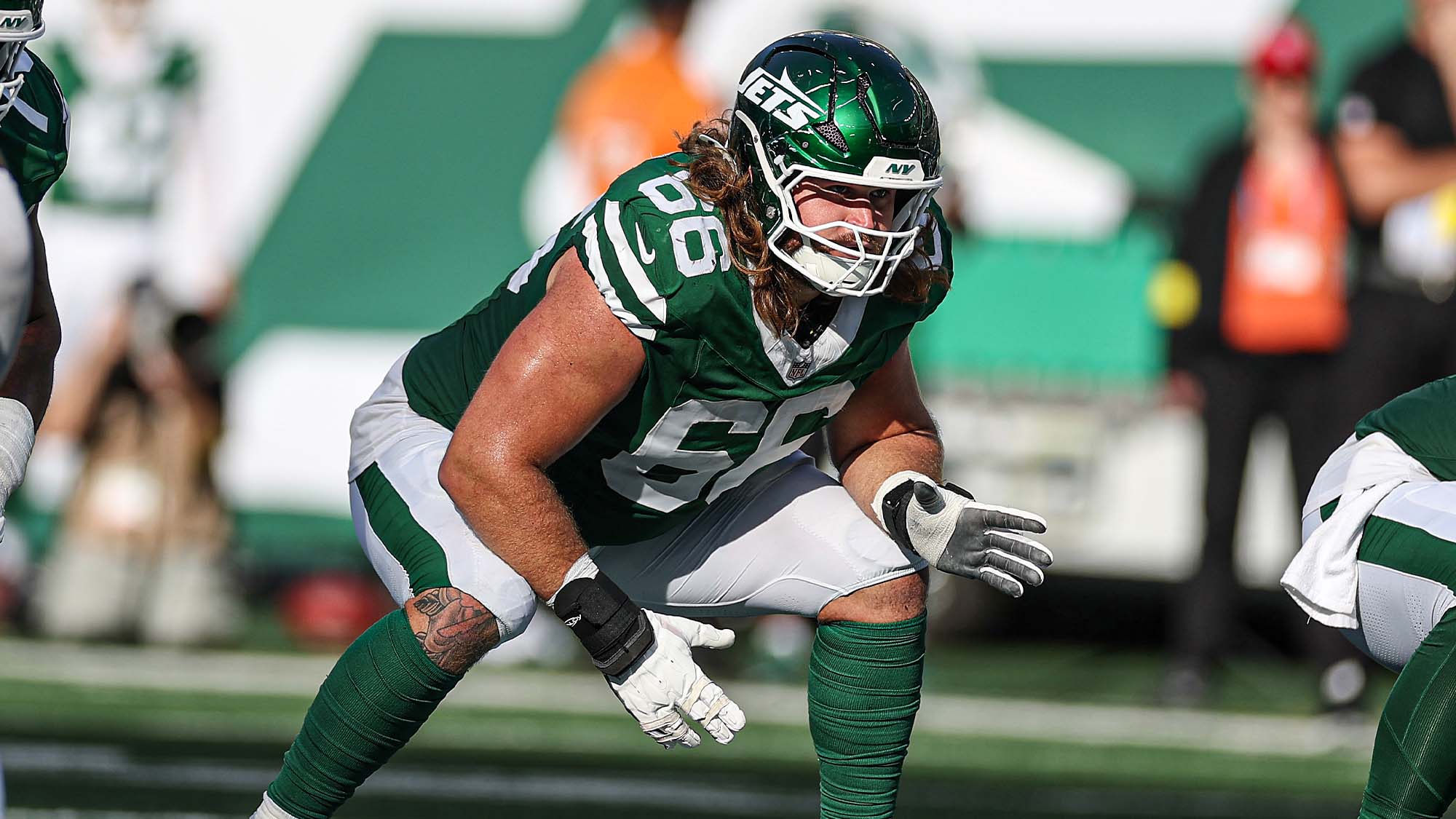
Browns DT Maliek Collins (No. 96) vs. Jets RG Joe Tippmann (No. 66)
The second-year breakout of 2025 fifth-overall pick Mason Graham has been among the primary reasons for Cleveland’s surprising start. Graham already has 4.0 sacks, the most among defensive tackles.
However, Graham will be absent for today’s game, which means his fellow starter, 11th-year veteran Maliek Collins, will have the onus of picking up the pass-rush slack.
Collins, who has always been better known for his pass rushing than his run defense, has remained a solid pass rusher in the later stages of his career. He came into 2026 with at least five sacks in each of the past three seasons, and he already has one within the first four games this year. Collins is also tied for 17th among defensive tackles with 11 total pressures.
So far, Collins has played most of his snaps on the left side of the defensive line, across from the right guard. It remains to be seen whether Cleveland will adjust due to Graham’s injury, but if Collins stays home on the left side, his primary matchup will be Jets right guard Joe Tippmann, who has been New York’s most consistent offensive lineman.
Tippmann is more than ready to handle Collins in pass protection. The Wisconsin product has been credited with allowing three total pressures (including zero sacks) on 145 pass-blocking snaps, per PFF. His allowed pressure rate of 2.1% is the ninth-best mark among 63 qualified guards.
Meanwhile, in the run game, Tippmann should have a major advantage against Collins. Tippmann’s 72.3 run-blocking grade at PFF ranks 11th among right guards, while Collins has a 52.1 grade as a run defender.
PFF grades aside, the Jets show their faith in Tippmann’s run-blocking—along with RT Armand Membou—by leaning fairly heavily toward calling runs in his direction. The Jets have run to the right side on 57% of their designed rushes, compared to 43% to the left.
So, the Jets are likely to emphasize the Tippmann-versus-Collins matchup in the run game fairly often, especially in a game that is projected to (again) feature plenty of rain at MetLife Stadium. Advantage: Jets.
The pass game, though, is where this matchup will hold the most weight. Whether Cleveland can replace Graham’s pass-rush impact is perhaps the biggest variable in today’s game. Collins will be primarily responsible for filling the void, and Tippmann will be tasked with containing him.
If Tippmann continues playing the way that he has so far, the Jets’ offensive line should be in a strong position to win the battle of the trenches.
