
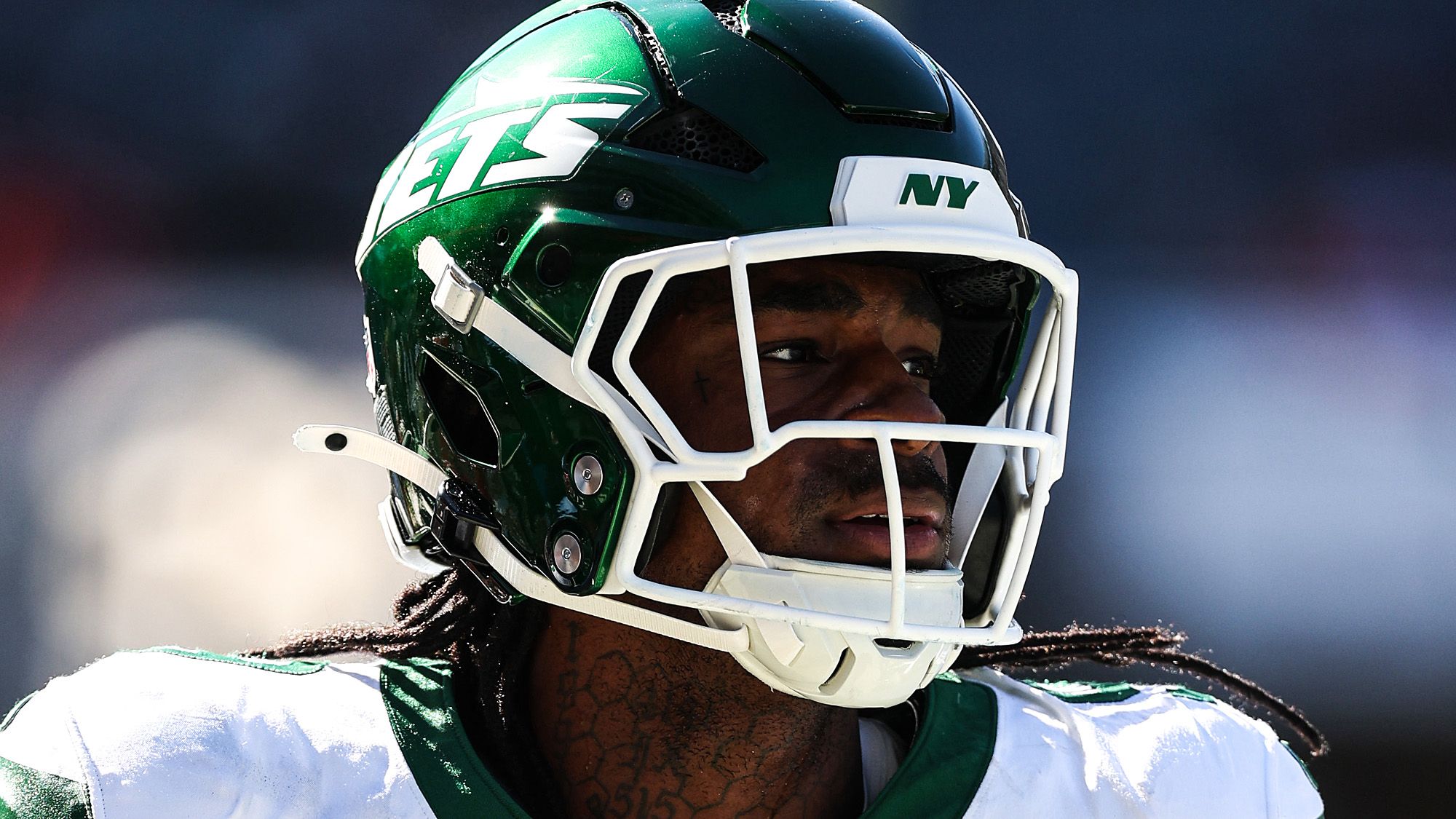
For the New York Jets, the goal moving forward should be to identify long-term building blocks on both sides of the ball.
At 2-5, New York’s playoff hopes are quickly fading, causing many fans to shift their focus to the long term. Conversations around the team are centered on figuring out which players can be legitimate pieces for years to come.
In those conversations, Will McDonald’s name commonly comes up. What is the 2023 first-rounder’s true value? Starter? Pass-rush specialist? Even that?
New York faces a fascinating dilemma with McDonald, which they can approach from several angles.
What should the Jets do with McDonald?
After being selected in the first round of the 2023 NFL draft, McDonald is in the final year of his rookie contract, though the Jets exercised his fifth-year option in May, which means he remains under team control next season.
While he’s under control, the Jets aren’t locked in to keeping him or giving him a long-term extension. Given their current standing, they could consider trading him at the deadline, which our own Michael Nania recently outlined.
This season, McDonald’s snap count has plummeted from 66% to 46%, a notable decrease in his role. That suggests the Jets don’t view him as an every-down edge rusher, which is true. Entering this year, his limitations as a run defender had become painfully obvious.
In Aaron Glenn’s system, McDonald just hasn’t looked to be a fit. He isn’t playing nearly as much, his struggles are persisting against the run, and his bread and butter, pass rushing, has fallen off drastically.
Through seven games this season, the edge rusher has generated just two sacks and 14 pressures, ranking 45th among 133 qualifiers at his position in sacks and 55th in pressures. Much of that production came in the season opener. Over the last six games, he has just one sack and nine pressures.
When McDonald doesn’t consistently have the opportunity to pin his ears back and go after the quarterback with his burst and athleticism, what does he offer? His all-around game is arguably not even starting-caliber for an edge rusher.
McDonald’s lone calling card is pass rushing, so when he isn’t impacting the game in that facet, he isn’t exactly doing much to help the defense. Right now, he just doesn’t look like a long-term piece for the Jets.
As Jet X’s Robby Sabo recently broke down, the Jets should start steering away from these types of specialized players. McDonald’s one-dimensional game makes him a difficult piece to fit into the scheme.
The Jets have a few options with McDonald. First, they could look to trade him at the deadline and scour the market to see what he’s worth. They could also wait to try to make a move in their offseason or give him another chance next season to prove that he’s worth an extension.
Let’s explore the deadline option. The Jets have two games (vs. Las Vegas and at Kansas City) before the trade deadline, which is set for Nov. 10, the Tuesday after Week 9. Perhaps McDonald can fill up the stat sheet over the next two games, and the Jets can capitalize on trading him while his value is high.
Even if he balls out, the question is what the Jets would get in return. A fourth-round selection? Something in that range? It seems hard to believe that the Jets could get a Day 2 pick in exchange for the Iowa State product. Perhaps the package could look like a Day 3 selection along with a young player, maybe a young edge.
Or, they could wait until the offseason. If his value just isn’t there at the deadline, give McDonald 10 games to raise his stock, then reconsider a deal in the offseason.
Lastly, they can ride out his fifth-year option, hoping he can flash his elite pass-rushing traits with a level of consistency that he has not displayed over the past two seasons.
Would that be beneficial, though? His struggles against the run are evident, and he’s pretty much established himself as an up-and-down pass-rushing specialist.
At this point, how high is McDonald’s ceiling? He’s already 27 years old and has been in the league for three-and-a-half seasons. Aside from his rookie-to-sophomore jump, there haven’t been notable improvements, and over the past two years, his consistency has started to dwindle.
Taking McDonald out of the equation, the Jets most likely have just two edge rushers on their current roster who they will want to rely on next season: No. 2 overall rookie David Bailey and Kingsley Enagbare. While Enagbare will be a free agent, he has played well enough that the Jets will likely be strongly interested in bringing him back. He has been the Jets’ most valuable chip in that room this season.
Joseph Ossai is also under contract, although he has gone through an injury-plagued season, making it difficult to evaluate him. The Jets would incur a $17.2 million dead money charge by releasing him this offseason, so he will likely be back as well.
Eventually, the Jets will have to make a decision on McDonald. Whether it’s at the deadline or in the offseason, the Jets must assess his value and decide how to move forward with him.
