
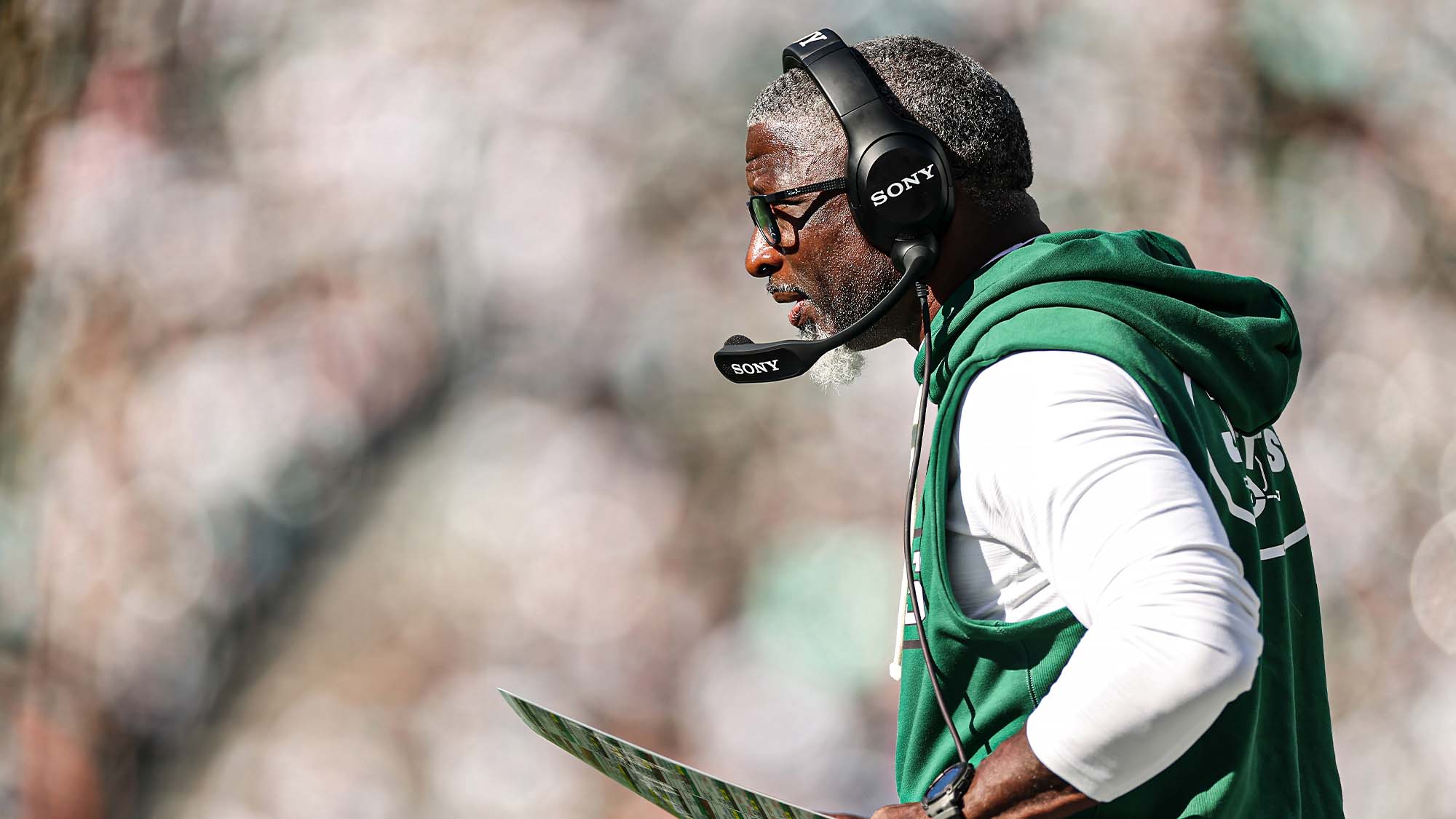
The 2026 New York Jets are 2-6, a record that will always frustrate an NFL fanbase and generate criticism from the media. But for this particular Jets team, it’s not just about the record, but the way they have arrived to it.
New York keeps losing games in the same fashion: They play competitively behind the impressive individual displays of many of the roster’s key building blocks, but manage to lose due to follies in high-leverage spots, which often appear directly attributable to the coaching staff.
Thus, Aaron Glenn and his coaching staff are taking all the heat after New York’s latest loss, a 38-33 home defeat to the Raiders, in which the Jets’ young weapons looked dominant, but they still blew a two-score halftime lead to a team traveling cross-country with a four-game losing streak.
The flak is understandable, but sometimes, fanbases tend to blame the coaching staff only because it feels like the easiest fix for a struggling organization. If the team has a super-roster but is only being held back by an inept coach, it’s easy to envision the team turning into a juggernaut the following season if they could just replace the coach.
Not every coaching staff that takes heat from fans and analysts deserves it. But in this case, the blame appears to be completely justifiable.
According to one metric, the Jets’ coaching staff has indeed been the worst in the NFL—if you believe in the logic behind it, at least.
Your team. Your final drive.
Jet X Final Drive
Ten Jets eras. One defining finish.
Take the headset when the game is on the line.
Call the plays, manage the clock and chase a score—or make the stop. Choose your era and log in to post Coach Points.
Learn MoreExplore Final Drive and choose your era. Fresh situations. Every time.
The Jets’ whole is much less than the sum of the parts
Many people prefer to judge NFL coaching staffs based on a simple formula: Whole – Sum of Parts = Coaching.
Simply put, if the team’s final results are better than what you’d expect based on the cumulative talent of the roster, then the coaching staff must be making a positive impact, and vice versa.
This is an equation that can be solved using the eye test, but the eye test is endlessly subjective, making it extremely difficult to quantify a coaching staff’s impact.
Ahead of the Jets’ Week 8 game against the Raiders, we did our best to quantify this equation. Our methodology was to subtract the sum of a team’s parts from their whole (i.e., win-loss record) to generate a “wins above expected” metric that could theoretically be credited to the coaching staff, if you believe in the idea that the gap between the whole and the sum of the parts is the coaching staff’s responsibility.
The “whole” can be quantified by win-loss record, but the tough part is quantifying the “sum of the parts”. There will never be a perfect way to do it, but we figured that Pro Football Focus’ grading system was a decent approach for encapsulating the cumulative “talent” of each team.
Why? Well, despite their many flaws, PFF’s grading system is the only metric tracked across every position that is based on individual execution within what the player can control. It’s completely separate from whether the players’ efforts contribute to a team playing winning football as a unit. The grades are scored through an eye-test judgment of how far above or below expectations the player executed his role on each play.
PFF tracks an “overall team grade” for each team. This grade is not intended to convey how “good” the team actually is, but rather, it is an accumulation of the individual PFF grades from all players on the roster. As a result, it makes sense for quantifying the “sum of the parts”.
With linear regression analysis, we calculated “expected win total” for each team based on their team PFF grade. Essentially, we used the correlation between team PFF grade and win percentage to predict how many wins a team “should” have based on the cumulative individual execution of their players.
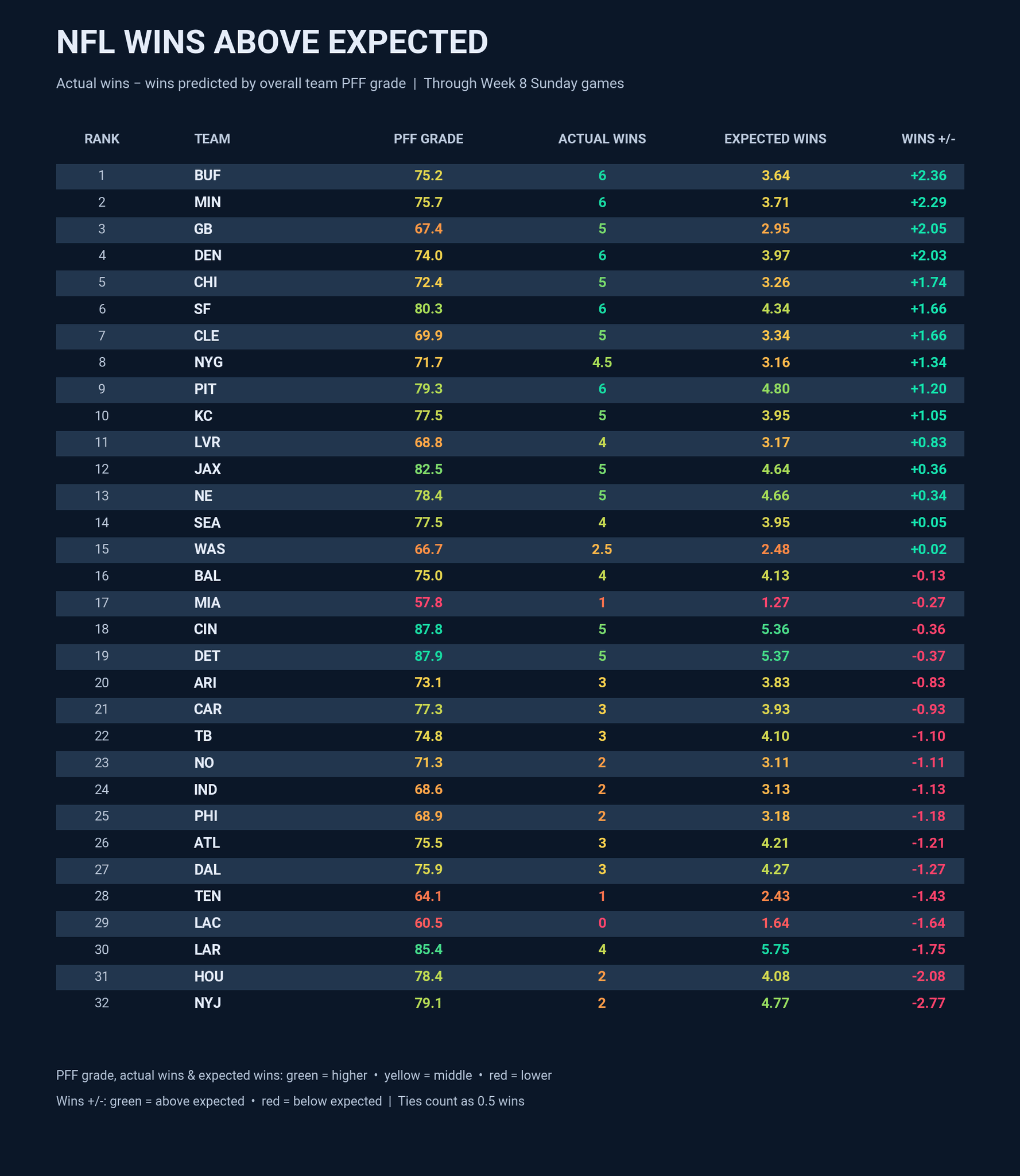
After Week 7, the Jets ranked 16th in team PFF grade (75.0) but had the fifth-worst win percentage (.286). With two wins compared to their 3.69 expected wins as predicted by their team PFF grade, the Jets had -1.69 wins above expected, placing 30th in the NFL.
Well, they just dropped a whole lot lower on that list after a game that perfectly encapsulated their season: Stocked with high-quality individual play, but dragged down to a loss by crucial team mistakes in the spots that most heavily affect the scoreboard.
After Week 8’s Sunday games, the Jets flew up to seventh-best in team PFF grade (79.1), while the loss dropped their win percentage to fourth-worst. They are now expected to have won 4.77 games based on their team PFF grade, whereas they have still only won two. Their -2.77 wins above expected is now the worst mark in the NFL, and it’s over a full win worse than the 30th-ranked Rams, a larger gap than the one between Los Angeles and 20th-ranked Arizona.
Here is the full list.
Here is a scatter plot that sorts each team by their team PFF grade and their win percentage. Teams below the red line are underachieving, while teams above it are overachieving. The Jets are further below the line than any other team (a visualization of their “wins above expected”).
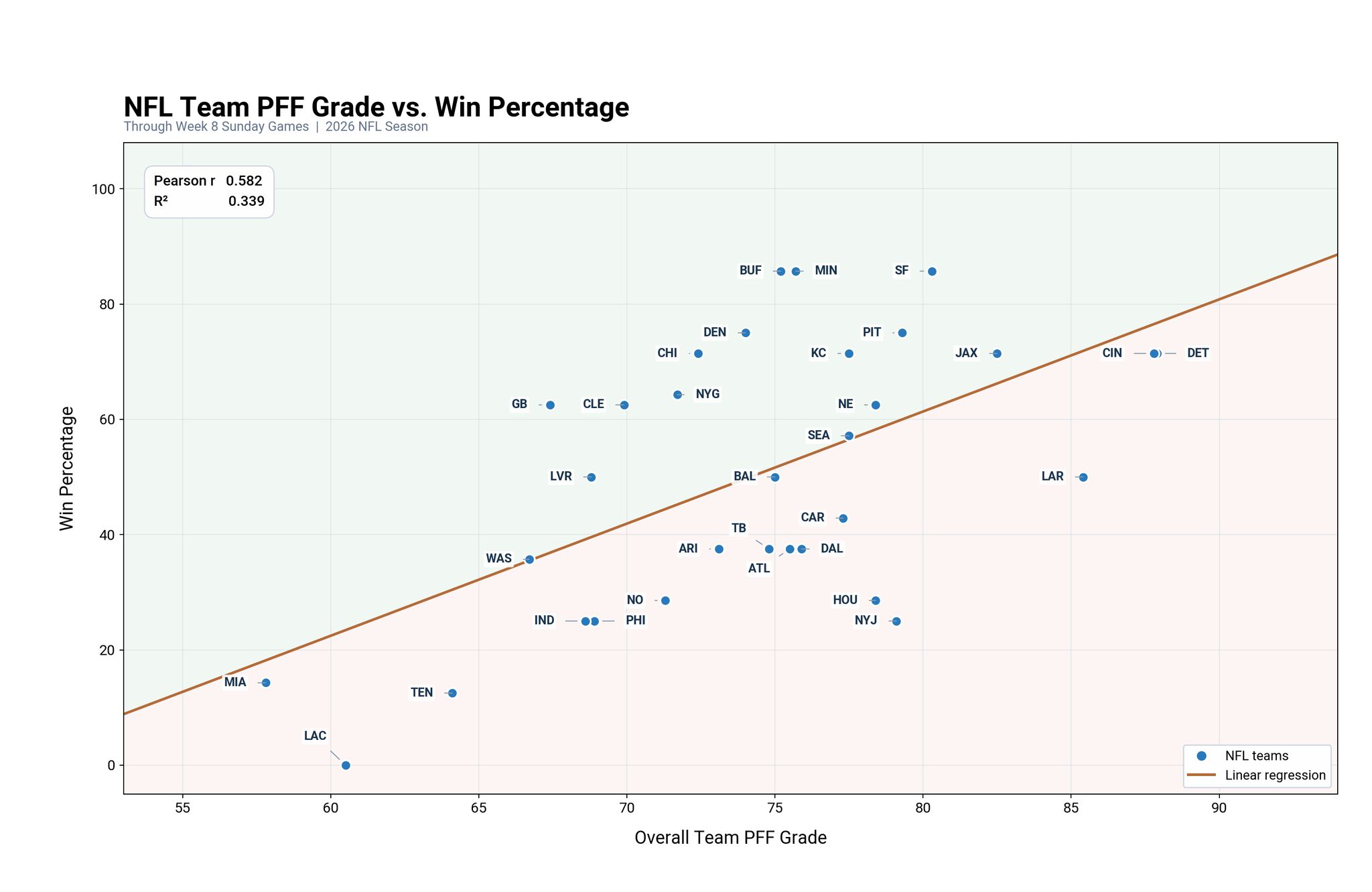
Save for the similarly disappointing Texans, most of the teams with similar team PFF grades to the Jets have above-.500 records. The six closest teams to the Jets in team PFF grade are the 49ers (80.3, 6-1), Steelers (79.3, 6-2), Texans (78.4, 2-5), Patriots (78.3, 5-3), Seahawks (77.5, 4-3), and Chiefs (77.5, 5-2), who have combined for a 28-16 record.
That’s a win percentage of .636, which isn’t far off from the .596 win percentage that the Jets are expected to have based on their 4.77-3.33 expected record. Instead, they’re a .250 team. In other terms, they are on pace to finish with 4.3 wins, whereas the cumulative individual execution of their players dictates that they should actually finish with 10.1 wins.
Of course, there are plenty of legitimate flaws in this analysis. You might think PFF grades are complete bogus and carry no weight whatsoever in any type of study. That’s fair enough. There is also the debate as to whether the Jets’ poor performance in big moments is more of a player-execution problem or a coaching problem.
If there were a perfect stat for evaluating coaches, we’d all be using it. There isn’t. We all do the best we can to judge coaches with the information at our disposal. This is just one way of measuring the impact of coaching. If you think its flaws negate it as a coaching metric, that is completely fair.
Still, it’s worthwhile to try and put some objective data to an often-emotionally-charged debate that is raging across the largest sports media market in the country. The Jets’ coaches have received plenty of vitriol from fans this year, and while it seems plenty justified based on the eye test, there is no harm in taking the analysis a step further to see if widespread fan criticisms hold up under an objective lens.
Sure enough, they do.
No NFL team’s whole is further below the sum of its parts… based on one rudimentary measure, at least.
