
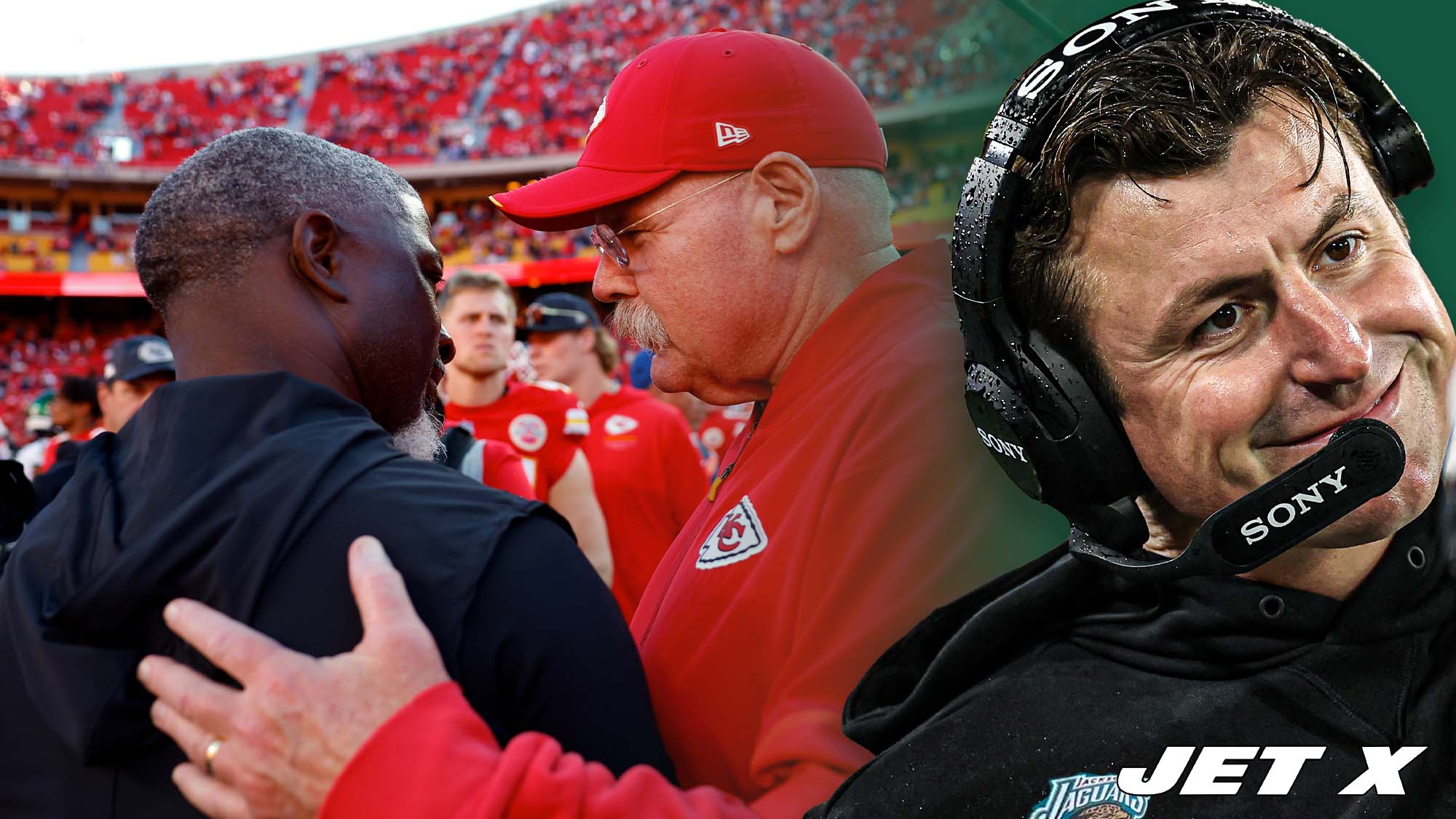
Those who do not learn from history are doomed to repeat it; or so they say.
The 2019 New York Jets were nothing to write home about. Their playoff hopes were gone before Halloween, they failed to score a touchdown in a quarter of their games, and their most memorable moment was an ESPN graphic of their starting quarterback pointing at the camera.
But as the 2026 Jets progress through the franchise’s latest hopeless season, the horrors of the 2019 squad are looming over them like a dark cloud. At 2-7, the 2026 Jets are on the brink of either succumbing to the foolish blunders of 2019 that doomed the franchise for years to come, or escaping the storm to find sunny skies and blissful times on the other side.
And as the season goes on, they are starting to lean heavily toward the latter fate.
The New York Jets are… exactly where fans should want them to be?
Before we get to the 2019 Jets team and its parallels to the Jets’ current predicament, it’s critical to understand where the Jets stand right now.
Long before the Jets’ 2026 season even began, they knew how high-stakes the 2027 offseason would be. After the 2025 trade deadline, they were armed with three 2027 first-round picks, and given the lack of franchise quarterback options at their disposal in 2026, they were highly likely to punt their pursuit of a centerpiece signal-caller to 2027 as well. Two seasons out, it was shaping up to be one of the most important offseasons in franchise history.
With the 2026 season more than halfway complete, those stakes have only risen. Their picks are projecting to be much better than expected, each currently slotting in the top 13, with two in the top six; it could be one of the most lucrative hauls of draft capital in NFL history. To boot, the Jets have learned that their current young core of talent is relatively strong compared to their record, and on the verge of being ready to anchor a consistent winner with another year of seasoning and the right coaching.
It all means one thing: The Jets simply cannot squander the 2027 offseason. Messing it up could ruin the franchise for a half-decade or more. There is no room for taking chances; they must have the utmost confidence in their plan.
To ensure they do their best not to squander the upcoming offseason, they have to be completely certain about something: The leaders in charge of using those assets.
General manager Darren Mougey doesn’t seem to be going anywhere. If the storyline of the 2026 season is that the Jets are underperforming compared to their talent, then the man in charge of raising the talent level should be rewarded, not punished. It’s the coaching staff that seems to be holding the team back from where it should be, based on its collective on-paper talent.
Given this, when the dust settles on 2026, the Jets have to ask themselves a question, and they must answer it with brutal honesty.
Here’s the deal. The Jets know what they need from their head coach in 2027: Someone who can cohesively work with Mougey to choose the right players with three first-round picks and oodles of cap space, build an environment that puts those players in the best positions to succeed, and, most importantly, properly develop a franchise quarterback. So, the million-dollar question is, who do the Jets trust more to achieve those goals: Aaron Glenn or the field?
That brings us back to 2019.
While the Jets’ 2019 head coach, Adam Gase, was in his first season, compared to Glenn currently being in his second, it’s fair to say that Gase was immediately under similar pressure and expectations to Glenn.
The Jets hired Gase fresh off three seasons as the Miami Dolphins’ head coach, and he was a controversial hire, given his 13-19 record over the previous two seasons. Considering that the Jets were entering the second year of franchise quarterback Sam Darnold’s career and had spent an absurd amount of cap space on big-ticket stars in the offseason, Gase was expected to have the Jets in the playoff hunt right away.
If he couldn’t do that, it would be Gase’s third straight season failing to lead a winning team as a head coach. That would be enough of a sample size to determine that he didn’t deserve any more rope beyond that season.
Gase quickly justified concerns about his hire. By the halfway mark, the Jets were 1-7, with five of the losses coming by at least 14 points. While Darnold missed three of those games, the Jets were inexcusably non-competitive in those three losses, getting outscored 84-23. Even after Darnold returned, the Jets went 1-3 in his first four starts back, getting outscored 110-57.
By November 9, 2019, it seemed that Gase’s bed had been made. Darnold had regressed in his second year, the team was getting blown out left and right, and embarrassing moments were stockpiling. Given that Gase already had a three-year sample size of head coaching in the rearview, it did not feel like there was anything Gase could conceivably do over the next eight games to prove that he was the Jets’ answer at head coach.
On November 10, things turned for the Jets. They narrowly defeated the 2-7 New York Giants in a MetLife Toilet Bowl, kickstarting a 6-2 close to the season.
When it was all said and done, the standings showed a 7-9 record, a three-win improvement over Todd Bowles’ performance in 2018. They were also 7-5 after Darnold’s Week 5 return.
Those surface-level win-loss numbers made it easy for the Jets to justify keeping Gase instead of admitting they screwed up so badly that they had to fire their head coach after one season. Beneath the 6-2 finish, though, it was obvious that no real progress had been made, at least not enough to alter Gase’s outlook as a head coach.
Only one of the Jets’ six wins came against a team above .500, and it was a season-finale win over a Bills team that rested its starters. Even then, the Jets only won 13-6. Overall, the wins leaned toward unimpressive, including a seven-point win over the 2-7 Giants, a one-point home win over the 3-9 Dolphins, and a six-point home win over an 8-8 Steelers team that played Mason Rudolph and Duck Hodges (who?) at quarterback.
Meanwhile, the two losses were grotesque: a 22-6 loss to an 0-11 Bengals team (a game that Gase infamously skipped Thanksgiving dinner with his family to plan for) and a 42-21 prime-time beatdown at the hands of the Ravens.
Given how terrible the Jets were over the first eight games, and how uninspiring Gase’s overall head coaching resume was through 3.5 seasons, that second half of the 2019 season should have been considered nowhere close to good enough to justify a return. Unfortunately, though, NFL teams tend to make these decisions based on the win-loss record, with little regard for the underlying context, so Gase returned. You know what happened next if you’re a Jets fan.
Circling back to the present day, the Jets find themselves at a similar crossroads.
Glenn has just about provided all the evidence New York needs to answer that pivotal question: Do they trust Glenn or the field to capitalize on the momentous 2027 offseason? He is a 5-21 head coach. Nine games into his second season, his team has the same record it did one year prior, despite the roster being significantly more talented. He repeatedly makes the same coaching mistakes, and his teams repeatedly fall short in the same areas.
Like Gase on November 9, 2019, the Jets should be able to understand that, considering how ghastly Glenn’s multi-year body of work already is, there is almost zero chance that Glenn could do anything over the remaining eight games to lift his overall body of work to a level that inspires enough confidence to choose him over the field in 2027.
Yet, as we alluded to, NFL franchises still seem married to the almighty win-loss record, even in an era when we have infinite information at our disposal to evaluate teams and coaches beyond a metric as simple as wins and losses. So, if the Jets manage to get to 8-9, 7-10, or dare I say 6-11, it cannot be ruled out that the team would keep Glenn based on the supposed “progress” suggested by the team’s 2026 record compared to its 2025 record, as well as its second half of 2026 versus the first half.
That’s why Jets fans, if they are being completely honest with themselves about what is best for the future, should not be too upset about the team’s 2-7 record.
Imagine the Jets stop that punt return against the Packers in Week 2, and then stop that kick return against the Raiders in Week 8. With just two special teams plays flipped, it’s easy to envision the Jets at 4-5 right now, well on their way to the 6, 7, or 8-win season that might be enough to punch Glenn’s ticket to 2027.
But with those two pivotal special teams plays flipped… would anything about Glenn as a head coach really change?
He’d still have blown all those unnecessary timeouts. He’d still have been outscored 107-9 in the last two minutes of the first half. He’d still have been outschemed by opposing offensive play-callers on a weekly basis. He’d still make it unclear whether he really did know if his team had the ball or not coming out of the half in New England.
He’d still be the man who hired a debut coaching staff so bad that nearly all of it was fired after one year. His replacement staff seems equally poor if not worse, featuring the fossilized bones of Frank Reich at offensive coordinator, leading the Jets to the NFL’s worst red zone offense since Nathaniel Hackett’s “gold zone” Jets machine in 2023 (and Hackett had the excuse of Zach Wilson, whereas Reich has a solid starter in Geno Smith).
So, when it comes to the aforementioned franchise-altering question, the Jets actually seem likelier to answer it correctly now that they’re 2-7 as opposed to 4-5.
The Jets are on track for a dismal finish in the standings. That will be enough to show ownership the light, making it abundantly clear to them that a new hire (even without knowing who it might be) has a better chance of nailing the 2027 offseason than Glenn.
Most Jets fans already know this, and would know it regardless of the team’s record. From here, even if the Jets pull a 2019 Gase-like finish to get to a respectable final record, nothing about Glenn’s outlook should change. But in the eyes of the Jets, that outlook probably would change, given their own historic tendency, and that of other NFL teams, to value wins and losses over the big picture.
That’s why, bizarre as it may be to say, the losing—with the critical caveat that it has occurred in spite of the roster’s young players showing plenty of talent—probably leaves the team better off for the future.
It isn’t because of tanking purposes—the Colts already have that covered for the Jets—but to save the Jets from themselves. As of now, we have no evidence that the Jets would have the guts to can a head coach if he led a team to a 5-3 finish and a 7-10 record that represents faux “progress”. So, every loss pulls them further from making the same mistake they made in 2019.
Think about where Glenn’s stock sits now, and add a 5-3 finish that has the same feel to Gase’s 2019 finish. Even with that type of run added to his resume, would you still feel more confident about Glenn developing a franchise quarterback than Grant Udinski, Sean McDermott, Mike Tomlin, Klay Kubiak, or Nate Scheelhaase?
If we’re going off the objective evidence on each coach’s resume, the answer is a resounding no.
Losing never feels good in the moment, but sometimes, taking a step back can allow an organization to take two steps forward. The NFL is littered with recent examples of this.
In 2024, the Jacksonville Jaguars were 2-9 entering their bye week, fresh off a 52-6 loss in Detroit. The team had gone completely down the drain after two straight 9-8 seasons.
Head coach Doug Pederson had built plenty of favor in Jacksonville. He was a former Super Bowl-winning head coach who replaced the horrible likes of Urban Meyer, quickly leading Trevor Lawrence to a breakout year and the team to the divisional round of the playoffs. His second season, though, raised red flags.
After making a five-win jump and getting within eight points of the AFC championship game, the 2023 Jaguars were expected to leap to title contention in Lawrence’s third season. They showed that for 11 games, starting 8-3. But then, the cracks in Pederson’s operation began to show, as they stumbled to a 1-5 finish and missed the playoffs. That left Pederson under the microscope going into 2024.
By the time of that 52-6 loss in Week 11 of 2024, dropping the team to 2-9, it felt like Pederson’s fate had been sealed. The franchise had gone far off the rails of the track Pederson initially had them on.
After that bye week, though, the Jaguars flirted with potentially saving Pederson. All six of their post-bye games were decided by one score. With a six-game winning streak to finish 8-9, could the Jaguars have retained Pederson?
We’ll never know, because the Jaguars went 2-4 in those one-score games, culminating in a 4-13 finish and Pederson’s firing. The result: Liam Coen, who has led Jacksonville to a 19-6 record in his first 25 games.
If you settle for mediocrity at head coach, you never know who you might have missed out on. Odds are, if your team is rapidly regressing under its current leadership, a new leader will perform better. This has even been true for franchises who dumped coaches with far more success under their belts than Glenn.
They often say that the grass isn’t greener on the other side. Well, when you’re 5-21… it probably is.
Sure, there is no telling who the Jets will end up with if they move on from Glenn. Regardless of how appealing the crop of potential candidates may be, the Jets cannot predict how things will pan out. Any of those prospective candidates could elect to stay at their current job instead of pursuing head coaching opportunities, or they could downright reject the Jets’ advances.
But how much worse could things really get? 4-22? 3-23? What’s the difference at that point?
The real variable here is the ceiling.
What is Glenn’s ceiling? Through 26 games, he does not have a signature victory. He also isn’t an offensive-minded head coach and has not shown the ability to hire an offensive staff that can produce touchdowns.
At best, Glenn seems like the type of coach who might be able to rah-rah his way to a frisky seven or eight-win season. If that’s the goal, sure, run it back.
But if the goal is winning championships, there is almost no way to dispute that any other head coaching candidate would offer a higher chance of getting the Jets there than Glenn, no matter how uncertain their resume is.
Jaguars offensive coordinator Grant Udinski is only 30 years old and has never called plays. Sure. But he’s an offensive mind who is tuned in with the modern game, has learned from and been vouched for by two of the best current head coaches in Kevin O’Connell and Liam Coen, and is overseeing a highly successful offense. The ceiling is certainly there.
Similar stories follow 49ers offensive coordinator Klay Kubiak and Rams offensive coordinator Nate Scheelhaase.
Mike Tomlin and Sean McDermott have already shown they can lead perennial playoff contenders and oversee the development of a franchise quarterback. Of course, each brings their own set of questions, but there is no mystery as to whether each coach could do what the Jets need their next head coach to do.
Not to mention, as much as the Jets have been an unappealing landing spot in recent years, that could all change in 2027. With a talented young roster, three first-round picks in 2027, and plenty of cap space, the Jets could be an extremely appealing job for head coaching candidates. They offer a strong foundation in place as well as the assets for a new coach to immediately put his own stamp on the organization.
For these reasons, the Jets may have their pick of the litter after all; they may not have to “settle” for someone who is low on their list of candidates (but even then, would arguably still be a better bet than the alternative of standing pat).
All things considered, the Jets’ future is shaping up quite nicely, and they can thank the blessing in disguise that is their 2-7 record.
