

In official terms, the New York Jets defeated the Los Angeles Chargers last week, which means they have a chance to build a two-game winning streak by defeating the Miami Dolphins this afternoon (1 p.m. EST).
But did the Jets really win?
The Chargers came into the game with a 1-8 record and a league-worst average point differential of -10.6. Simply put, they were the laughingstock of the NFL.
While New York took care of business by defeating the hapless Chargers, it wasn’t pretty; the Jets escaped by a narrow 27-24 margin, allowing Mike McDaniel’s offense to enjoy by far its best game of the year.
With a +3 scoring margin against a team that has yielded an average scoring margin of +10.6 to the rest of its opponents, the Jets actually underperformed by 7.6 points compared to expectations. In this regard, it was the Jets’ sixth straight game falling short of expectations, based on the opponent’s point differential in the rest of their games.
Not only that, but it was the Jets’ sixth straight game falling well short of expectations; in each of their last six games, the Jets’ scoring margin was more than seven points worse than expected. Their average margin versus expected in those six games? A grotesque -11.2.
Here is a look at how the Jets have performed in each game this season, based on their actual scoring margin compared to the opponent’s average point differential in all non-Jets games.
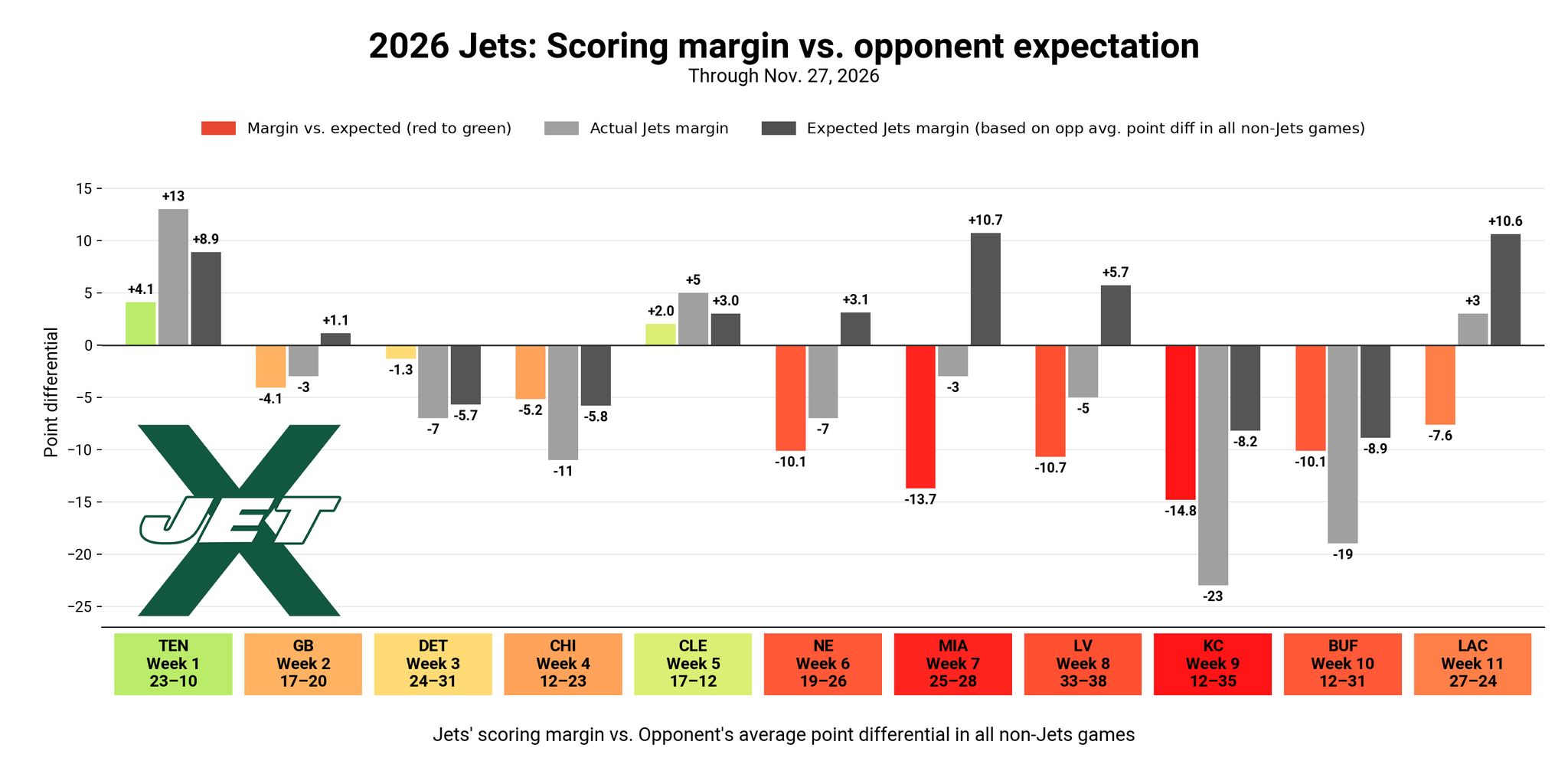
For you mobile users out there who, justifiably, would prefer not to squint at the grimy details of my nerdy chart, seen below is a more digestible look at solely the Jets’ margin versus expected in each game, with the contextual bars (the Jets’ actual margin and their expected margin) removed.
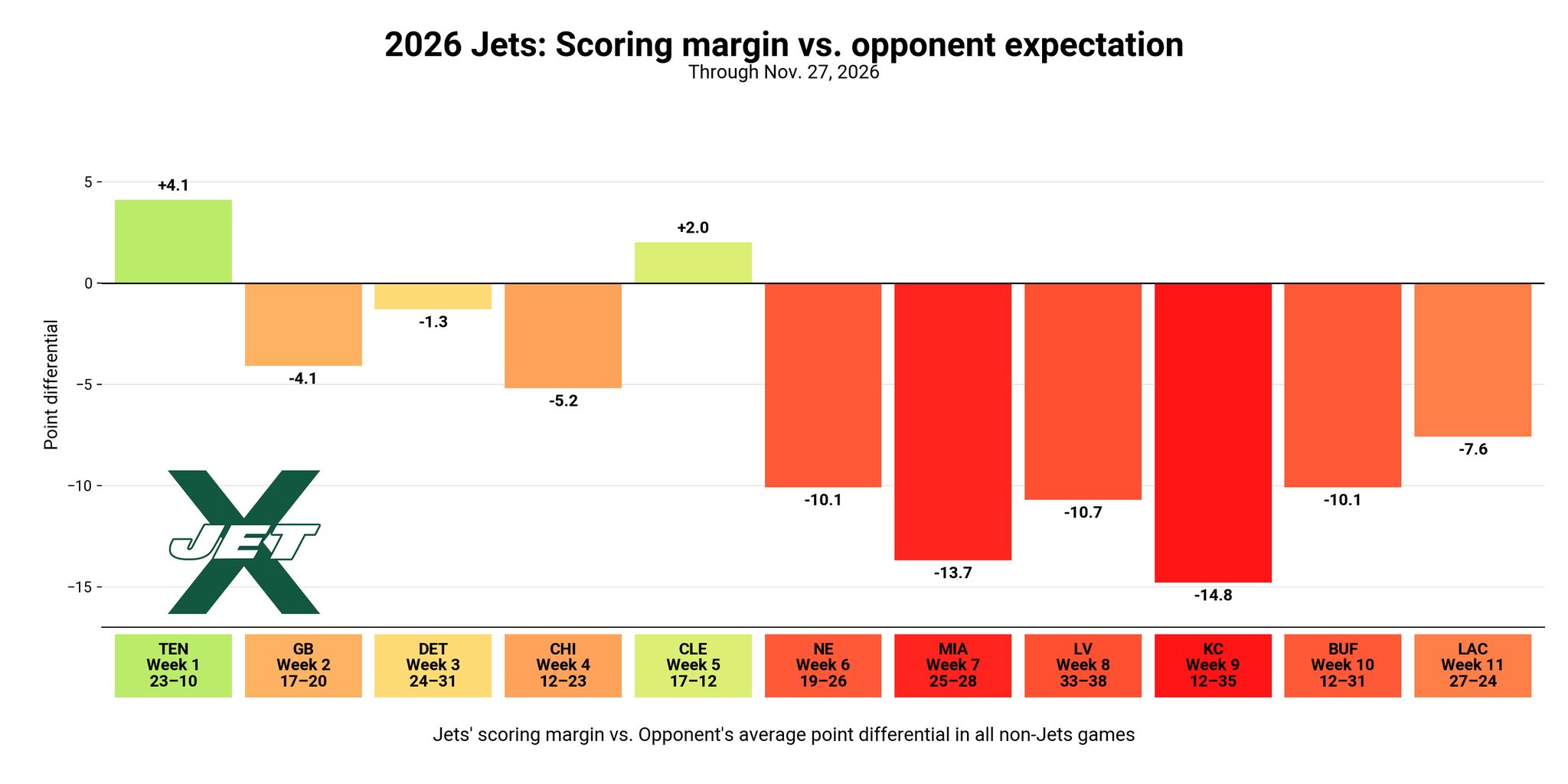
Through five games, the Jets weren’t doing too shabby. Not only were they 2-3, but they overperformed in both of their victories, and their three losses each stayed at least somewhat close to expectations. Overall, the Jets’ average margin versus expected from Weeks 1-5 was a respectable -0.9.
Since their Week 6 trip to Foxborough, though, the Jets have been an eyesore. They lost by a touchdown to a mediocre Patriots team that has otherwise had a -3.1 point differential this season, followed by a three-point loss to a Dolphins team that is 0-9 with a -10.7 point differential in the rest of its games.
From there, the Jets lost by five to a Raiders team with a -5.7 point differential in the rest of its games. After that came a two-game stretch in which the Jets were run off the field to an egregious extent by two AFC powerhouses, followed by the narrow win over a Chargers team that has usually been steamrolled.
Adjusting for the quality of the opponent, we haven’t seen the Jets play well since their Week 5 win over the Browns (who actually have a -3.0 point differential outside of the Jets game despite their 6-3 record in those contests, but the Jets outperformed that mark). In fact, New York’s first two wins remain arguably their only “quality” performances of the year.
Even across the Jets’ eight losses, not a single one could be considered a “good loss” in the sense that they played a tough opponent closer than expected. All eight defeats were by more points than the opponent’s average point differential in the rest of their games.
The Jets played competitively against the 6-5 Packers in Week 2, but losing by three to the Packers at home has not aged well, given that the Packers have a negative point differential (-1.1) across the rest of their games. Green Bay didn’t even have Jayden Reed, Zach Bako-Bewele, Javon Hargrave, or Micah Parsons.
New York’s 31-24 loss in Detroit seemed impressively competitive at the time, but it has aged into another example of a close loss that wasn’t as much of an accomplishment as it may have felt like, given that the Lions have either lost or won by fewer than seven points in four of their other six home games outside of the Jets game.
Simply put, the Jets have not only gone just 3-8 over their first 11 games of 2026, but the underlying quality of that 3-8 record has also been poor, which reflects poorly on head coach Aaron Glenn. There doesn’t seem to be any sort of sneaky silver lining under the surface: His team’s final product just flat-out stinks.
So, yes, the Jets can win today to carry a two-game win streak into the bye week, while also surpassing their 2025 win total with five games left to build on it. But when you toss the win-loss record aside and examine the Jets’ quality of performance in totality, the results are ugly.
If Glenn wants to change that over the final six games, he can’t just win games; he needs to start winning them in impressive fashion. To do that against Miami today, he must lead a thorough blowout over a 1-9, tanking organization led by its backup quarterback.
The Dolphins’ average point differential outside of their Week 7 game against the Jets is -10.7. So, winning by a touchdown and a field goal is the bare minimum. But to begin stockpiling evidence that he can coach his team to exceed expectations, Glenn should aim to win by at least three scores today. Anything less, and he will have done little to change his outlook as the Jets’ potential head coach of the future.
Football may be about nothing more than wins and losses at the end of the day, but when it comes to evaluation, that isn’t the case. Analyzing the big picture is crucial, and when you do it for Glenn and the 2026 Jets, their 3-8 record actually comes out looking even worse than it initially appears. Adjusting for opponent quality, they’re more like a 2-9 team.
For a head coach trying to prove why he should be brought back despite starting 6-22 with an 0-9 division record and one multi-score win, it certainly isn’t ideal to have your team’s underlying performance look worse than its 3-8 record suggests.
Glenn’s goal is simple, albeit challenging: Destroy the Fins today, beat the tenacious Broncos out of the bye, and obliterate the lowly Cardinals in Week 15. Pull it off, and perhaps the conversations will shift a little by Christmas Day.
