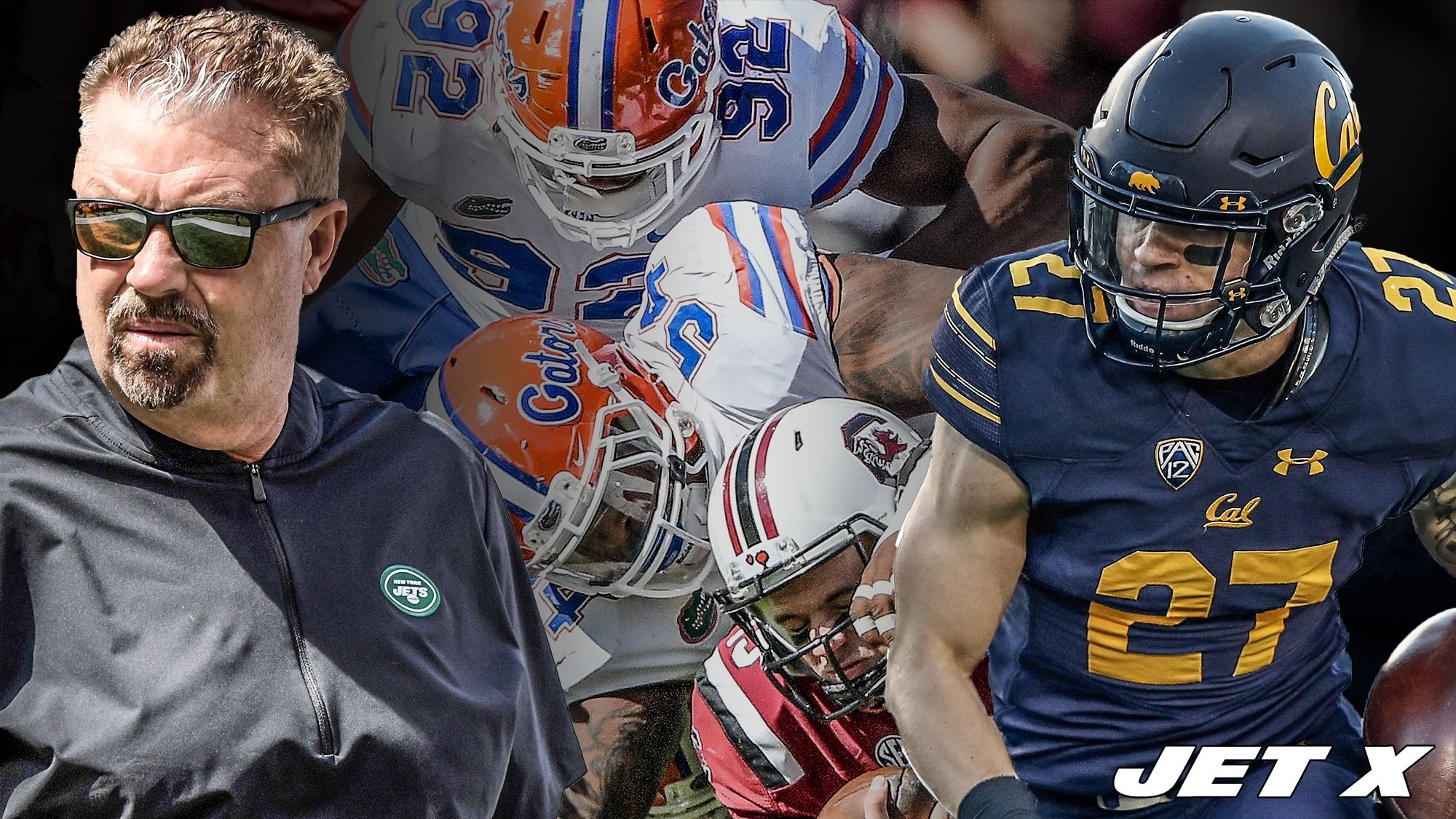
New York Jets defensive coordinator Gregg Williams is now equipped with intriguing defensive pieces, including a tremendous Big Dime look.
[sc name=”robbysaboheadshot” ]
It’s third-and-11. The game is on the line. MetLife Stadium is losing its mind while Gregg Williams knows he has 5-10 seconds to decide on the next call.
Mr. Williams realizes he needs more than “testicles in the C-gap.” He needs a pass rusher, an athletic freak on the edge who can pin his ears back and get to the quarterback.
It’s just not there. At least it wasn’t in 2019. Training camp 2020 will help the New York Jets sort out if a legit pass rusher is present this time around—something that’ll drastically make Williams’s job easier.
For now, Williams may have to take drastic measures when that above situation is presented. Does he send Jamal Adams? Does Brian Poole come with him? Do they dare go man on the backend?
Whatever the call, at the very least, the Jets defense is adding several pieces that can help a defense that played well a season ago—despite the lack of an edge presence.
Ashtyn Davis, FS
The two shocks of Joe Douglas’s first NFL draft start with Ashtyn Davis in the third round and James Morgan in the fourth. Why snag a safety when Adams and Marcus Maye have things locked down?
For one, Maye isn’t a picture of health. He missed 10 games in 2018 and entered 2019 with many questions. The team’s newest safety plugs many more holes than the average onlooker believes.
Davis, 23, is a big-time athlete. The California walk-on used his track and field abilities en route to the NFL. The 110-meter hurdle champ at the 2017 Pac 10 meet brings speed to the backend for the Jets.
He’s a deep safety who can do a little of everything, which means he’s perfect as the third safety, especially in the Big Dime.
Davis allows Williams the opportunity to use Adams in a variety of ways everybody’s accustomed to with a much greater safety net. Maye and Davis combining as the two-deep look is a defensive coordinator’s dream (while Adams wreaks havoc everywhere else).
What Davis really does is provide Adams much more of a chance at freedom. In 2019, Williams was forced to use Adams as one of his top rushers. In 2020, he’ll do the same thing without the same level of concern on the backend.
Jabari Zuniga, EDGE
Oh, the horror; yet another third-round Florida edge rusher. Douglas surprised folks with the Jabari Zuniga pick just a year after Mike Maccagnan amazingly failed with Jachai Polite—the very same kid who openly admitted he had never watched himself on film at the 2019 combine. Zuniga is a different story.
Injuries held this kid back, which is interesting considering one of Douglas’s trends during the draft was to stay away from injury-prone players. But hey, if a legit edge can be found in Round 3, it’s a move worth taking.
At 6-foot-3 and 264 pounds, Zuniga is a bigger edge player, yet doesn’t quite fit into the tweener category that features Henry Anderson and Kyle Phillips (3-to-5-tech players who were forced to also play the edge at times a year ago).
Williams will enter camp with Zuniga down the depth chart, wanting him to work his way up into a starting subpackage edge role opposite Jordan Jenkins in the end (best-case scenario).
Bryce Hall, CB
Not only did Denzel Mims fall into the accepting arms of the Jets, but Virginia’s Bryce Hall did as well.
The Harrisburg, PA native is a 6-foot-1, 202-pound corner who should fit Williams’s outside-corner zone scheme. It will make sense to plug him opposite Pierre Desir at the No. 2 or 3 spot on the depth chart to start, hoping his zone skills translate into the scheme.
Bail technique makes sense with Hall, as his backpedal is barely worth mentioning. And again, that fits what Williams likes doing in the secondary. His corners will often find themselves playing the flat or a deep-third in a straight Cover 3 or 3 Cloud.
Hall will never find himself on the inside. He’s just not that type of player.
The Others
- Quincy Wilson, CB/S (Trade via Colts)
- Lamar Jackson, CB (UDFA)
- Bryce Huff, EDGE (UDFA)
- Sterling Johnson, DT (UDFA)
- Javelin Guidry, CB (UDFA)
- Domenique Davis, DT (UDFA)
- Shyheim Carter, S (UDFA)
Quincy Wilson offers depth in the secondary. Whenever an NFL team trades a late-round pick for an established NFL player, it’s a win. Wilson has experience at both corner and safety.
Lamar Jackson surprisingly went undrafted. The Nebraska product is a taller, lanky corner who, again, it’s a man-to-man cover guy and fits what this Jets defense wants to do on the backend. (Hell, the entire way of the NFL these days is about zone match coverage.)
The real wild-card of the group is Bryce Huff, an edge out of Memphis. His twitchy-nature allows for explosion off the snap and his body fits the athletic, play-in-space prototype that’s desperately needed on this unit at the moment.
Final Thoughts
While Douglas focused on the offensive side of the ball in 2020 (and rightfully so), pieces such as Davis, Zuniga and Hall fit specific spots of desperate need. Davis fits the bill as that perfect third safety, Zuniga will have to prove himself as an edge who can play both the run and get after the quarterback, and Hall is an experiment who’ll need to learn the ins-and-outs of Williams’s backend schemes.
Once it’s all said and done, it’s very possible the edge spot remains a desperate area of concern entering the 2021 draft. But, at the very least, Gregg Williams has been equipped with a few more pieces that’ll make life easier for the entire unit in 2020.


I don’t see Patrick Onwausor on your depth chart.
Not everybody is on this one. This is just the Big Dime with the top players. Check out this one for the full depth chart: https://twitter.com/jetsxfactor/status/1254398596771971073
With the acquisition of Wilson, it may kill the Logan Ryan deal , possibly saving the Jets 6-7 million. . Hopefully that could be rolled over into a veteran Edge, possibly Everson Griffin or Vinny Curry.
Very true.