
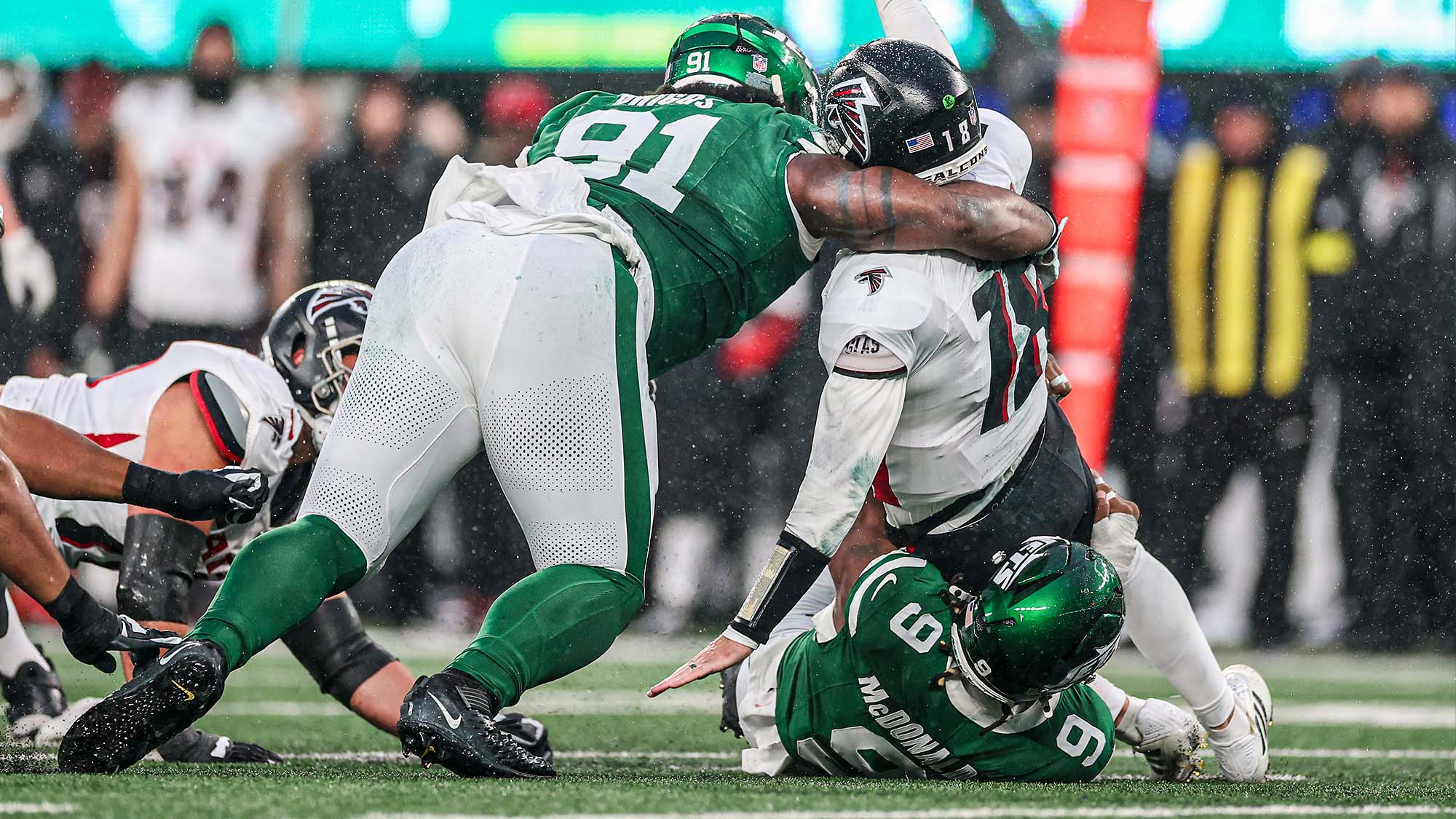
He’s one of the New York Jets’ brightest rising stars, and he has the potential to be among the NFL’s best players at a premium position.
But if you bring him up in a conversation with a casual NFL fan as one of the reasons you’re optimistic about the Jets’ future, you’ll get a one-word response: “Who?”
His name? Jowon Briggs.
Get used to hearing it and typing it, NFL casuals. Just don’t forget that both vowels in “Jowon” are an “o”, not an “a”.
For someone who is one of the better young players for an NFL team based in the United States’ largest metropolitan area, Briggs is bafflingly anonymous nationwide. If we pull up Google Trends, it is revealed that Briggs’ name has seen fewer Google searches across the nation than the Jets’ punter over the past 12 months.
That’s no slight on Austin McNamara, who is a stud of the highest proportions in his own right. Perhaps it is also the unfortunate reality of a team that gives its punter an obscene amount of screen time.
Still, it highlights that the ratio between Briggs’ production and his national notoriety is among the most skewed that we have seen for any NFL player in recent memory.
It isn’t an unusual predicament for a Jets team that receives little national attention. The Jets are usually out of the playoff conversation well before Halloween, causing the entire roster to be ignored for most of the season, even the players who perform well.
This is something entirely different, though. We’re not talking about someone who is just “pretty good” or “solid”. Briggs spent a half-season playing elite football at one of the game’s most valuable positions, and he did it in just his second year. This type of player should be a household name among football fans, no matter what jersey he wears.
For some reason, he’s not. It’s time to change that by proclaiming loud-and-clear how phenomenal this player was in 2025.
Jowon Briggs’ 2025 dominance
After the Jets traded Quinnen Williams in early November, Briggs elevated from a rotational role to a featured starting role over the Jets’ final nine games. His snap count rose from 37.0% over the first eight games to 64.6% over the final nine.
Upon receiving a spike in snaps, Briggs immediately catapulted to the top of every pass-rushing leaderboard among defensive tackles. And it wasn’t just about him racking up a higher volume of plays due to the increase in opportunities—his efficiency was off the charts.
From Weeks 10-18, Briggs posted the following rankings among qualified defensive tackles, per Pro Football Focus:
- 7th in total pressures (29)
- 2nd in PFF pass-rush grade (89.4)
- 3rd in pass-rush win rate (19.4%)
- 6th in pressure rate (14.4%)
Only two other players over this span ranked top-three in both PFF pass-rush grade and pass-rush win rate: Chris Jones and Jeffery Simmons, two perennial All-Pros.
Not to mention, Briggs maintained consistency over the entire stretch; it is not as if this production is skewed by one or two massive games. In eight of the nine contests, Briggs’ pressure rate was above the positional average for defensive tackles. He had a PFF pass-rush grade of at least 74.0 in six of the nine games.
Remember, this is a nine-game sample in which Briggs was playing nearly two-thirds of the Jets’ snaps (a high mark for a DT). It doesn’t smell like a small-sample fluke, especially when considering that Briggs received zero assistance from the rest of the Jets’ defensive line to pull attention away from him.
Despite Briggs’ dominance, the Jets’ defense finished with the second-fewest sacks (26) and the lowest pressure rate (15.1%) in the NFL. Their interior defensive line was particularly silent in the pass-rush department; outside of Briggs’ 4.0 sacks and 10 QB hits, the rest of the non-Williams defensive tackles on the roster combined for 1.5 sacks and 2 QB hits over the entire season. That’s essentially nothing, for all intents and purposes.
It is also important to consider that since the Jets spent most of the season in catch-up mode, the defense rarely benefited from obvious passing situations in which they could pin their ears back and rush the passer with reckless abandon. Briggs still maintained elite pass-rushing efficiency despite having to respect the run threat on nearly all of his snaps.
Let that sink in: As a second-year player getting his first career starting experience, with zero pass-rush help at his position to clear space for him, and on a team that was constantly trailing, Briggs rushed the passer at a Chris Jones/Jeffery Simmons level for a nine-game span.
And this guy receives less attention than the Jets’ punter?
The cherry on top is that pass rushing is not even supposed to be Briggs’ calling card. When the Jets traded for him in August 2025, he was acquired to be a rotational run-stuffer.
Amidst his pass-rush explosion, Briggs maintained solid production against the run. His 7.3% run-stop rate ranked 49th out of 133 qualified defensive tackles (64th percentile), and he only missed two tackles against the run; his 5.4% missed tackle rate placed 39th out of 133 (71st percentile).
So, the Jets got the above-average run stopper they were hoping for, and he just so happened to develop game-wrecking pass-rush impact, too.
The scary part (for the AFC East) is that Briggs should only continue rising in 2026. At 24 years old with eight NFL starts to his name as he enters Year 3, this is a player on the rise.
Plus, if Briggs receives more favorable circumstances in terms of his surrounding interior pass-rush help (something the Jets hope he will get from players like David Onyemata and Darrell Jackson Jr.) and the game script (the offense creating more obvious pass situations for the defense), his pass-rush numbers are bound to skyrocket even further.
It isn’t often that we see players with this much potential receive this little hype. Perhaps that is just the way Briggs and the Jets would prefer it to be, though.
