
One of the greatest challenges of NFL analysis is quantifying a coach’s impact on his team’s success.
We all know that coaches have a major effect on the outcome of any football game, perhaps a greater effect than in any other sport. On any given play, all 22 players on the field are more-or-less doing exactly what their coaches told them to. Picture the coordinators as the writers, and the players as the cast.
Therefore, it stands to reason that offensive and defensive play-calling are paramount in determining the outcome. Some might even say that the play-callers on each side play a larger role in the final score than any individual player, aside from maybe the quarterback.
The challenge is that, as outsiders, it can be difficult to determine exactly how large a role the coaches are playing. They could call the worst play and get bailed out by an elite player, or they could call the perfect play and get hung out to dry by poor execution.
The cinema analogy holds up here. Even the greatest actors will fail to make a bad script look good. But if the script is magnificent, it probably won’t be held back by an average actor.
Since it’s up to the players to determine whether a play call is executed or not, the best way to evaluate the quality of a coach’s play-calling is by their process. This way, we separate them from the execution of their players, which is largely out of their control.
That’s what we’re going to try to do here today. We are going to rank all 32 teams in the 2025 NFL season by the expected efficiency of their passing games, based on the distribution of targeted route types.
In simpler terms, how effective was each team at targeting the types of throws that typically lead to positive results?
Then, to make it relevant to the New York Jets’ 2026 outlook, we will analyze the historical tendencies of Jets offensive coordinator Frank Reich and assess how his strategy would have stacked up in the 2025 season.
Without further ado, let’s find out which NFL teams had the most (and least) optimal pass-game strategies in 2025.
Methodology
The folks at FTN Fantasy track passing statistics based on route types. Any non-throwaway/batted pass/spike/etc. is categorized into one of these 13 route types:
- Corner
- Deep Out
- Drag
- Go
- Hitch/Curl
- In/Dig
- Post
- Quick Out
- Screen
- Slant
- Swing
- Texas/Angle
- Wheel
Using league-wide statistics, we can calculate the league-average efficiency on each route type. This gives us an idea of which routes teams should try to throw more often and which they should avoid. Picture it like NBA teams realizing they should attempt fewer long twos and more corner threes, or MLB teams coveting more walks and homers over singles.
Here are the 2025 league averages for EPA (expected points added) per attempt by route type:
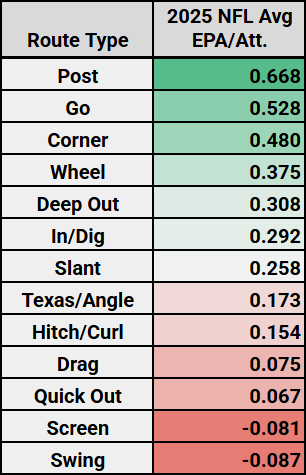
Using these numbers, we want to determine each team’s effectiveness at maximizing pass attempts on efficient route types while minimizing attempts on inefficient ones.
To do this, I calculated “expected EPA per attempt” for each team’s passing offense by charting their total attempts for each route type and crediting them with the league-average EPA for each attempt.
For instance, every post route attempted by a team yielded 0.668 expected EPA, every go route yielded 0.528 expected EPA, and so on. From there, I accumulated their expected EPA across all attempts and divided it by their total pass attempts to generate expected EPA per attempt (xEPA/Att.).
By this methodology, the offenses that best position themselves for success will be those that accumulate the most attempts on post, go, corner, wheel, and deep out routes. The offenses that put themselves in suboptimal positions will be the ones that swap out a hefty chunk of the aforementioned route types for things like screens, quick outs, drags, and hitches/curls.
After the routes are dialed up, it’s up to the players to execute—a coach can call deep shots all day, but his quarterback has to hit them, and his receivers have to catch them. This metric does not account for the execution or the results of the routes that were called.
However, by simply looking at the route-type attempt distribution for each offense (without evaluating the results of those attempts), we can get a solid sense of which play-callers did the best and worst jobs of setting up their players for efficient outcomes.
Results
Here are the results for the 2025 season.
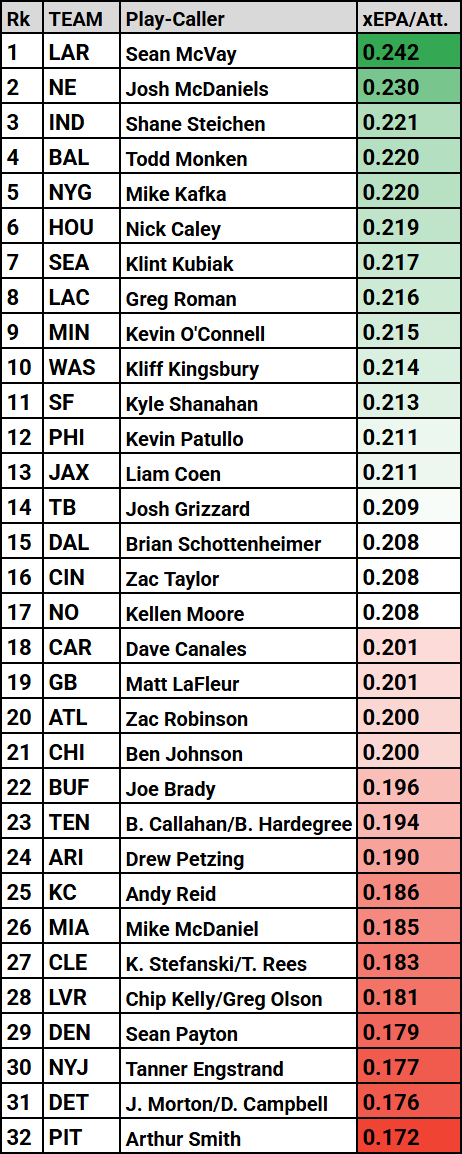
Unsurprisingly, Sean McVay sits at the top, which is all the evidence we need that this is a list coaches should want to rank higher on. Whatever McVay is doing, the rest of the league is trying to copy it.
For the Jets, first-year offensive coordinator Tanner Engstrand sits at No. 30, which provides some solid evidence that New York may have made the right decision to move on.
But is Frank Reich an upgrade?
If he adheres to his past tendencies, the answer is “not much”.
Here is a look at the route-type attempt tendencies of Reich’s offenses over his last three NFL seasons (2021-23):
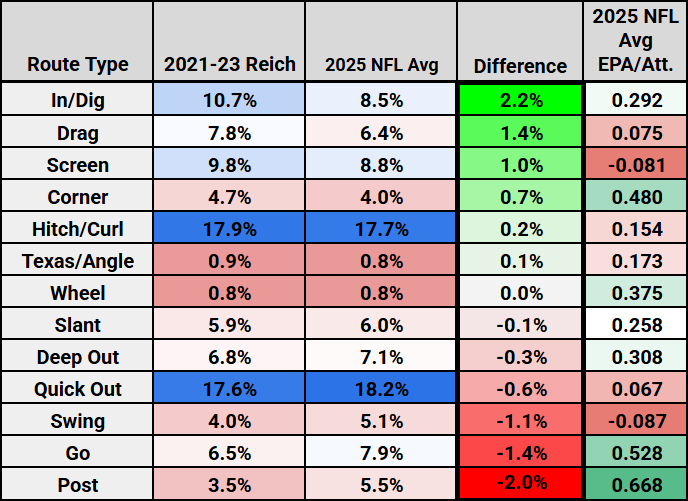
The main takeaway here is that Reich’s two least-favorite route types compared to the 2025 NFL average were the go and post routes, which also happen to be the two most efficient routes in the league. He also had drags and screens among his top three favorite routes compared to the league average, which are both among the least efficient routes.
Altogether, based on his route-type attempt distribution from 2021-23, Reich’s expected EPA per attempt in 2025 would have been 0.192, placing him 24th in the league, slotting between Arizona’s Drew Petzing and Tennessee’s combination of Brian Callahan and Bo Hardegree.
That would be a slight upgrade over Engstrand’s 2025 finish, but nothing substantial. Considering that Reich is 64 years old while Engstrand was a first-year coordinator, perhaps it would have been wiser to bet on Engstrand’s improvement rather than a sudden philosophical shift from the aging Reich.
There is a catch, though—one that makes Reich’s route-type distribution very interesting for the 2026 Jets.
While Reich’s 2021-23 route-type distribution would be suboptimal relative to current NFL trends, it would actually make him a great fit with Jets quarterback Geno Smith.
The dig and drag routes were Smith’s two most efficient route types (based on EPA per attempt compared to the NFL average) during his successful three-year run as the Seattle Seahawks’ starter. They also happen to be Reich’s two favorite routes compared to the NFL average over his three most recent seasons.
The question New York has to grapple with is whether the compatibility between Reich and Smith is enough to override the fact that Reich’s offense would be behind the times if left unchanged.
Should the Jets build an offense that adheres to the strengths and weaknesses of their 35-year-old stopgap starting quarterback? Or should Reich adapt to modern NFL trends and expect Geno to catch up?
That is the dilemma Reich, head coach Aaron Glenn, and the entire Jets organization must grapple with as they construct their offensive vision for the 2026 season.
Reich’s offense, at least the last version we saw, does not target nearly enough vertical shots to keep pace with the best offenses in today’s NFL. At the same time, it is pretty much tailor-made to let Geno Smith do what he does best.
It will be a perplexing challenge for the Jets to solve over the next 53 days as they prepare for their season opener. Most likely, it will remain a weekly puzzle throughout the season.
The best coaching staffs in the NFL, though, are not the ones who go into Week 1 with the most foolproof plan. They are the ones who do the best job of adapting throughout the season.
The Jets have never been a part of that group, certainly not offensively. Let’s see if Reich’s veteran experience changes that, or if the team looks back and wishes it had gone with a higher-upside, more forward-thinking coach to lead the offense.
