
Ten games into the 2026 season, the New York Jets’ offense finds itself in a strange situation.
With the emergence of several young, promising weapons, there is reason to be hopeful about the future. In the present, though, the offense has struggled to do what consistently wins football games: finish drives in the red zone.
Currently, the Jets own a 37.9% red-zone conversion rate, the lowest in the league. Their recent stretch reflects that: a nine-quarter streak without a touchdown.
How much of the Jets’ struggles are due to execution vs. Reich?
Reich’s performance
To better distinguish between Reich and the personnel, I created a metric called Play Caller Value Rating (PCVR). It’s a composite metric designed to evaluate offensive play-callers while doing as much as possible to separate them from the players’ execution.
The model combines five categories to evaluate a play-caller’s overall effectiveness. The categories are weighted as follows:
- Situational play-calling (35%): How effectively a play-caller adjusts his approach given down, distance, score, and game situation
- Efficiency relative to roster (20%): Whether an offense is outperforming or underperforming expectations based on its personnel
- Drive sustainability (15%): How consistently an offense moves the ball and keeps possessions alive
- Personnel usage (15%): How a coordinator uses different formations and personnel groupings given what’s working and what’s not
- Formation disguise (15%): How much information an offense reveals through pre-snap alignments
Of course, it isn’t a perfect measurement of coaching ability. No metric can entirely separate a coordinator’s decisions from his players. However, my goal is to find a more comprehensive starting point than something as bland as points per game.
Through Week 10, Reich ranks 19th among 32 play-callers with a PCVR of 52.4. Basically, he’s been around the league average in this metric this season.
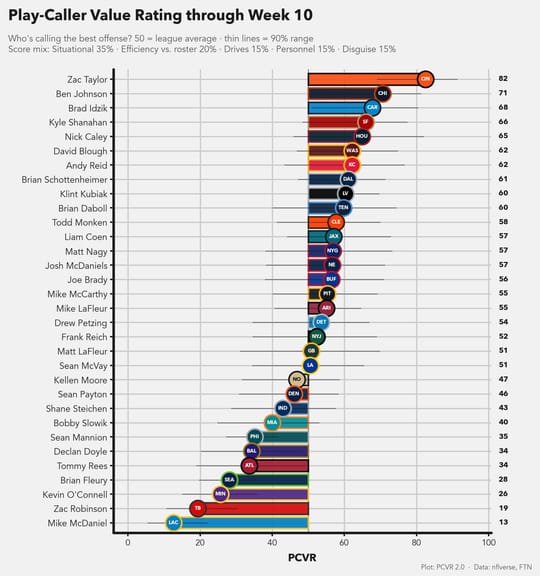
Interestingly, though, his ranking has fluctuated a ton since the start of the year. After Week 5, he ranked 25th before climbing to 14th by Week 8. Following the loss to the Kansas City Chiefs in Week 9, though, he fell back to 21st before climbing back to 19th after Sunday’s win over the Buffalo Bills.
The Jets actually rank 11th in offensive success rate at 44.3%. So, the Jets are moving the football; that’s known. However, once the team gets into the red zone, they just consistently stall out.
Gang Green also ranks 11th in explosive play rate (9.7%), meaning they have plenty of offensive firepower. Still, though, it just all comes back to being able to finish possessions. Ranking just outside the top 10 of both success and explosive play rate isn’t anything to scoff at.
Another fascinating tendency is how Reich’s approach changes given the score. PCVR uses pass rate over expectation to measure how frequently a coordinator elects for a passing play compared to what would typically be expected in similar game situations. It accounts for factors such as down, distance, score, and other situational variables.
Overall, the team ranks 20th in the metric (0.7%). On early downs, the number is even lower, at -2.1%, ranking 25th. When the Jets are playing with a lead, most tellingly, Reich tends to get very conservative. That pass rate over expectation mark drops to -4.0% when leading, the fifth-most conservative mark.
On the other hand, when the team is tied, he ranks fourth in the stat (+7.1%). It’s interesting that once the Jets get ahead, he becomes significantly more inclined to run the football.
Keep in mind, this doesn’t account for the result of the play, but the situation at the time given several situational factors. There’s nothing inherently wrong with adjusting to in-game situations; frankly, it’s a good thing, but that’s been an interesting tendency of Reich’s so far.
However, becoming overly consistent can cause issues, especially for an offense like the Jets’ that hasn’t done a strong job keeping the chains moving on third down, converting just 34.1% of their third-down attempts, which ranks 29th in the league.
One component Reich should integrate further into the offense is play-action. The Jets rank just 21st in play-action rate, although Geno Smith has found immense success out of those looks.
Through 10 weeks this season, Smith leads 39 qualified quarterbacks in Pro Football Focus’ passing grade on play-action (91.1), and third in adjusted completion rate (85.9%) and yards per attempt (9.9). Out of play-action, he has been one of the best QBs in the league. Despite that, though, Reich’s play-action usage ranks in the bottom 11 of the league.
Altogether, Smith has been good enough for the Jets to be better than 2-8. Has he been perfect? No, but certainly serviceable enough for the Jets to be hovering around .500 right now.
There have been some other areas to criticize Reich.
He is using motion at just a 50.6% clip, which ranks 30th in the league. Now, motion doesn’t automatically mean offensive success; the Miami Dolphins and Los Angeles Chargers are both in the top three for motion usage. However, using it at least around the league average would be encouraging, as it indicates a modern, innovative offense. It doesn’t hurt to gain information about the defense pre-snap.
More concerning, he hasn’t particularly done a great job of leaning into what’s working. The Jets rank third in passing DVOA (44.6%) out of 12 personnel (one running back, two wide receivers, two tight ends), but just 13th in usage. Meanwhile, they rank 16th in 11 personnel usage (one running back, three wide receivers, one tight end) and 22nd in passing DVOA in that set.
With that in mind, Reich has to do a better job of leaning into what’s working. Clearly, the Jets have assembled an encouraging TE duo with Kenyon Sadiq and Mason Taylor, and when they are on the field together, the offense is successful. So, it would be wise for the OC to just lean into what’s working more often than not.
Reich isn’t the Jets’ biggest problem, but he could certainly do a better job working with what he has.
