
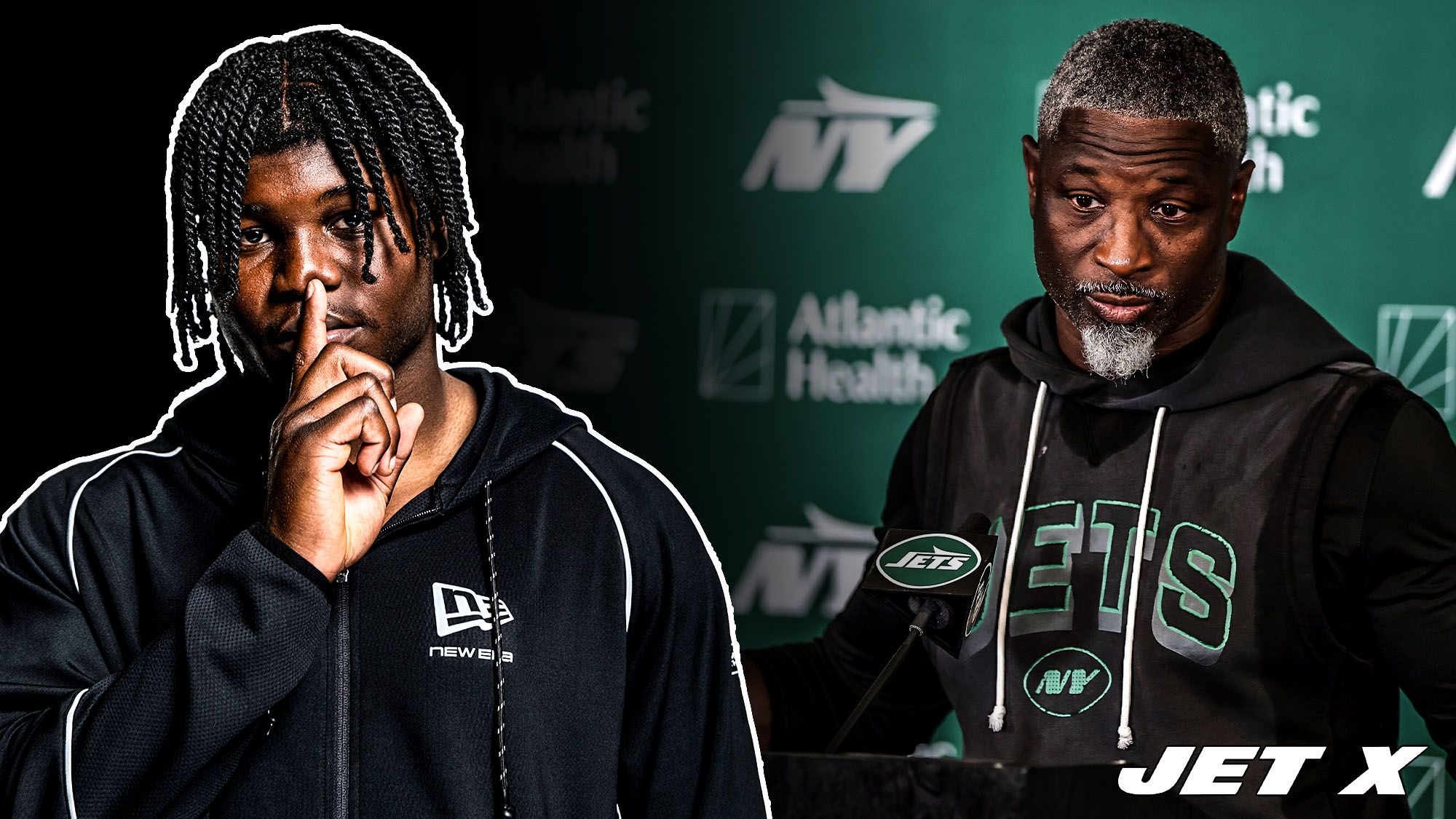
Florham Park, N.J. — Aaron Glenn had every reason to go with the flow. When SNY’s Connor Hughes asked him a David Bailey-specific question, the New York Jets’ head coach could have easily ridden the unstoppable momentum that currently makes the No. 2 overall pick in last April’s draft completely bulletproof.
Instead, he responded in a way that both challenges his young rookie and makes it clear that there’s more work to be done.
“Well, we all know that he’s a good player,” Glenn said in response to watching Bailey produce against a different team on Tuesday. “We all know that he’s a damn good pass rusher. So, there are times when you expect that. Does that make sense?”
No hype. No celebration. No nonsense.
In a way, Glenn suggested, “Hold on a moment, everybody; we’re getting ahead of ourselves here, and it’s unfair to Bailey.”
Despite the widely reported dominance of Bailey among reporters and fans, the reality is far different. While the Texas Tech product’s quickness off the edge is elite and draws eyes, much of his play still comes from outside of the defensive structure, which raises the chances of hurting the defense.
By no means is he the only defensive culprit, either. In fact, the Tampa Bay Buccaneers, who are in town for a back-to-back joint practice before Friday’s preseason opener, dominated the Jets early in Tuesday’s practice.
Baker Mayfield was “on time” far too often, taking inside chunks against Glenn’s defense. Tampa also heaped designed screens onto the field, time and again, which didn’t look pretty for the Jets’ defense — despite Demario Davis doing his damndest to be everywhere at all times.
The worst part of it, by far, was the Bucs’ rushing attack.
That nagging gap integrity issue I’ve been harping on for a week now came into play yet again. The Bucs owned the chain game, as New York wasn’t up to snuff at the point of attack.
That’s precisely the point that’s in Glenn’s mind right now, and Bailey is just one of many who have to come together to make this unit’s overall run-fit game more of a quality aspect for this team.
“You expect [Bailey] to win a number of his battles when it comes to [pass-rushing], but you also expect things to happen to where you have to coach him, and he’s going to learn some things, too,” Glenn added. “So, it really goes both ways when you look at that.”
Kudos.
Alleviate as much pressure as possible while making it crystal clear that the carrot still remains dangling on the stick. Besides, again, the reports regarding “Bailey’s domination” are far too fantastical.
One of the reasons for this is a matter of football 101. Time and again, a reported Bailey sack occurs despite the Jets’ speed demon off the edge taking a wider-than-standard path outside of the offensive tackle.
Because he isn’t stonewalled and instead gets to the side of the tackle, forcing the tackle to turn and run, many believe it’s a plus play for the edge. That just isn’t the case.
When an offensive tackle can open the hips and simply guide a speedster wider than the allocated arc, it’s a major win for the offense — even if it doesn’t look that way in real time.
In other words, a “flash of elite quickness” doesn’t necessarily equate to a “positive defensive play.”
There are also major question marks regarding his balanced-down instincts.
It’s understandable why Bailey exhibits a one-track mindset focused on hunting the quarterback; his elite quickness will cause damage in the National Football League. There’s no way to argue otherwise.
But if the defensive integrity is sacrificed in favor of Bailey’s pass-rushing prowess, which sometimes demands a wider-than-usual cone-type radius, the defensive guesswork becomes unmanageable.
A handful of times on Tuesday morning, Bailey found himself lost in space or torn between sides. He, along with several teammates, didn’t feel the screen well enough (referring to play recognition).
Tampa also sent a jet-sweep his way on one occasion that saw Bailey string things out entirely too wide. Instead of deciding to knock back while squeezing the edge shorter, he continued with the field’s flow — without resistance.
It opened the seas for the ball-carrier. Fortunately, a second-level defender made a tremendous outside-in tackle while hunting from the backside.
“I’m anxious to really watch the tape, and I’m anxious to see the plays that he didn’t do well, to see exactly why and how he’s going to learn from that. So, I’m more excited to watch that to be able to coach him, and to be able to say, ‘OK, this is what we’ve got to do in these situations. … In these situations, when you don’t win, I want to coach you on how to make sure you operate in that situation.'”
Think about what that means, not only when run-defending but pass-rushing as well: defending mobile quarterbacks as an 11-man unit. Maintaining proper rush lanes is as serious as cancer in the modern NFL, and neither Geno Smith nor Baker Mayfield is about that life.
Glenn and the Jets certainly have a pass-rushing weapon on the roster. One inside move he put on the left tackle — once the Bucs’ bookends began leaning to the outside after Bailey’s consistent hammering of that area — shows how quickly he can hit home:
Whether they have an absolute stud, from an overall perspective, is something we all need to be extremely careful about.
Perhaps most importantly, that kind of care will have the most positive impact on the player himself, David Bailey.
Hat tip to Hughes, who followed up with a question that resulted in a critical answer:
“There are pass-rushers around the NFL that take a year or two to get there to really start making an impact felt,” Hughes started. “You’ve been around some guys that make it right away, and it seems like [David Bailey is] on track to do that, [right]?”
Aaron Glenn’s answer was equally brilliant, as it was short and to the point:
“Well, we’ll see.”
Now that, my friends, is a legitimate and serious football answer from a football head coach, wanting more from his young player.
