
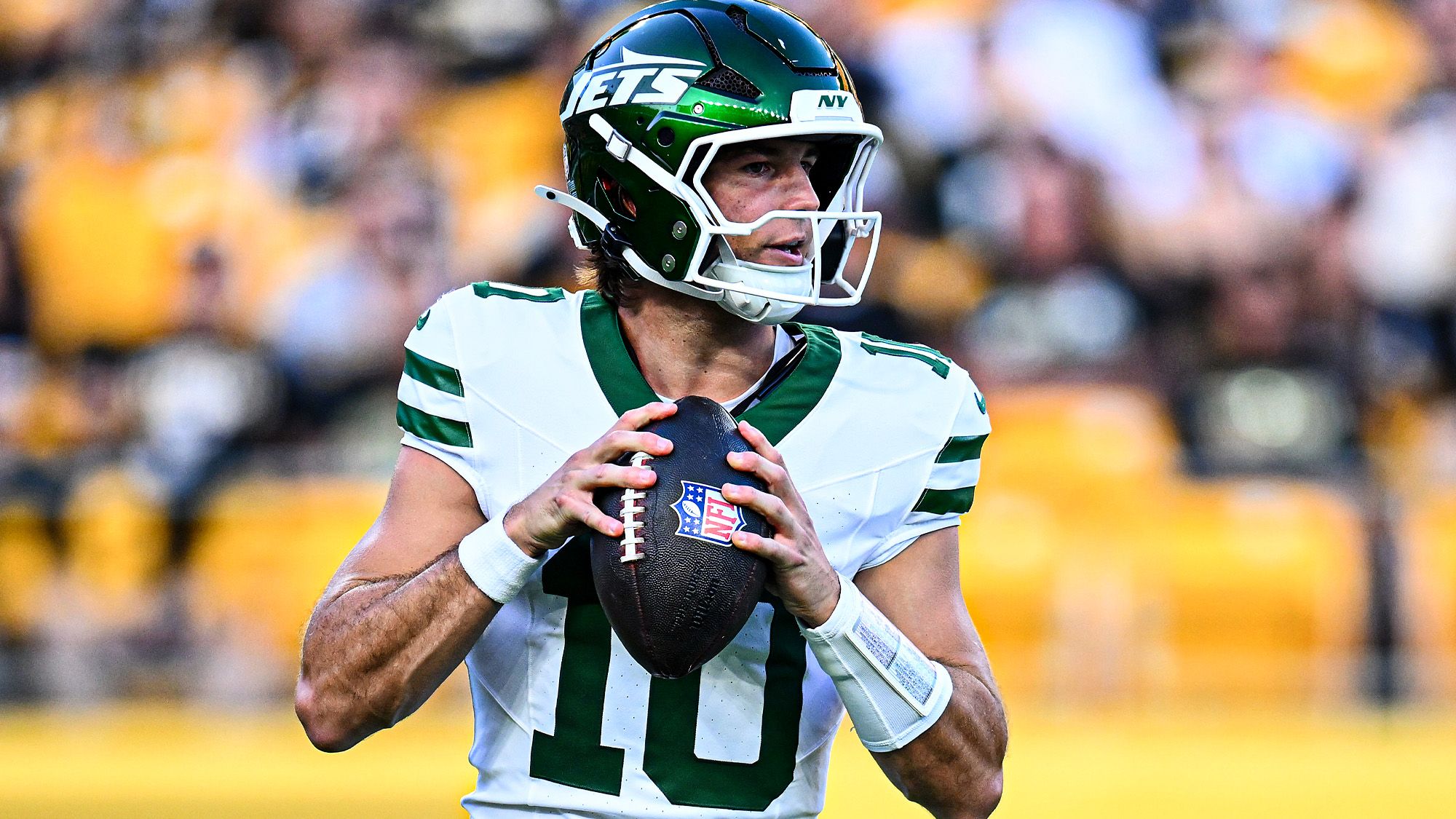
One of the most important players to monitor throughout the New York Jets’ preseason has been fourth-round rookie Cade Klubnik.
The Jets obviously want him to earn the team’s QB2 job behind Geno Smith, and currently, among his competitors, he seems to be the internal favorite for the job through two preseason games.
However, has he been good enough to prevent the team from adding an established veteran around cutdown day to serve as Smith’s backup?
Assessing Klubnik’s preseason
Throughout the Jets’ first two preseason games, Klubnik has completed 15 of his 21 passing attempts (71.4%) for 138 yards (6.6 yards per attempt) with zero touchdowns and zero interceptions.
During New York’s preseason opener, Klubnik played with the team’s first-team offense as Smith missed the game due to foot soreness. Both of his drives led to points while he completed five of seven passes (71.4%) for 56 yards.
His outing on Friday against the Pittsburgh Steelers was similar to his first preseason appearance. He didn’t have any major blunders, but there also weren’t many “wow” plays, although he had a standout throw on an incompletion to Isaiah Williams.
On third down, the pocket collapsed while the Jets were inside their own 20-yard line. Despite the pressure, Klubnik stayed in the pocket and delivered a pass into a tight window to Isaiah Williams, which would have moved the sticks, but it fell through his hands.
Klubnik showed solid anticipation on this throw to convert a third-and-10.
On third-and-two inside their own 15-yard line, Klubnik escaped pressure and not only picked up a first down with a 16-yard scramble.
It would have been nice to see Klubnik show off his arm talent a little bit and take a few deep shots these past two games. During the height of his NCAA career in 2024, Klubnik’s deep passing was among the best in college football.
He completed 35 deep passes (20+ yards), which finished third in the NCAA, trailing just Jaxson Dart (37) and Cam Ward (34), both of whom were first-round picks in 2025, with Ward being the No. 1 overall selection.
Overall, the Klubnik-led operation was much smoother during the team’s first preseason game against Tampa Bay, as expected, since the Clemson product was working with the Jets’ starting offense.
Playing with the backups against Pittsburgh, he was pressured six times on 14 dropbacks (43% pressure rate), compared to twice on eight dropbacks (25% pressure rate) in the opener. The backup offensive line lacks established pass protectors, which was evident.
Internally, there is no doubt that Klubnik should be the favorite for the job. Not only did the Jets trade up for him in the fourth round in this year’s draft, but everyone knows what Bailey Zappe and Brady Cook offer.
Both Zappe and Cook have thrown more career interceptions than touchdown passes, while Cook’s four starts at the end of the Jets’ 2025 season were among the worst quarterback play Gang Green has seen.
However, has Klubnik done enough to show that he’s trusted to be one play away from starting throughout the regular season?
Do the Jets need to add a veteran QB?
It’s an interesting conundrum.
There are strong cases on both sides of this equation. Some folks would prefer to just see Klubnik if Smith is forced to miss time, allowing the team to get an evaluation on the fourth-round pick ahead of next offseason.
In no world would Klubnik prevent the Jets from drafting a quarterback high in the 2027 NFL draft, but at the very least, it would provide an evaluation of his future. He could perhaps prove he is worthy to be the team’s definitive QB2.
On the other hand, some worry that if Smith goes down while the Jets are competitive, Klubnik won’t be reliable enough to keep the team in games.
While I completely understand both perspectives, I fall into the latter camp to a degree.
It all comes down to the situation at hand. Suppose it is Week 3 of the season, and the Jets are 2-1 or even 1-2, and Smith has to miss two weeks due to a minor injury. In that case, I think it’s wise to thrust an experienced veteran into the situation.
In contrast, if it’s Week 13 or so and Smith gets hurt while the Jets are uncompetitive or he gets benched because his play isn’t up to snuff, then yes, a turn to Klubnik would make sense. At that juncture, going to a veteran would be nonsensical.
So yes, adding an established veteran quarterback around cutdown day would be wise for the Jets. A name that makes sense is Philadelphia Eagles signal-caller Andy Dalton.
Dalton is not a lock to make Philly’s roster, as he is competing for the team’s backup job with Tanner McKee, while rookie developmental option Cole Payton also remains in the fold.
If he shakes loose, the Jets should certainly have their eyes on the 38-year-old.
Since being selected in the second round of the 2011 NFL draft, Dalton has made 169 career starts while boasting an 84-83-2 record.
Before landing with the Eagles this offseason, he was a member of the Carolina Panthers. In 13 games (seven starts) as a Panther, Dalton completed 64.7% of his passes for 1,643 yards, 10 touchdowns, and seven interceptions.
While Carolina went 1-6 in his starts, the record is more attributed to a poor supporting cast. Dalton’s numbers over that span are certainly serviceable for a QB2 in the league and an established upgrade over anything the Jets currently have.
He also has a connection to the Jets’ coaching staff, having played under offensive coordinator Frank Reich in Carolina during the 2023 season.
Ultimately, the Jets shouldn’t trade assets for a backup quarterback, but Klubnik hasn’t shown enough to make them ignore the veteran cutdown-day market entirely.
If someone like Dalton becomes available, the Jets should certainly explore adding him to their roster.
There is nothing wrong with continuing to develop Klubnik while keeping a proven contingency plan in place if Smith goes down early and the rookie isn’t ready to handle NFL action just yet.
