

One of the biggest questions surrounding the 2026 New York Jets is their offensive play-caller, Frank Reich.
At 64 years old, he returns to the NFL after a year in the college ranks at Stanford, following a year away from football after his prior two stops in the pros ended with in-season firings.
How will he adapt his scheme? That question will play a significant role in the Jets’ offensive success in 2026. If he is unable to adapt his scheme to the modern game, New York will have a tough time outcoaching opposing defensive coordinators.
What’s promising, though, is that the Jets’ offseason moves and decisions on cutdown day hint that Reich is planning a notable change to his scheme this season.
Reich’s potential scheme change
My great colleague Michael Nania dove deep into Reich’s play-calling tendencies over the years, and one thing is clear: he hasn’t particularly favored 12 personnel (1 RB/2 TE/2 WR) and 13 personnel (1 RB/3 TE/1 WR).
Reich has consistently relied on a very high usage rate of 11 personnel (1 RB/1 TE/3 WR), while phasing “heavy” personnel packages (less than three receivers) into the background.
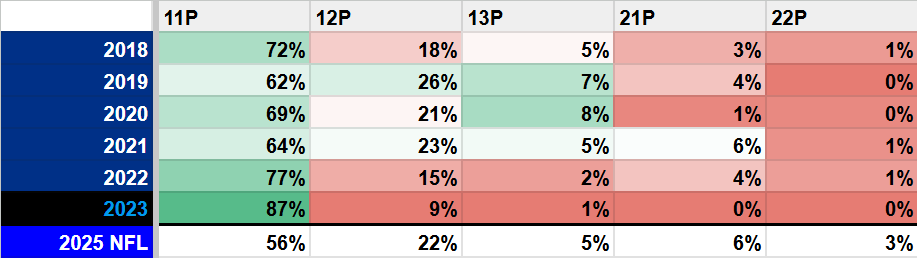
From 2018-23, Reich’s teams finished below the NFL’s 2025 average in 12 personnel (22%) in all but two seasons: a 26% mark in 2019 and 23% in 2021. In his two most recent seasons, 2022 (15%) and 2023 (9%), his teams were well below 22%.
For 13 personnel, he hovered around the 2025 league average of 5% and even surpassed it in 2019 and 2020, but it fell to just 2% in 2022 and 1% in 2023.
One of the league’s strongest trends over the past few seasons has been the revitalization of 12 personnel. Look at Klint Kubiak, who just won the Super Bowl as the Seattle Seahawks’ offensive coordinator, and offensive mastermind Sean McVay with the Los Angeles Rams. They have recently started using 12 personnel at an increasing rate.
The Super Bowl-champion Seahawks ranked eighth in the NFL with a 30% usage rate of 12 personnel in 2025. Meanwhile, the NFC runners-up, the Rams, led the league with a 31% usage rate of 13 personnel.
Based on the Jets’ roster decisions, it appears they could be planning to shift in that direction.
The team selected Oregon tight end Kenyon Sadiq with the No. 16 overall pick in April’s NFL draft, one year after drafting Mason Taylor in the top 50 the year prior. That gives the Jets two top-50 tight ends over the past few years, with Sadiq being a first-round selection under Reich’s watch.
Beyond that, there is Jeremy Ruckert, who signed a two-year extension during the 2025 season. Most interestingly, though, the Jets also elected to carry a fourth tight end in Jelani Woods, who overlapped with Reich during his time with the Indianapolis Colts, as well as fullback Andrew Beck.
Beck, who converted from tight end to fullback earlier in his career, is a Swiss Army knife and has proven to do a little bit of everything: run-blocking, special teams, and even catching passes. He had two receiving touchdowns with New York during the 2025 season, which ranked second on the team.
So, why would the Jets carry four tight ends and a fullback if they were planning to use 12 and 13 personnel, or even 21 and 22 personnel (packages involving a fullback), well below the league average, which Reich has historically done?
That would be nonsensical from a roster-building standpoint. It’s difficult enough to work three tight ends into an offense at times. Now, the team has four tight ends and a fullback.
Overall, the Jets’ roster-construction choices offer a pretty telling clue about where Reich may be headed in terms of play-calling. Teams don’t keep four tight ends and a fullback unless there is a clear plan to get them involved.
This doesn’t necessarily mean the Jets will finish atop the league in 12- and 13-personnel rates this season, but it’s fair to expect Reich to use heavy personnel packages more frequently than in the past.
Modernizing his scheme and adapting to where the modern game is headed would be a very strong step in the right direction for Reich as he returns to the NFL.
