

During his first season as the New York Jets’ head coach in 2025, Aaron Glenn made a lot of puzzling game-management decisions.
Regardless of being a first-year head coach or not, those are just the simple things that an NFL HC needs to nail, especially in Glenn’s case, since he wasn’t calling plays that season. His role was to be the “CEO/game manager” as head coach, and he even failed in that role, contributing to a rough 3-14 campaign.
This season, it will be even more interesting to monitor his progression, or lack thereof, with game management, particularly since he is also calling New York’s defense this year, an added responsibility that he didn’t have a year ago.
Right away in the Jets’ Week 1 victory over the Tennessee Titans, Glenn faced a multitude of tough fourth-down decisions.
How did he handle them? Here’s a look at each crucial one.
Call 1 — 10:14 in Q2, 4th & 2 at TEN 40, 7-3
For this breakdown, we’ll use Ben Baldwin’s fourth-down model as a guide. It takes the situation (down and distance, field position, score, time remaining, etc.) and weighs whether a team is better off going for it, kicking, or punting.
To be clear, this doesn’t indicate there is just one right decision, but it gives us a good baseline for judging a coach’s decision-making in the moment.
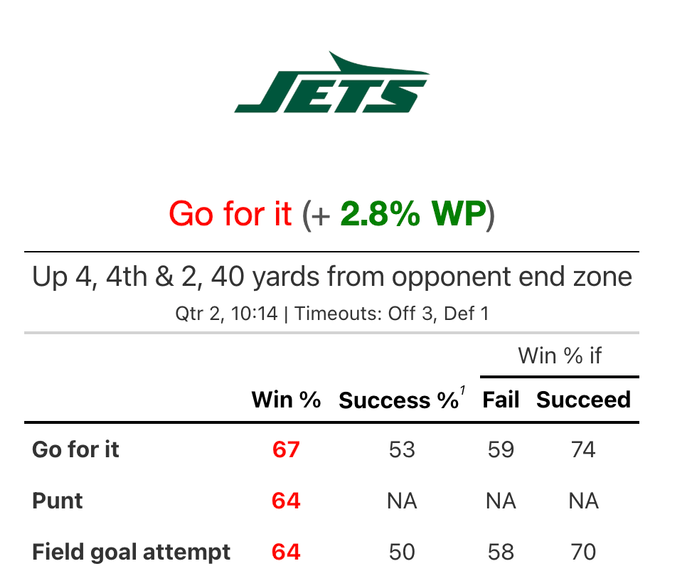
This was a pretty clear opportunity for the Jets to be aggressive. From the Tennessee 40, they were stuck in no man’s land where a punt doesn’t gain you much, while a 58-yard field goal attempt would have been a bit of a reach, especially with the distance limitations that Jason Sanders showed over the summer (this was proven later on when he badly missed a 54-yarder).
Baldwin’s model favored going for it, giving that decision a 67% win probability, compared to 64% for either punting or attempting the field goal. The model estimated the Jets had a 53% chance of converting, and a successful conversion would have pushed their win probability to 74%.
Glenn did exactly that. He left the offense out on the field, and Geno Smith hit Garrett Wilson over the middle for nine yards, comfortably moving the Jets and getting the Jets down to the Tennessee 31.
Good process, good result. 1-0 for Glenn.
Call 2 — 7:29 in Q2, 4 & 1, at TEN 22, 7-3
Later on the drive, Glenn faced another fourth down, and this one was an even stronger case to go for it.
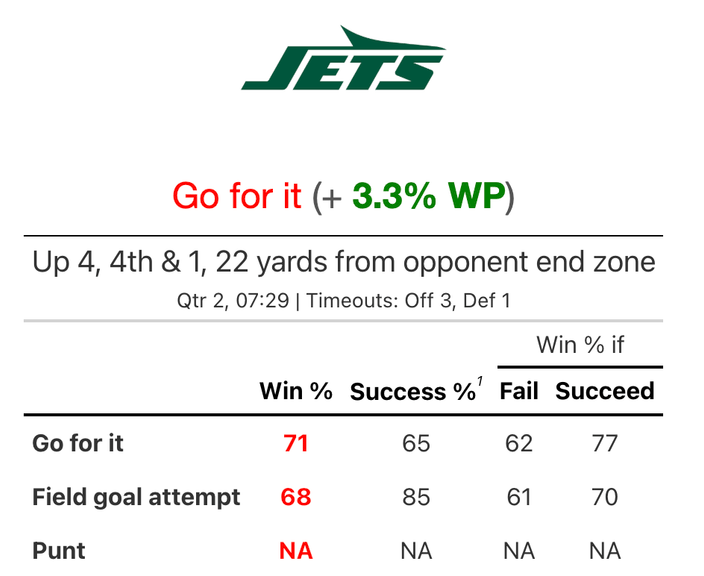
On fourth-and-1 from the Tennessee 22, Baldwin’s model gave the Jets a 71% chance to win by going for it, compared to a 68% chance by kicking the field goal.
The model estimated a 65% chance of converting, and if the Jets picked it up, their win probability jumped to 77%. Even if they failed, it would have been 62%, only six percentage points below the field-goal route.
Also, the Jets converted their first time around, so momentum was on their side.
Glenn stayed aggressive. Braelon Allen took the handoff and picked up three yards through the left side, moving the chains again. Two fourth downs, two calculated aggressive decisions, and two conversions.
2-0 for the HC.
Call 3 — 5:03 in Q2, 4th & 5 from TEN 14, 7-3
After going for the first two, Glenn finally took the points here, and the model backed him up.
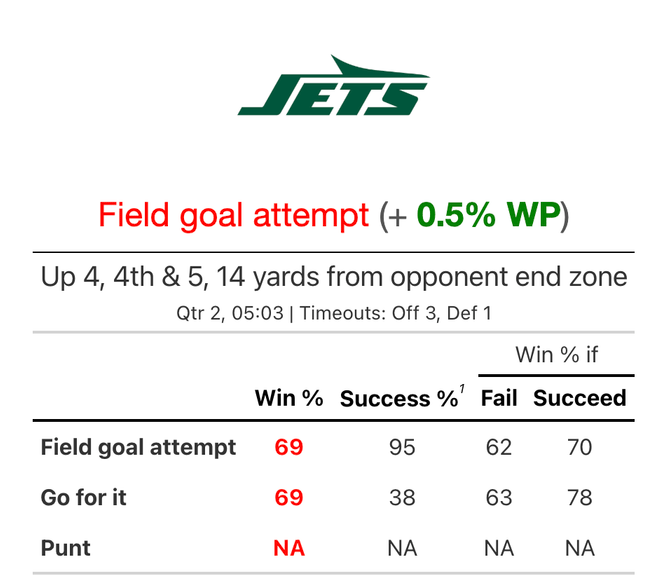
This one was much closer. Baldwin’s model had the field goal at roughly a 69% win probability, only 0.5% better than going for it. The big difference was the distance. On fourth-and-5, the Jets were estimated to have just a 38% chance of converting, compared to a 95% chance of making the field goal.
Considering the Jets were already up four, taking the short field goal and making it a touchdown game made plenty of sense. This is a prime example of Glenn picking his spots for when to be aggressive and take what he can get, as Sanders drilled a 33-yard field goal.
Call 4 — 2:44 in Q2, 4th & 8 from TEN 36, 10-3
This was another spot where Glenn was better off taking the points.
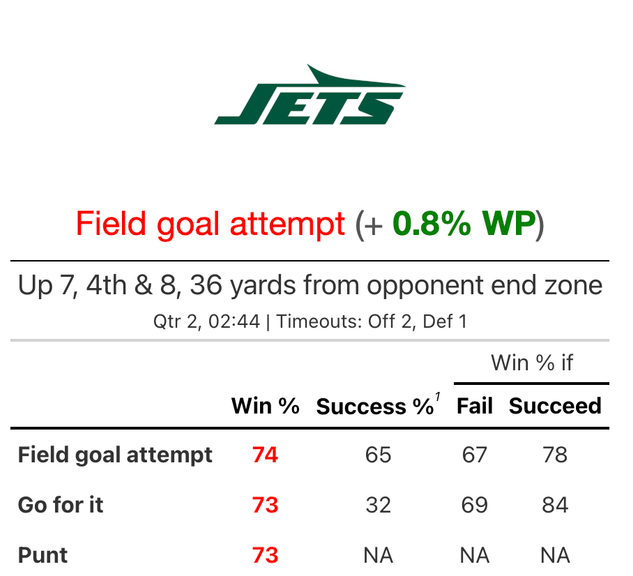
Baldwin’s model slightly favored the field goal, giving the Jets a 74% win probability if they kicked, compared to 73% if they went for it. The model also estimated just a 32% chance of converting on fourth-and-8.
The interesting part was the kick itself. From the 36, this was a 54-yard field goal, so it wasn’t exactly automatic (the model estimated a 65% chance of making it). Glenn put his trust in Jason Sanders, and the veteran kicker missed it wide left.
That is a key reason why this model shouldn’t be blindly treated as the truth. It can’t measure things like the reliability of the specific kicker involved.
While the model credits Glenn for his process here, it also isn’t accounting for Sanders’ situation as the Jets’ kicker. Still, even if they went for it, eight yards is a lot to get on fourth down.
This is a tough one, but Baldwin favors Glenn.
Call 5 — 4:44 in Q3, 4th & 1 from TEN 23, 17-3
This was another spot where the model wanted Glenn to be aggressive, although the preference was slight, with the Jets having a 94% chance of victory by going for it versus 93% by attempting a field goal.
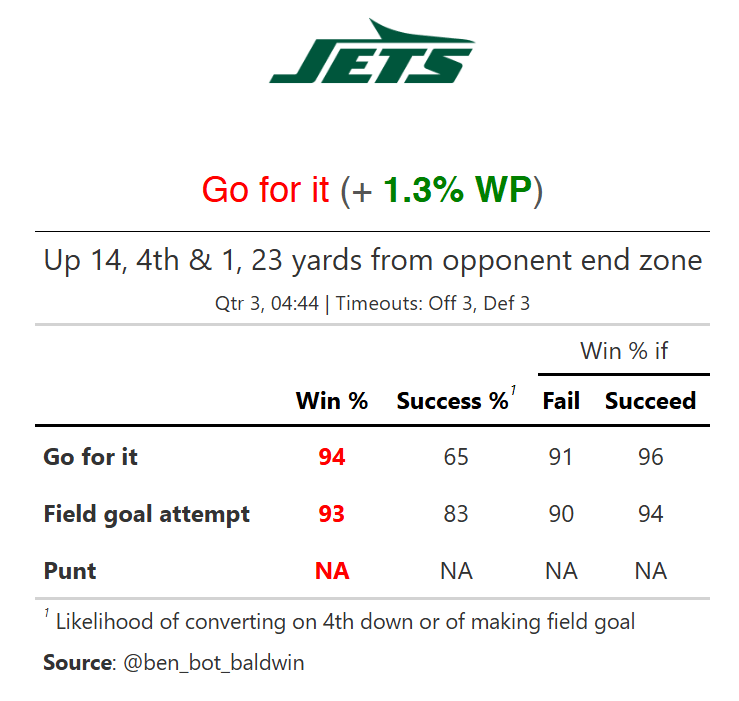
The Jets had a 65% chance of converting on fourth down, and with a 14-point lead, there wasn’t much downside to going for it, as their win probability would still be 91% if they failed. If they converted, they had a chance to milk more clock and take a three-touchdown lead, all but sealing the game. The model estimated that New York’s win probability would jump to 96% with a conversion.
Glenn made the correct choice and went for it. Braelon Allen rewarded him with a 23-yard touchdown, but a holding call on Josh Myers resulted in a 10-yard penalty, so the Jets were backed into fourth-and-10 from the Tennessee 32-yard line.
Call 6 — 4:33 in Q3, 4th & 10 from TEN 32, 17-3
Given that Sanders missed badly from 54 yards earlier, the Jets could have punted here, and it wouldn’t be a bad decision, based on the model. Attempting the field goal, though, was preferred, as long as Glenn trusted his kicker.
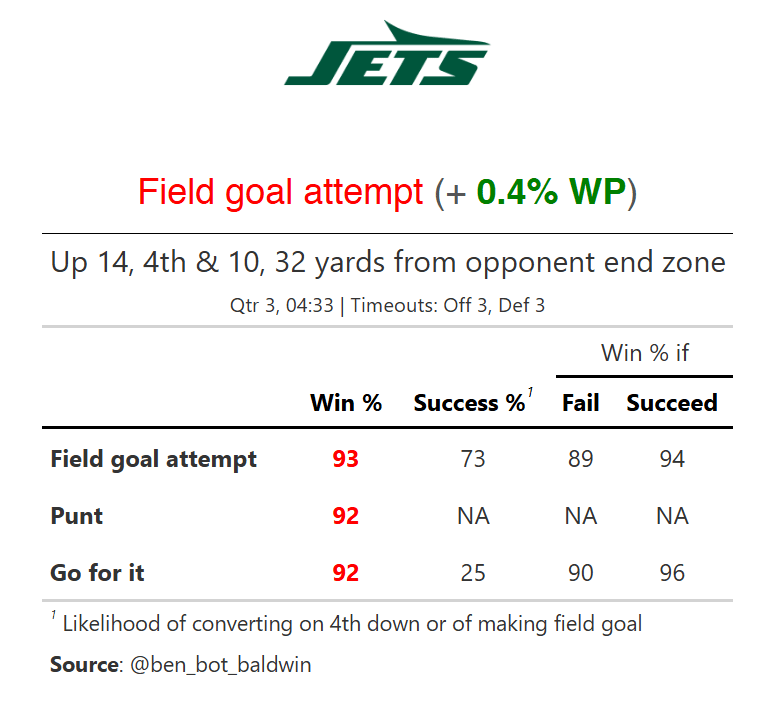
Glenn bet on Sanders, and it paid off, as the veteran made his 51-yard attempt to put New York up by three scores.
Call 7 — 9:46 in Q4, 4th & 1 from TEN 41, 20-3
Facing fourth-and-1 just outside of Sanders’ field goal range with a 17-point lead and under 10 minutes to go, the model preferred for Glenn to try and squash Tennessee’s remaining hopes by extending the drive.
However, the preference was marginal, as the Jets’ win probability was near-certain whether they kept the offense on the field or punted.
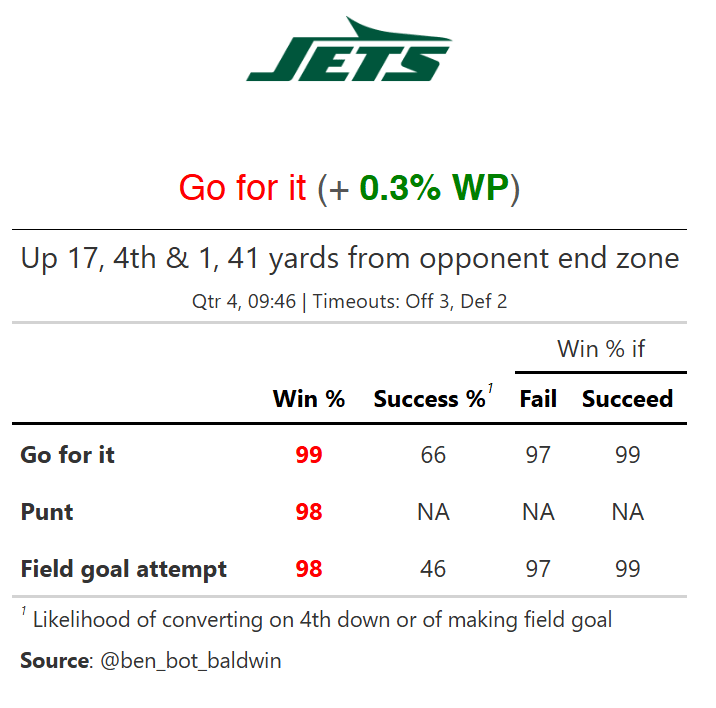
Glenn kept the offense on the field for a hard-count attempt, took the delay of game penalty, and punted. That’s a sound process in this situation.
Recap
Looking at all seven decisions, Glenn managed the game well.
What stood out wasn’t simply that he was aggressive. He seemed to understand when to be aggressive. Early in the game, when points and possessions were still at a premium, he kept the offense on the field for fourth-and-short twice. Both decisions matched Baldwin’s model, and the Jets converted both.
Once again, the calculated aggressiveness is what was promising.
When the Jets faced fourth-and-5 from the Tennessee 14, the model slightly preferred the field goal, and Glenn took the points. Later, he was willing to trust Sanders from distance, even after he missed badly from 54 yards earlier in the game.
There will be much tougher fourth-down decisions this season, especially in close games where a percentage point or two could be the difference. In Glenn’s first game of the season after a rough first year, though, there wasn’t much to critique about his game management.
