
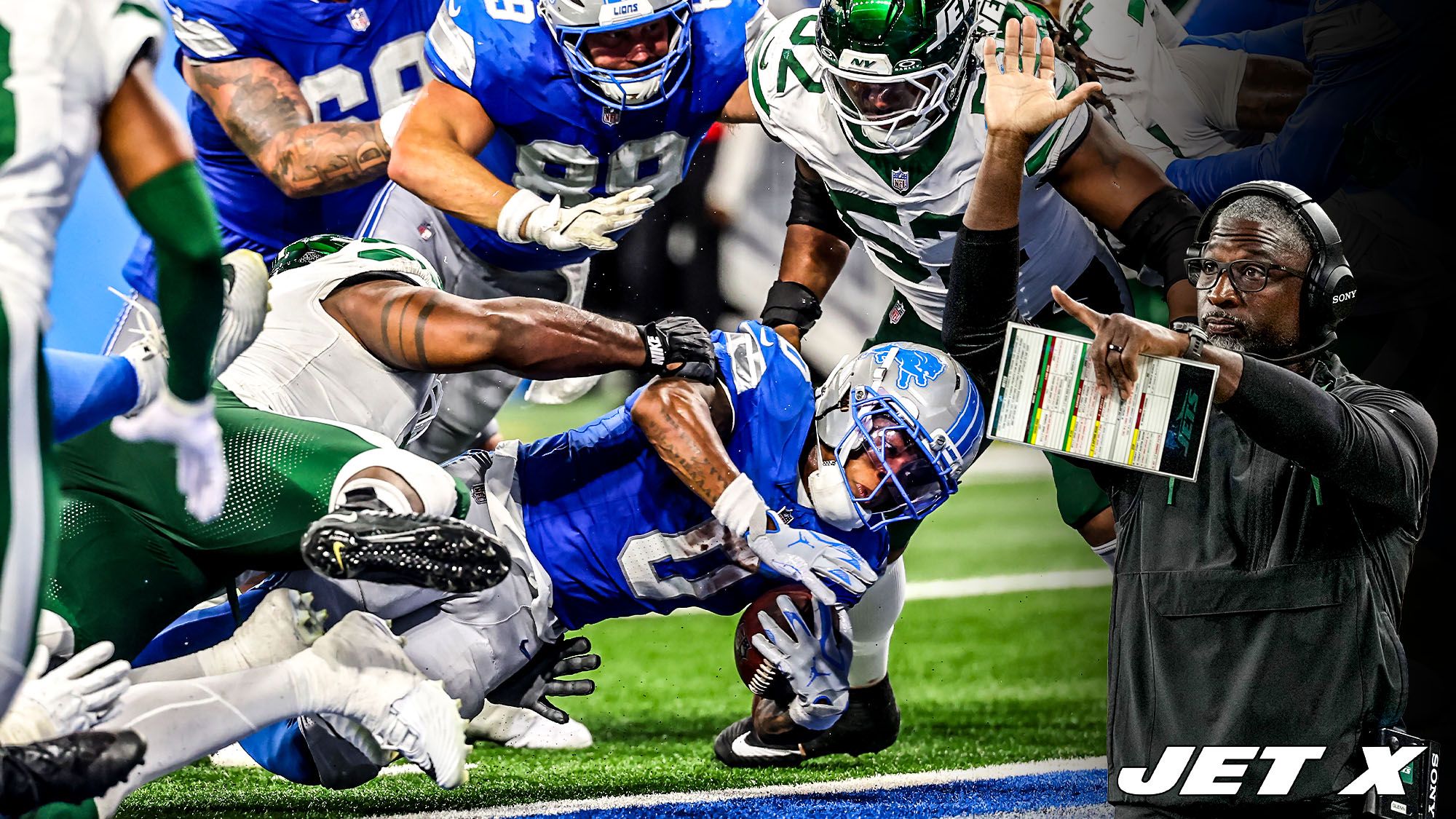
Aaron Glenn’s New York Jets almost did it. They almost stunned the Detroit diehards during Week 3 play by overcoming a 14-point fourth-quarter deficit against the high-powered Lions.
Unfortunately, almost does not count.
Jahmyr Gibbs’s 1-yard touchdown to begin the fourth quarter — the score that cemented an overpowering drive by the Lions’ offensive line — put the home team up by 14 points. Eight of the 12 Lions snaps (including penalty plays) came on the ground, as Detroit’s offensive line bullied the Jets’ front.
All told, Detroit finished with 131 yards on 30 carries. Excluding Jared Goff’s six yards on four carries, the Lions’ 4.8 yards-per-carry mark paced Dan Campbell’s squad.
While 4.8 isn’t apocalyptically bad, it still falls under the “bad” side of the ledger. Worse yet, the Lions didn’t gash the Jets on any singular massive chunk. Gibbs’s long of the day, just 17 yards (of a total 99), meant something much worse occurred…
Detroit dominated the trenches.
It was far too consistent and overwhelming, and the term “bully ball” has nowhere to hide when watching what transpired. Glenn’s run defense was far worse than the box score would lead anybody to believe, and that’s not even the worst part.
Glenn’s Week 3 game plan was correct, and his team’s mentality was on point, yet the New York Jets still could not win.
The Jets embraced the modern game
Think about the New York Jets offense for a moment, ok? As usual, in the modern NFL, the fourth quarter of a football game went absolutely bonkers.
New York vs. Detroit was relatively low-scoring for most of the game. Heading into the fourth, the Lions held a 17-10 lead.
That’s 27 points. Each team put up 14 in the fourth quarter. Guess what? That’s 28 points.
This, my friends, is just one characteristic of today’s football.
Don’t think of defenses ever genuinely stopping offenses in this modern version of the game that used to covet and market hard-hitting VHS tapes that promoted the best hits of the last decade. Instead, think of it in a more nonsensical way: offenses intentionally holding themselves back to ensure mistakes are kept at a minimum.
Matt LaFleur did precisely that in Week 2. Knowing his offensive line was in shambles, he called the game in a way that protected his team from plays that would have left them with no chance of victory.
Due to the circumstances, LaFleur’s goal was to keep his team’s head above water until the fourth quarter. Why? Well, because he understands and embraces, like many of the better coaches in his league, that today’s fourth quarter is unlike any other.
Even the most conservative games fracture in crunch time. It’s the time that demands offenses to let it fly loosely, because there’s no other choice.
Although concerns about Glenn’s traditionalist and conservative nature are warranted, his offense certainly let it all hang out when needed.
The Jets’ mentality was correct
Not only did Geno Smith and company get it done late in the game, but Frank Reich’s start-of-game plan made sense.
There are no secrets here: The Jets’ Week 2 tape was right there for the Lions’ coaching staff to consume all week. And it’s tough to imagine them not consuming enough of it when they prepared for Week 3.
The more the Week 3 tape is viewed, the more favorably it compares to the Jets’ Week 2 disaster at home against the Buffalo Bills from a season ago.
From a final score standpoint, the 2025 iteration that ended in a 30-10 loss looks drastically different from the 20-17 overtime heartache against Green Bay. But that’s only due to the differences in the Bills’ ready-to-roll offensive line compared to the Packers’ devastated one, and the Jets’ professional quarterback status this year as compared to 2025.
Those differences aside, the overall strategies on the field played out in an eerily similar fashion.
Packers defensive coordinator Jonathan Gannon was as aggressive against the Jets’ rushing attack as Sean McDermott was. Nearly every clear-cut rushing down, along with most first and second-balanced-down situations, saw the opponent run-blitz the Jets offense.
For the Bills last year and the Packers this season, it was simple: Take away the Jets’ rushing attack at all costs, and dare them to beat us over the top.
Jets fans know how Justin Fields and the passing game handled it last year. Reich’s offense didn’t fare much better.
In Detroit, however, the game plan was appropriate. New York understood the Lions would be aggressive on run downs, so they came out with an aggressive mentality.
The very first play of the game was a sprint-out to the right. Reich moved the pocket for Geno, who hit Garrett Wilson for a 6-yard gain.
Seven of the nine Jets plays on their second drive were also passes, and all three of the Jets’ plays on their third drive were pass attempts. By the time Kenyon Sadiq made his spectacular diving touchdown grab at the 5:33 mark of the second quarter, the Jets had called 16 pass plays to just 6 on the ground.
It still wasn’t enough
At the end of the day, that correct mentality still wasn’t enough. Granted, the Lions’ defense hardly looks competent, but at the very least, the hurdle of needing this Jets team to showcase an appropriate mindset for new-age situations must be cleared.
If a team’s DNA doesn’t even allow the possibility of potential twists and turns, many of which are opponent-specific, there’s no point in having meaningful conversations.
Defensively, which is Glenn’s bread and butter, the game plan was a bit more muddied. While the Jets may have technically blitzed well into the double-digits, that doesn’t necessarily mean Glenn’s defensive strategy was to attack Jared Goff aggressively.
Upon first glance, it appeared that Glenn played more conservatively than he almost always does. The Jets deployed lighter boxes and two-high looks consistently, almost daring the Lions to stick to the rushing attack.
There isn’t a defense today that can stop the Lions’ offense altogether; the rules don’t allow it. Glenn’s game plan was to make Detroit travel the long way — don’t yield any chunk plays while betting they give up on the running game too soon.
There were times when Detroit should have run the ball more — considering the success they had — but they also found way too much success in the passing game. This is especially brutal when realizing how safe Glenn played things from a back-end perspective.
For New York Jets fans, highlighting these positives is hardly a consolation. With a combined 4-16 record in his first 20 games as head coach, winning football games is what genuinely matters to a downtrodden fanbase.
Nevertheless, acknowledging the truths in each game is important, especially in today’s game — an era of football that demands every head coach allow for the possibility of playing in a very offensively aggressive and efficient manner.
Despite the concerning run defense and offensive line problems, Aaron Glenn’s Jets, at the very least, arrived in Detroit with an appropriate game plan and correct mentality.
Instead of failing to embrace some of the realities of today’s National Football League, which offers no clear runway to success, the New York Jets just got plain beaten. They lost the game in the trenches — because the Detroit Lions were … better.
