
At this point in the NFL season, offenses across the league are still trying to find their offensive identity, especially those teams with new play callers and quarterbacks.
The New York Jets are firmly in that category, particularly with the arrival of Frank Reich as offensive coordinator and quarterback Geno Smith, who has been excellent so far.
While it’s only a three-game sample size, there is a clear indication of what’s worked and what hasn’t for the Jets, personnel-wise.
Which fits the Jets better: light or heavy personnel?
In all three of the Jets’ games this season, they have taken a largely different approach with their personnel looks.
In Week 1, they favored heavy sets with multiple tight ends on the field. It was promising to see that approach from Reich right out of the gate, as 12 personnel looks have become a successful wrinkle in the modern game.
Here is a breakdown of the Jets’ personnel usage rates in Week 1 and where they ranked across the league:
- 11 personnel (1 RB/1 TE/3 WR): 44.4% (23rd)
- 12 personnel (1 RB/2 TE/2 WR): 23.8% (13th)
- 13 personnel (1 RB/3 TE/1 WR): 17.5% (5th)
- 22 personnel (2 RB/2 TE/1 WR): 12.7% (3rd)
- 14 personnel (1 RB/4 TE/0 WR): 1.6% (Used once; one of only two league-wide uses in Week 1)
That worked for the Jets. They secured a 23-10 Week 1 win over the Tennessee Titans, and it didn’t feel like there were any glaring offensive issues. For the most part, everything moved smoothly.
In Week 2, though, the Jets changed things up, and it seemed to hurt them. The team ran a whopping 69.4% of their plays out of 11 personnel, the seventh-highest rate that week and a 25-percentage-point increase from Week 1. The Jets’ offense struggled to get going, never finding a true rhythm before falling to the Green Bay Packers 20-17 in overtime.
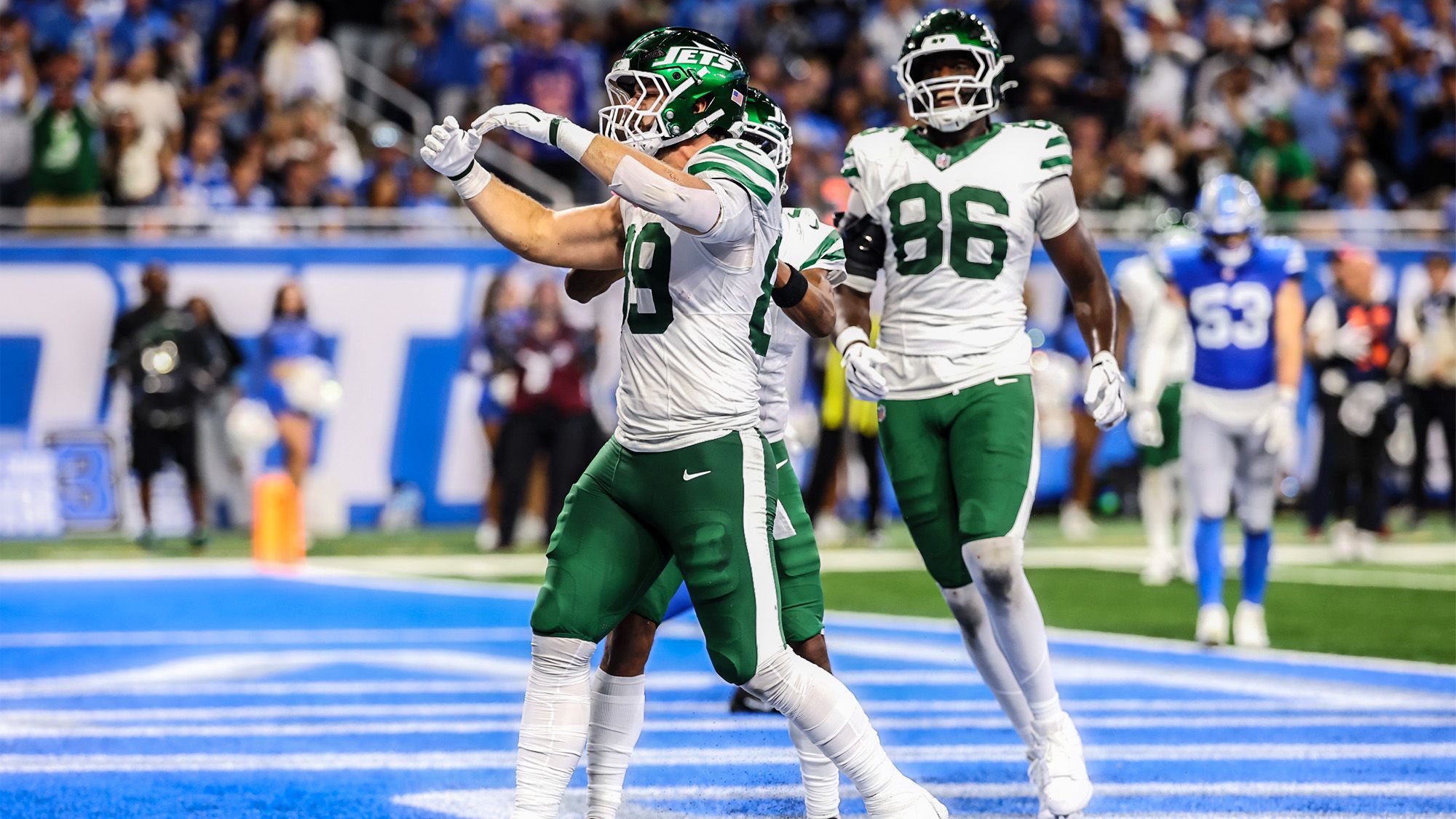
Then, on Sunday, against the Detroit Lions, the team ran 11 personnel at a similar rate (63.3%). But on 22 plays with multiple tight ends on the field, they found success.
Despite being without Mason Taylor, the offense generated 188 yards (8.5 yards per play) and two touchdowns in multi-TE packages. First-round rookie Kenyon Sadiq had his first true statement game in the NFL, posting seven catches for 105 yards and becoming the first Jets rookie tight end with a 100-yard game since Dustin Keller in 2008.
Jet X Offseason Simulator
Build your next NYJ roster. Shape contracts, recruit free agents, make trades, and draft.

The Jets were missing WR Adonai Mitchell, who led the team in targets the week prior, which may help explain why they didn’t have as much success in 11 personnel. However, in two of three games when the Jets have leaned into heavy sets, they’ve found success.
Being without Mitchell is even more of an argument to roll with multiple tight ends. At the end of the day, it’s important not to overcomplicate things. Putting the best playmakers on the field ultimately equates to success, and so far for the Jets, that has come in 12 and 13 personnel.
Why roll with 11 personnel when the two wide receivers next to Garrett Wilson would be Isaiah Williams and Sterling Shepard?
Jeremy Ruckert also deserves some credit for stepping up, giving the Jets another reason to roll with multiple tight ends more often. Against the Lions, he caught all five of his targets for 39 yards and a touchdown.
Sadiq and Ruckert combined for 12 catches for 144 yards and two touchdowns against Detroit. That should give Reich even more reason to lean on his tight ends, especially when Taylor returns to the fold.
Through two games, the 2025 second-round pick had only been targeted three times, but during his rookie campaign, he proved his upside as a receiver. Last year, he reeled in 11 of his 14 contested targets, for a 78.6% contested-catch rate, second among qualified tight ends, trailing only George Kittle.
Interestingly, despite the Week 1 rates and Sunday’s success, Reich hasn’t historically used many multi-TE looks. He has been much more of an 11 personnel guy.
With the Carolina Panthers in 2023, he ran 11 personnel on 87% of their plays, the second-highest rate in the league. Earlier, with the Indianapolis Colts in 2022, his 77% rate finished third. With Carolina, he was fired after Week 11, and the data covers the full season; still, he ran 11 personnel at a very high clip.
With this roster, though, and the early results, there is a strong argument to flip the script on that trend. Also, it has worked around the league. The Super Bowl-winning Seattle Seahawks used 12 personnel 29.9% of the time last year, ranking eighth in the league. Meanwhile. Sean McVay’s Los Angeles Rams led the NFL in 13 personnel usage (30.5%).
Overall, the whole “identity” mantra can be cliché. However, for the Jets, their most offensive success so far has come with multiple tight ends on the field.
