

To snap their three-game losing streak by defeating a 3-1 team, the New York Jets had to improve in many ways.
Which of those improvements, though, are signs of things to come? And which will go down as flashes in the pan?
Let’s break down the Jets’ biggest spikes of Week 5 and deduce which ones could be sustained and which ones are likely to flame out.
David Bailey’s breakout
Second-overall pick David Bailey finally had his signature game, registering three sacks, nine total pressures, and seven total tackles in a performance that will likely earn Rookie of the Week honors.
Will Bailey play like this every week for the rest of the season?
No.
He won’t even play like this on a weekly basis in his prime; no NFL player has ever averaged three sacks and nine total pressures per game. Consider that in his record-setting 2025 season, Myles Garrett averaged 1.4 sacks and 4.9 pressures per game. So, essentially, Bailey’s performance against the Browns was approximately the equivalent of two whole peak Myles Garrett performances.
Yeah, don’t expect that to happen very often, especially this year.
However, that doesn’t mean Bailey’s performance should be written off as a fluke. Even if he won’t put up those exact numbers every week, his breakout against the Browns represented real progress. It was the first time that we saw him routinely winning one-on-one reps as a pass rusher. That’s a meaningful springboard for Bailey moving forward.
It can take young pass rushers a while to hone their craft at the NFL level, even the greats. Former third-overall pick Will Anderson had one sack in his first seven games. J.J. Watt had two sacks over his first nine games. Khalil Mack did not get a sack until his 10th game. We can go on.
Bailey’s performance against Cleveland is a sign that he just might be starting to figure things out. There will still be growing pains from here, and he won’t look this unstoppable every week, but it was an important stepping stone for the Texas Tech product.
Verdict: Real
Braelon Allen runs wild
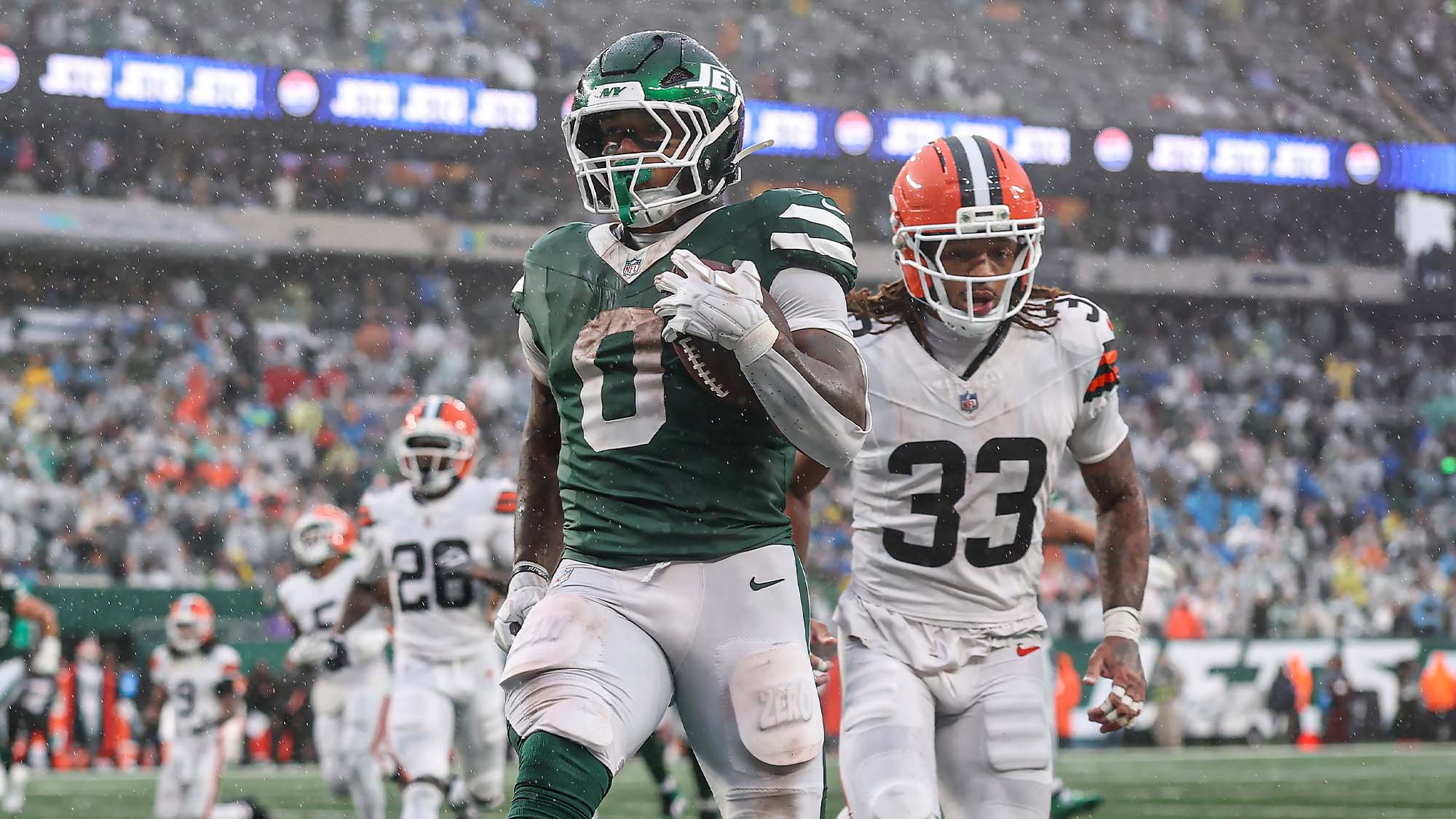
In his second straight start relieving Breece Hall, Braelon Allen had his best game as a Jet, rushing 24 times for 116 yards (4.8 yards per attempt) and a go-ahead touchdown in the fourth quarter.
It was a legitimately excellent performance from Allen, who consistently made impressive cuts and forced defenders to miss. He finished the game with 108 rushing yards after contact (4.5 per attempt) and eight missed tackles forced, per Pro Football Focus. The production he recorded was largely self-created, which is the mark of an impactful running back.
New York’s coaches were finally vindicated for their decision to roll with Allen as the clear-cut RB2 over Isaiah Davis. Allen showcased the full extent of what he can do with his 250-pound frame as a bell-cow back.
However, for now, this performance looks like a blip on the radar. Consider that 5 of Allen’s 12 career rushes for 10+ yards came in this game alone. Entering the game, he had seven rushes for 10+ yards on 143 carries (one every 20.4 attempts), before racking up five on 24 carries (one every 4.8 attempts). That spike seems too massive to be sustainable.
The Jets are still itching for Breece Hall to return, as among the running backs on their roster, he offers the most well-rounded skill set and the most reliable knack for explosive plays. Allen’s breakout is promising, but the Jets should not count on him to do that routinely just yet.
If he can consistently perform with similar efficiency on the smaller volume of a complementary role, though, the Jets would gladly sign up for that when Hall returns.
Verdict: Unsustainable
The Jets’ run defense comes back to life
New York had trouble containing Deshaun Watson, who rushed six times for 40 yards, but the Jets did an excellent job of thwarting Cleveland’s designed runs. The Browns’ running backs combined for 56 rushing yards on 17 carries, a measly 3.3 yards per attempt. Even more impressively, the backfield ran for just two first downs.
How did the Jets get eight sacks? It all started here. Because their early-down run game wasn’t going anywhere, the Browns were constantly forced into predictable passing situations, allowing the Jets’ pass rushers to tee off.
The Jets need their run defense to continue playing this well if they want to replicate the pass-rush explosion they enjoyed against Cleveland. The good news is that there are plenty of reasons to believe this run-stopping performance was sustainable.
Coming into the year, the Jets had the pieces to field a strong run defense. It was arguably their best facet on paper among the core four units: pass offense, pass defense, rush offense, and rush defense.
Through four games, the unit was not living up to the hype, but its struggles seemed far too out of character to continue. The Jets’ run defense felt due to trend toward its on-paper capabilities, and that upward climb began against Cleveland.
With players like T’Vondre Sweat, Harrison Phillips, Demario Davis, and Kingsley Enagbare within the front seven, the Jets are loaded with run-stuffing talent up front. Throw in David Bailey’s surprisingly solid start against the run, along with excellent contributions from safeties Dane Belton and Minkah Fitzpatrick, and this defense should be capable of stopping the run quite well.
Even fourth-round rookie Darrell Jackson Jr. has stepped up. Veteran free agent pickup David Onyemata was poised to be among the leaders of the run defense, but he has been on injured reserve due to core muscle surgery. With Onyemata sidelined, Jackson has stepped into a larger role, and he has delivered; he currently leads the Jets with eight run stops despite playing just 57 snaps against the run.
New York’s run defense should be expected to continue trending up.
Verdict: Real
