

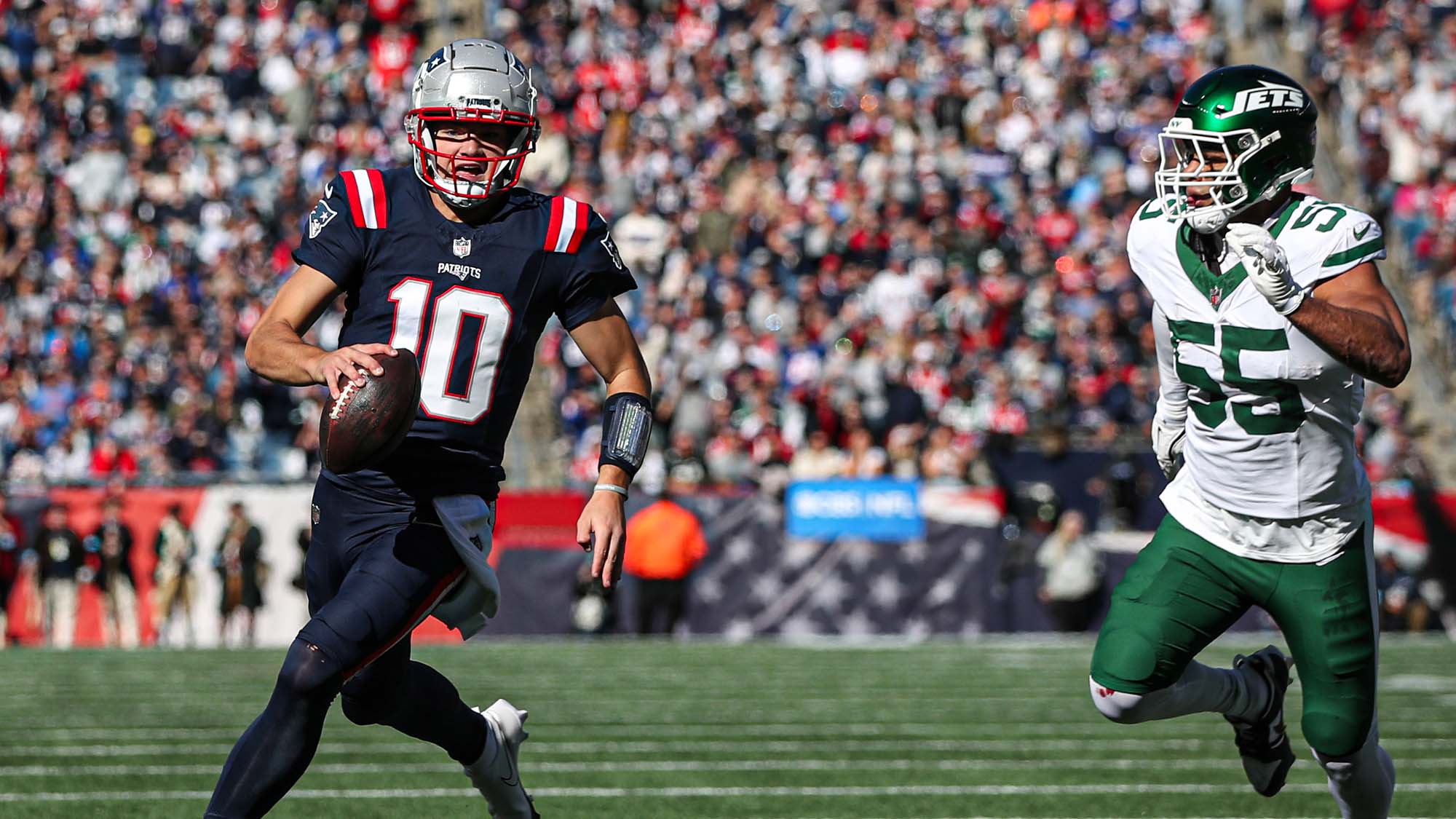
November 12, 2006.
That’s the last time the New York Jets earned a regular-season victory in Foxborough over the New England Patriots’ QB1.
New York last won at Gillette Stadium in Week 18 of the 2023 season, but it was against a 4-13 Patriots team led by backup Bailey Zappe.
Prior to that, the Jets had not won in Massachusetts since their legendary playoff win in January 2011, but their last regular-season win was in Week 11 of the 2008 season. That Pats team, though, was led by backup Matt Cassel, as Tom Brady had suffered a season-ending injury in Week 1.
The Jets’ 17-14 triumph over Brady in Week 10 of the 2006 season remains the Jets’ most recent regular-season road win over a Patriots starting quarterback. It kick-started a 6-2 post-bye stretch for New York, culminating in a 10-6 record and a wild card appearance, although the Patriots got revenge in the wild card round.
Nearly 20 years later, the Jets are aiming to finally earn their next signature road victory in the building that sits just 205 miles up I-95, as Drake Maye and the reigning AFC champions await.
Defeating Maye in Foxborough would easily be Aaron Glenn’s greatest achievement as the Jets’ head coach through 23 games, and it would also be the Jets’ most impressive victory in at least three years. Pulling it off will require some masterful coaching strokes from the Jets’ head honcho, as the Pats are 7.5-point favorites.
If Glenn wants to give his underdog squad the edge it needs to record the upset, he should strongly consider making one sweeping change to his defensive approach.
How can Jets turn Drake Maye back into a pumpkin?
Drake Maye had a horrendous start to the 2026 season. Through three games, he had completed 51 of 80 passes (63.8%) for 585 yards (7.3 yards per attempt), one touchdown, and six interceptions, while also losing a fumble and taking nine sacks.
Over the last two games, though, Maye has returned to his MVP runner-up form, completing 48 of 71 passes (67.6%) for 643 yards (9.1 yards per attempt), seven touchdowns, and one interception, adding one rushing touchdown and one lost fumble. He took only two sacks.
If the Jets want to bring back the version of Maye that we saw in Weeks 1-3, they might want to consider a strategy that would be atypical for them: blitzing at a low rate.
Maye’s turnover woes have primarily occurred on plays when he was not blitzed. Six of his seven interceptions this season were on non-blitzed throws, as well as seven of his 10 turnover-worthy throws, according to Pro Football Focus.
Additionally, Maye has been a lot more susceptible to getting sacked when not blitzed. He’s taken eight sacks when not blitzed, tied for the fourth-most, while he has only been sacked three times when blitzed, which is only 16th. Maye’s pressure-to-sack rate (percentage of pressured dropbacks resulting in a sack) rises from 10.7% when blitzed to 17.0% when not blitzed.
The spike in sacks is largely because Maye tends to hold the ball much longer when the defense sits back. When blitzed, Maye averages 2.92 seconds to throw, but when not blitzed, that number jumps to 3.30, ranking fifth-highest among starting quarterbacks.
Mix it all together, and Maye leads the league with 14 combined sacks and interceptions when not blitzed (114 dropbacks). That’s more than triple his four combined sacks and interceptions when blitzed (64 dropbacks).
The sample size is different, but even from a rate standpoint, Maye averages one sack or interception every 8.1 non-blitzed dropbacks compared to every 16.0 blitzed dropbacks—essentially double the frequency.
Clearly, it seems preferable to play conservatively against Maye instead of constantly sending the house. However, that would require Aaron Glenn and the Jets to slide outside of their comfort zone.
According to Pro Football Reference, the Jets rank fourth in the NFL with a 37.4% blitz rate this season. They went wild against Deshaun Watson and the Cleveland Browns last week, blitzing on a whopping 64% of Watson’s dropbacks.
The Jets’ lofty blitz rate against Cleveland was a smart approach for that particular opponent. Watson struggled immensely against the blitz, completing 6 of 21 passes for 93 yards while taking six sacks, but was more reliable when not blitzed, completing 9 of 12 passes for 62 yards and taking two sacks. So, it made sense to keep the heat dialed up.
Against Maye, though, the five-game sample at the Jets’ disposal suggests strongly that a lower blitz rate would maximize New York’s opportunities to rack up interceptions and sacks. Glenn would be wise to lean into that.
While every great NFL coach has a distinct identity, they all have one thing in common: adaptability. In a sport that allows for vast stylistic differences from team to team and player to player, it’s crucial to adapt to the unique challenge in front of you each week.
If you stubbornly adhere to the same philosophies, it will work against some teams, but it will be exposed by others. The best teams, and the best coaches, are those who do the best job of molding into the opponent’s kryptonite each week.
Glenn and the Jets have become known for their blitz-heavy approach, but if they stick with it in New England, there is a good chance that Maye will punish them for it. Dialing back the blitzes would be a smart change-up to maximize the Jets’ odds of nabbing their most important win in years.
If the Jets can not only defeat the Patriots, but pull it off behind a stark schematic tweak designed to exploit the opponent’s weakness, it would be a huge feather in Glenn’s head-coaching cap.
