

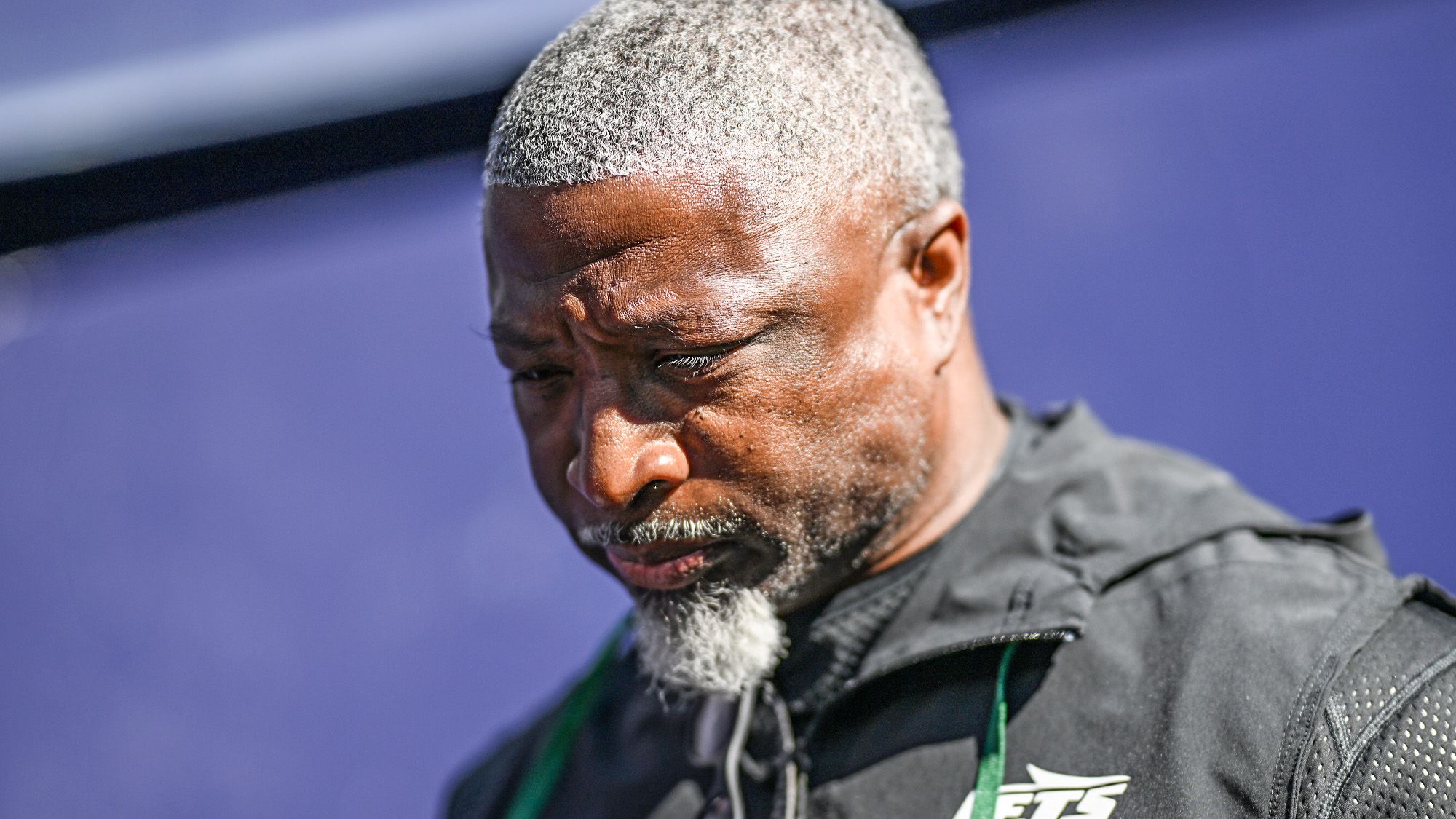
The New York Jets suffered a tough 26-19 loss to the New England Patriots on Sunday, falling to 2-4 on the season. Gang Green had an opportunity to deliver one of the organization’s most important wins in recent years, but they fell short by a touchdown.
Now, instead of being at .500, the team is 2-4. That is a big difference. At the end of the day, the team’s record and its struggles to win close games share a clear common denominator: coaching.
Coaching continues to kill the Jets
Nobody expected the Jets to start 6-0. Few people expected the Jets to come out of their first six games with a winning record. It’s not even that the team has lost four of their first six; it’s more about how they lost those games. Sunday is another prime example.
Throughout spurts of the Jets’ loss to New England, New York looked like they could go toe-to-toe with the Patriots. The Jets got on the board first, and Frank Reich’s offense consistently found success at moving the ball in the first half.
An offensive pass interference call on Tim Patrick forced the Jets to settle for a field goal, wiping away an opening-drive Omar Cooper Jr. touchdown, but the offense looked strong on the opening drive. Geno Smith hung in the pocket when he was blitzed, made throws under pressure, and Reich did a great job incorporating play-action and motion into the offense, making it a balanced attack between the passing game and the rushing attack.
Your team. Your decisions.
Jet X Game Simulator
Win a Free Lifetime Membership
Beat any of the five Legend challenges without simulating.
Play the weekly matchup or relive a classic. All four current-matchup modes are free. Log in to save Coach Points; members unlock every Classic game and challenge.
Learn MoreChoose your mode on the Game Simulator page. Free current matchup · Premium Classics.
On defense, Glenn’s group forced a three-and-out on their first drive, and they had their moments throughout the game, generating two turnovers that gave the offense two more chances to break through in the second half.
The issue, though, is that the Jets couldn’t finish when it mattered most on either side of the ball. At some point, that blame needs to go to the coaching staff. It’s clear the Jets have enough talent to compete with top teams; we’ve seen flashes of what they can look like when they are clicking. Far too often, though, those glimmers of hope don’t carry into the most critical moments.
First, there is Reich. He deserves credit for integrating play action and motion into the offense early on. In our deep dive into his play calling through five weeks, one of the top takeaways was that he needs to use PA and motion more consistently.
However, the biggest issue with Reich on Sunday wasn’t necessarily his overall game plan. The biggest problem was his situational play-calling, particularly on third and fourth downs. That’s where the Jets kept shooting themselves in the foot.
Overall, the Jets converted just three of their 10 third-down attempts (30%), failed on both fourth-down tries (coming with just one and two yards to go), and didn’t score a touchdown on any of their three trips to the red zone.
In a game decided by just seven points, those numbers tell you almost everything you need to know.
The situations where the offense failed to convert on fourth down both happened in the second quarter, and they were crucial.
The first instance came after the Jets faced third-and-two following a strong possession where they moved the ball into Patriots territory. Rather than getting creative, which had worked early on, Reich called consecutive shotgun runs, and Braelon Allen got stuffed short of the sticks on fourth down.
That’s just way too predictable, and it repeats a questionable call that Reich already made in a costly moment four weeks earlier. In Week 2 against the Green Bay Packers, Reich tried and failed to use the shotgun run in crucial short-yardage situations. It hasn’t worked at all for the Jets; why do they keep going back to it?
Somehow, the next possession was even more infuriating. Gang Green faced second-and-one, needing just a single yard to move the sticks. Guess what? The Jets failed to gain a yard on three consecutive run plays, and a fourth-down quarterback sneak by Smith landed short of the marker.
The Jets had three opportunities to pick up a single yard, and they couldn’t do it. Teams just can’t win football games like that, especially against a solid, well-coached team like the Patriots.
Reich continues to struggle to put his guys in strong positions to succeed in high-leverage spots. Why keep challenging the opposing defense the same way when it’s not working? Especially on inside runs. Why not incorporate some misdirection, or just find a way to create some sort of advantage?
Those are the types of adjustments that an experienced offensive play caller like Reich is supposed to make.
Overall, there were stretches where Reich was doing an impressive job of chaining plays together to get the ball moving. Even to open the second half, he did a great job of designing a play-action bootleg on first down, before a bounce to the outside with Allen. Then, on the third play, Smith uncorked one to Cooper for a deep 48-yard touchdown.
That brings up an interesting trends; Reich’s most impressive moments were the opening drive of the game and the first of the second half. That sticks out because it suggests that when he has time to plan out what he wants to do ahead of time, it works. The in-game adjustments, however, and his decision-making in crunch time, remain lackluster.
Reich needs to build on what his players are doing well. He has a talented group; he has just let them down in a fair share of big-time moments this season. The Jets did a strong job of moving the ball between the 20-yard lines on Sunday, but they couldn’t convert in the red zone, and that’s on the play-caller when it happens repeatedly.
While Reich deserves plenty of criticism for the offense, Aaron Glenn isn’t off the hook either. If anything, his continued struggles are even more disappointing.
To his credit, just like Reich, he had a wise approach to the opening possession. He utilized the front seven effectively without getting overly aggressive, leading to a three-and-out.
But just like Reich’s offense, the defense struggled to sustain that success. They forced two fumbles, but beyond that, there were several questionable moments.
One of the biggest questions with Glenn’s approach was his tendency to rush just three defenders in multiple situations.
The thought process behind dropping eight into coverage to limit explosives and take away throwing windows makes sense. However, against Drake Maye, that is the last thing a team can consistently do.
Look no further than the Patriots’ first touchdown. Facing second-and-10 from the Jets’ 42-yard line, Glenn decided to rush just three guys, giving Maye all day to survey his options, leading to a 42-yard touchdown to Romeo Doubs, who was wide open across the middle of the field.
Even more inexcusable were the three rushers themselves: defensive tackle T’Vondre Sweat, defensive tackle Harrison Phillips, and linebacker Jamien Sherwood. Coming off a three-sack game, David Bailey was standing around in coverage on the play, watching helplessly as Maye stood in the pocket and threw a deep touchdown.
For the Jets to come out on top, they needed to apply consistent pressure on Maye. That just didn’t happen; the team didn’t generate a single sack. The Patriots also lost three starting offensive linemen during the game. They constantly had to shuffle their offensive line and had only two starters by the fourth quarter. Still, the Jets couldn’t bring down Maye once. There is no excuse for that.
The defense struggled to get off the field in key moments. They allowed the Patriots to convert eight of their 15 third-down attempts (53.3%) and came up small in a massive red-zone moment early in the fourth quarter.
In that situation, the Jets trailed 17-13 and were building momentum to get back into the game if they could hold New England to a field goal. The Pats faced third-and-three right near the goal line, and what do the Jets do? Leave Hunter Henry completely uncovered for a seven-yard touchdown.
Moments like that are exactly where the defense needs to come up with a stop. Whether it was due to a poor play call or a miscommunication, that just can’t happen.
Then came the end of the first half. After the Jets’ offense had gone three-and-out, the Patriots had over a minute left with two timeouts. Trailing 10-3, all the defense needed was a stop to keep the game within one score entering halftime. New England ultimately marched downfield, though, taking a 17-13 lead with just 14 seconds remaining. The Jets committed penalties and missed tackles throughout the drive.
Even late in the fourth quarter, the defense had one final chance to give the offense a chance. They trailed 23-16 with just over seven minutes remaining, and the Patriots faced third-and-13 from their own 37-yard line. Maye connected with Henry on a 15-yard catch-and-run to move the sticks, and the Patriots ultimately ran out the clock. If they’d gotten a stop, the Jets would have had plenty of time to put together a game-winning drive.
Again, it wasn’t all bad for the defense. The turnovers were crucial, but the no sacks and inability to come up with stops in the big moments were tough.
Now, instead of being 3-3, the Jets are 2-2 and face a must-win game next Sunday against the 0-5 Miami Dolphins to keep their season alive. At the end of the day, the Jets keep finding ways to lose games that they have legitimate chances to win.
Until that trend flips, the common denominator will remain Glenn, Reich, and the coaching staff. Time and time again, they set the Jets up to fail in the moments that matter most.
